
Official statement
Other statements from this video 4 ▾
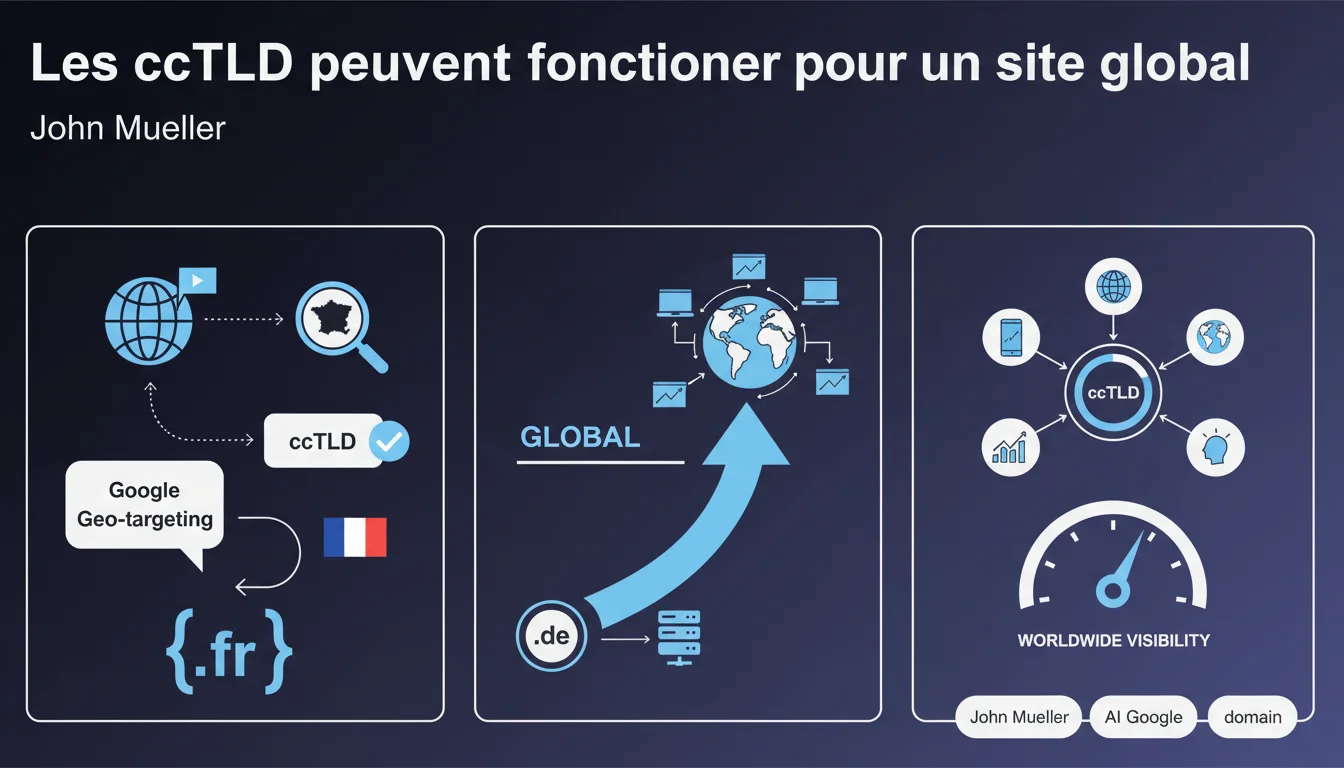
Google confirms that a ccTLD (country code Top-Level Domain) can function for a global website, even though it facilitates geotargeting to a specific country. International visibility remains possible, but there are nuances to understand to avoid pitfalls.
What you need to understand
What is a ccTLD and How Does Google Interpret It? <\/h3>
A ccTLD<\/strong> (country code Top-Level Domain) is a domain extension associated with a country: .fr for France, .de for Germany, .uk for the United Kingdom. Google uses this information as a geotargeting signal<\/strong> to determine in which country to prioritize displaying a site in search results.<\/p> What does this mean in practice? If you use a .fr, Google assumes by default that your content primarily targets a French audience. This signal is not absolute — other factors come into play — but it does weigh in the balance.<\/p> This statement addresses a recurring concern: the fear of becoming geo-locked<\/strong> by choosing a ccTLD. Mueller confirms that Google does not prevent a .fr or .de site from ranking in other markets, even if the initial geographical signal directs towards one country.<\/p> Other signals — content language<\/strong>, international backlinks, hreflang, geographical targeting in Search Console — can counterbalance this initial bias. But beware: "can work" does not mean "works as well as a gTLD." <\/p> A ccTLD can be justified if your primary market is a specific country<\/strong>, but you also want to reach other areas. For example: a French company exporting to Europe that wants to maintain its local credibility while being visible elsewhere.<\/p> In this case, the ccTLD reinforces your local presence<\/strong> while allowing for gradual expansion. But if your markets are evenly distributed geographically from the start, a gTLD (.com, .net) or a multi-domain structure makes more sense.<\/p>Why Does Mueller Emphasize That Global Visibility is Still Possible? <\/h3>
What Are the Use Cases Where a ccTLD Makes Sense for a Global Site? <\/h3>
SEO Expert opinion
Is This Statement Consistent with What We Observe on the Ground? <\/h3>
Yes and no. Google is truthful: a ccTLD can<\/strong> rank internationally. But in practice, it's often more complicated. Sites with .fr or .de generally struggle to impose themselves on competitive queries outside their country, unless with substantial SEO efforts.<\/p> Why? Because Google prioritizes consistent signals. A .fr with French content, .fr backlinks, hosted in France, will naturally be favored in France. Reversing this perception to rank in the US or the UK requires overcompensating<\/strong> with other signals — and this doesn’t always work.<\/p> Mueller remains vague on a key point: how much<\/strong> does a ccTLD penalize international visibility compared to a gTLD? He states it “still allows for global visibility,” but he provides no quantification. [To be verified]<\/strong>: there is no official data to measure this delta.<\/p> Another gray area: the impact varies by country. A .co.uk may rank more easily in the US than a .fr, simply because linguistic proximity and search behaviors are different. Google treats certain ccTLDs (like .co or .io) almost like gTLDs, which further complicates the picture.<\/p> If your international markets represent a significant portion of your revenue from the launch<\/strong>, starting with a ccTLD is a mistake. You will have to battle for every position outside your primary country, whereas a .com would have given you a neutral base.<\/p> Worse yet: certain ccTLDs are poorly perceived by users outside the country. A .fr in Germany may arouse suspicion, reduce CTR, and thus indirectly harm SEO. Google doesn’t block anything, but user signals will do the job in its place.<\/p>What Nuances Are Missing from This Statement? <\/h3>
In What Cases is This Strategy Risky? <\/h3>
Practical impact and recommendations
What Should You Do if You Already Have a ccTLD and Aim for International Expansion? <\/h3>
First step: correctly configure hreflang<\/strong> to indicate to Google the language and geographical versions of your content. Without this, Google will continue to prioritize the ccTLD market. Next, in Search Console, set a clear geographical targeting<\/strong> if you are targeting multiple countries with the same domain.<\/p> Develop an international backlink strategy<\/strong>. If all your links come from .fr sites, Google will strengthen the French signal. Obtain links from your target countries to level the playing field. Finally, tailor the language and on-page signals (currencies, local references) for each market.<\/p> Don’t let Google guess. If you have a .fr with English content targeting the US, without hreflang or Search Console targeting, you’re shooting yourself in the foot. Google will assume it's poorly translated French content.<\/p> Also, avoid diluting your efforts. A ccTLD aiming at 10 different countries without dedicated resources is a recipe for failure everywhere. Focus on 2-3 strategic markets and optimize for them before expanding.<\/p>What Mistakes Should You Absolutely Avoid? <\/h3>
❓ Frequently Asked Questions
Un ccTLD empêche-t-il vraiment de ranker à l'international ?
Est-ce que Google traite tous les ccTLD de la même manière ?
Faut-il migrer d'un ccTLD vers un gTLD si on vise plusieurs pays ?
Le hreflang suffit-il à compenser un ccTLD pour l'international ?
Peut-on utiliser un ccTLD pour plusieurs langues ?
🎥 From the same video 4
Other SEO insights extracted from this same Google Search Central video · published on 05/01/2022
🎥 Watch the full video on YouTube →Related statements
Get real-time analysis of the latest Google SEO declarations
Be the first to know every time a new official Google statement drops — with full expert analysis.
💬 Comments (0)
Be the first to comment.