
Official statement
Other statements from this video 6 ▾
- □ Is creating truly 'useful' content really the secret to ranking on Google?
- □ Is Japanese SEO really catching up with American standards?
- □ Does Google really roll out algorithm updates at different times in different countries?
- □ Does active community engagement really make you a better SEO professional?
- □ Does Google really read every single piece of user feedback submitted on their documentation?
- □ Why is Google probably ignoring your feedback on SEO documentation?
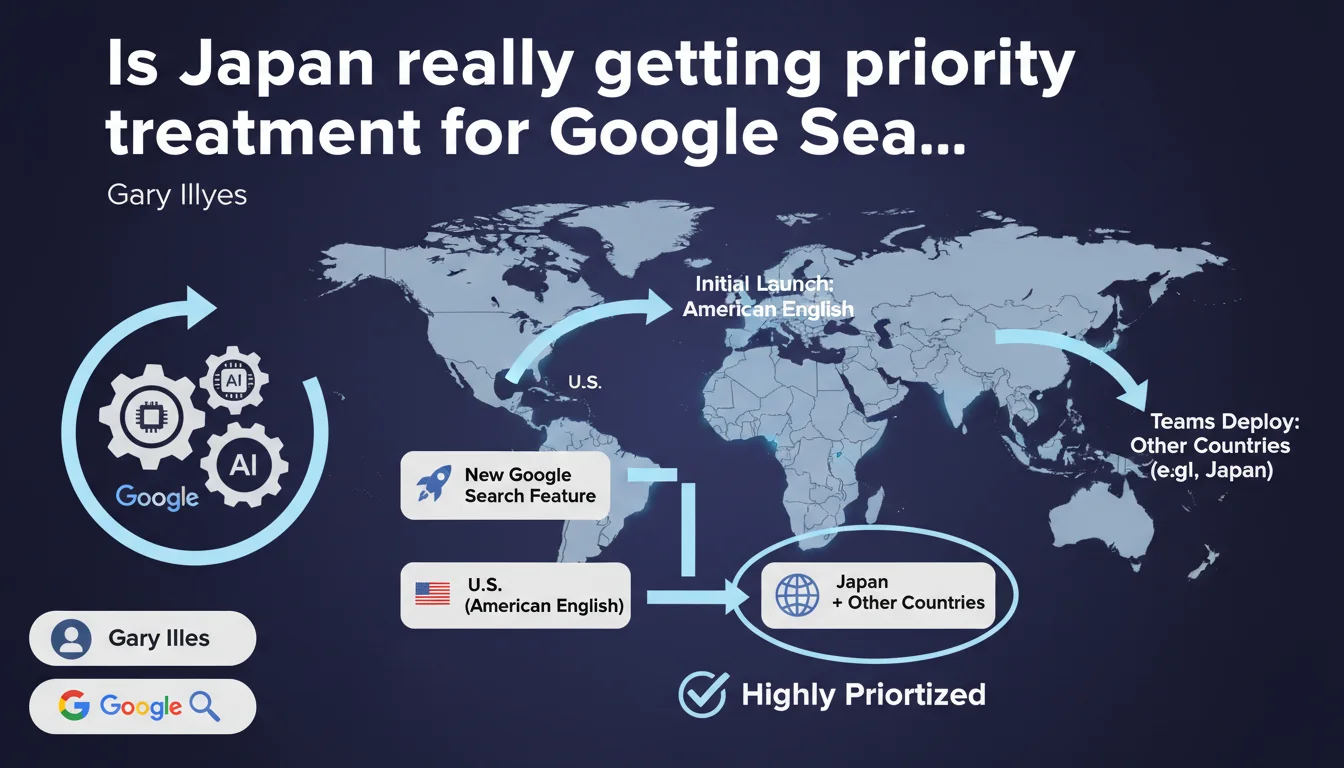
Gary Illyes states that Japan is a highly prioritized country for most Google Search teams. While certain features are initially launched in American English, teams actively work to deploy them in other markets like Japan. This means the Japanese market receives special attention, but not systematic preferential treatment across the board.
What you need to understand
Why does Google specifically mention Japan?
This statement comes at a time when non-English-speaking markets regularly complain about receiving new search features with a delay of several months. Japan represents a strategic market for Google: a connected population, strong technology adoption, and above all a formidable local competitor in Yahoo Japan.
By explicitly mentioning Japan as "highly prioritized," Gary Illyes is likely responding to internal or external criticism about feature deployment. The message is clear: certain non-English markets really matter to Google.
What does this concretely change for other countries?
The answer is nuanced. If Japan is prioritized, it implies there's a hierarchy in feature deployment. United States first, then a few strategic markets (including Japan), then the rest of the world.
For French-speaking, Spanish-speaking, or other linguistic zones, this confirms what we observe on the ground: features often arrive with a 6 to 12-month lag. And sometimes, certain features are never deployed at all.
Does this prioritization affect the ranking algorithm?
No, prioritization concerns search features (SERP features, rich results, knowledge panels, etc.), not the core ranking algorithm. A Japanese site and a French site are evaluated according to the same fundamental criteria.
What differs is access to new display formats in results. A Japanese site might be able to leverage a new type of rich snippet before a French site, which can create a temporary advantage in terms of visibility and CTR.
- Japan is confirmed as a priority market after the United States
- SERP features arrive in stages depending on countries
- The ranking algorithm remains uniform, only display features vary
- The time lag can create unequal opportunities between markets
SEO Expert opinion
Is this statement consistent with what we observe?
Yes and no. On the ground, we do see that Japan receives certain features before other non-English markets. Features related to generative AI, for example, were deployed in Japan relatively early.
But let's be honest: "highly prioritized" doesn't mean "at the same level as the United States". The American market remains the primary testing ground. Japan arrives in a second wave, possibly alongside India, the United Kingdom, and Germany. Others follow behind.
What justifies this prioritization?
Several factors come into play. First, linguistic complexity: Japanese uses multiple writing systems (kanji, hiragana, katakana), which requires specific technical adaptations. Google can't simply rely on translation.
Next, local competition. Yahoo Japan remains a significant player, unlike other markets where Google dominates without real competition. This pushes Google to invest to maintain its edge. [To verify]: we lack precise data on current market share in Japan, but historically Yahoo has always had a strong position there.
What are the implications for other markets?
If you work on French, Spanish, or other language sites, expect a time lag. It's not a question of the quality of your SEO work, it's a structural reality.
The problem is that Google rarely communicates about these delays. You see a new feature announced, you wait for it... and it never arrives in your country. Or maybe it does, six months later, without any official announcement. This complicates strategic planning.
Practical impact and recommendations
How can you anticipate new feature deployment?
First step: follow announcements specific to your market, not just major global announcements. Google sometimes publishes localized updates on its regional blogs or through Search Central communities.
Second step: test regularly. Create test pages for new types of structured data markup as soon as they're announced. Even if the feature isn't yet available in your country, prepare the groundwork. When it does arrive, you'll be ready.
Should you adapt your strategy based on your market?
Absolutely. If you operate on a "priority" market like Japan, you can be more aggressive about adopting new features. Invest quickly in new features to gain an advantage over your local competitors.
In a secondary market, be more pragmatic. Focus on fundamentals that work everywhere: quality content, solid technical architecture, optimized user experience. Features will come later, but the basics remain essential.
What risks should you avoid in this context?
The main pitfall: over-investing in a feature that may never arrive in your market. We've seen companies dedicate significant resources to projects based on American announcements, only to discover later that the feature wouldn't be deployed in their region.
Another common mistake: ignoring new features entirely on the grounds that they're not yet available. Stay informed, prepare yourself, but only execute when it's relevant to your context.
- Follow Google announcements specific to your geographic zone
- Regularly test the availability of new features in your country
- Prepare structured data markup in advance, without over-investing
- Prioritize fundamental optimizations that work universally
- Document the deployment delays you observe to better anticipate future ones
- Adapt your SEO roadmap according to your market's maturity level
❓ Frequently Asked Questions
Le Japon reçoit-il les mises à jour d'algorithme avant les autres pays ?
Pourquoi Google ne déploie-t-il pas toutes les features simultanément partout ?
Comment savoir si une nouvelle fonctionnalité est disponible dans mon pays ?
Cette priorisation impacte-t-elle le référencement des sites multilingues ?
Quels sont les autres marchés probablement prioritaires après le Japon ?
🎥 From the same video 6
Other SEO insights extracted from this same Google Search Central video · published on 26/04/2022
🎥 Watch the full video on YouTube →
💬 Comments (0)
Be the first to comment.