
Official statement
Other statements from this video 5 ▾
- □ Why do impressions always outpace clicks in your Search Console reports?
- □ Does Google really count impressions the way you think it does in Search Console?
- □ Are impressions without clicks really a non-issue for your SEO performance?
- □ Is Google really blaming your content for low click-through rates, or is the SERP itself the real problem?
- □ Can losing impressions actually boost your SEO performance?
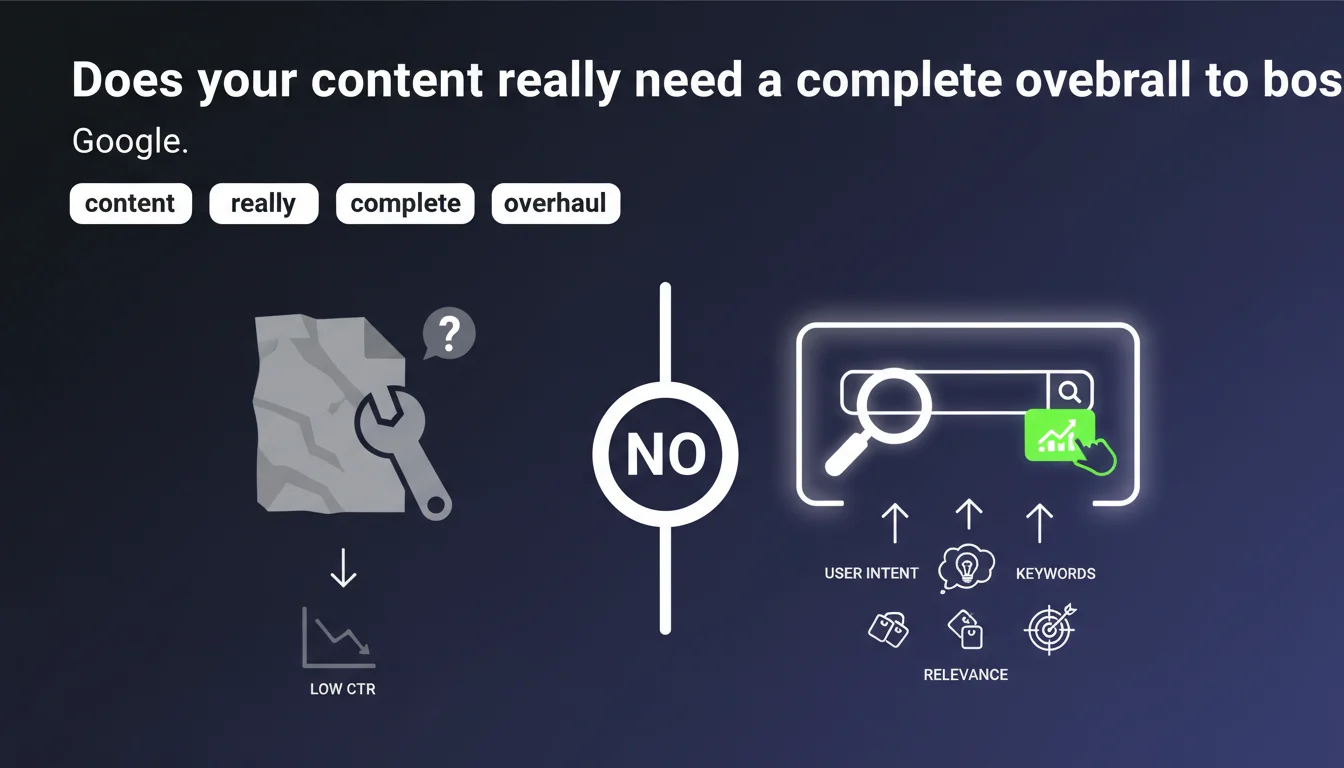
Google states that to increase your clicks, you must rework your content so it better reflects what users are actually searching for. This statement places content relevance at the heart of click-through rate optimization, not just title and meta tags. The key nuance here: Google isn't talking about manipulating snippets, but about genuine alignment between search query and content.
What you need to understand
What does Google really mean by "rework your content"?
Google isn't talking about optimizing your meta tags or adding emojis to your titles here. The phrasing is clear: it's the content itself that needs to be reviewed to better match user expectations.
This implies that low CTR isn't just a problem of how your result appears in the SERP, but a signal of misalignment between what you're offering and what the user is actually looking for. If your results aren't being clicked, it may be because your page doesn't address the search intent — or because Google has interpreted it that way.
Why does this statement challenge certain practices?
For years, we've optimized CTR by reworking snippets: more compelling titles, more persuasive descriptions, rich snippets, and so on. Google is telling us here: stop the window dressing, fix the substance.
This aligns with the logic of current ranking systems: if your content doesn't match the intent, even a perfect snippet won't save your CTR. And low CTR can become a negative signal for Google, which will interpret your page as irrelevant for that query.
What are the concrete implications for SEO?
This approach requires reviewing your underperforming pages not as objects to "technically optimize," but as content that needs to be realigned with the true search intent behind the query. This requires semantic analysis, behavioral analysis, and sometimes a complete editorial overhaul.
The risk? That this statement becomes Google's justification for traffic drops: "Your CTR is low? It's because your content isn't relevant." Except CTR is also influenced by position, featured snippets, and SERP structure — factors entirely beyond your control.
- Content must reflect search intent, not just contain the right keywords.
- Low CTR can be interpreted by Google as a signal of irrelevance.
- Optimizing the snippet is no longer enough: you must rework the substance of the page.
- This logic can justify ranking drops if your CTR is structurally low.
- CTR remains influenced by external factors: position, SERP features, competition.
SEO Expert opinion
Is this statement consistent with what we observe in the field?
Yes and no. On one hand, we do see that pages that align content with intent tend to perform better over time. A/B tests show that targeted editorial revamps can improve CTR and engagement.
But be careful: this statement deliberately ignores the fact that CTR is first and foremost a function of position. A page ranking 5th will have structurally lower CTR than a page ranking 1st, even if its content is perfect. Google doesn't clarify how it distinguishes between "poor CTR due to poor content" and "poor CTR due to poor position." [Needs verification]
What nuances should we apply?
Google isn't saying: "Manipulate your snippets to artificially boost CTR." It's saying: "If your CTR is low, it may be because your content doesn't match what people are looking for." That's an important distinction.
This means that CTR optimization must start with intent analysis, not copywriting tricks. If your page targets "best CRM," but the dominant intent is transactional while your content is informational, no amount of title tweaking will help.
Furthermore, Google remains vague on timing: how long does it take for a content revamp to impact CTR? And more importantly, how does Google measure whether the "rework" succeeded? No clarification. [Needs verification]
In what cases doesn't this rule apply?
If your CTR is low because you're overshadowed by SERP features (featured snippets, People Also Ask, Knowledge Panels), reworking your content won't change anything. You could have the best content in the world, but if Google displays the answer directly in the SERP, your CTR will remain low.
Similarly, on highly competitive queries where the top 3 results capture 80% of clicks, "more relevant" content won't compensate for a position deficit. Relevance is necessary, but not sufficient.
Practical impact and recommendations
What should you concretely do to align content with intent?
First, audit your low-CTR pages in Search Console. Identify those with click-through rates below average for their position. Next, for each page, analyze the intent: look for the exact queries generating impressions, and verify whether your content truly answers them.
If your page targets informational intent but top results are tools or comparisons, you have a misalignment problem. You need to either pivot the content or accept that this page will never rank well for that query.
What mistakes should you avoid during this revamp?
Don't fall into the trap of "adding more keywords" thinking that will suffice. Google speaks of reflecting what users are searching for, not keyword-stuffing your text with generic terms. Effective revamps require editorial restructuring: new headlines, new angles, new sections.
Also avoid confusing "relevance" with "comprehensiveness." A 5,000-word article won't get more clicks if it doesn't directly answer the user's question. Sometimes, less but better is the right approach.
How do you measure the impact of these changes?
Track the evolution of CTR by query in Search Console before/after revamp. Give yourself at least 4 to 6 weeks to see effects — Google needs time to recrawl and re-evaluate.
Also measure bounce rate and session duration: if CTR increases but users leave immediately, the content still isn't right. The goal isn't just to get the click, but to justify it.
- Identify pages with CTR below average for their position
- Analyze the true intent behind queries generating impressions
- Check whether current content addresses this intent or if there's misalignment
- Rework the editorial angle, not just add keywords
- Restructure sections to better match user expectations
- Measure CTR evolution over 4 to 6 weeks post-revamp
- Track engagement metrics (bounce rate, session duration) to validate relevance
❓ Frequently Asked Questions
Est-ce que retravailler le contenu garantit une augmentation du CTR ?
Comment savoir si mon contenu est aligné avec l'intention de recherche ?
Google pénalise-t-il les pages avec un faible CTR ?
Faut-il réécrire toutes les pages à faible CTR ?
Combien de temps faut-il pour voir un impact après refonte ?
🎥 From the same video 5
Other SEO insights extracted from this same Google Search Central video · published on 05/02/2025
🎥 Watch the full video on YouTube →
💬 Comments (0)
Be the first to comment.