
Official statement
Other statements from this video 4 ▾
- □ Comment exploiter vraiment le rapport Performances de Search Console pour piloter votre visibilité organique ?
- □ Comment Search Console peut-elle révéler les véritables blocages de votre indexation ?
- □ Comment diagnostiquer pourquoi Google n'affiche pas vos contenus actualisés ?
- □ Comment exploiter l'export des données Search Console pour booster vos analyses SEO ?
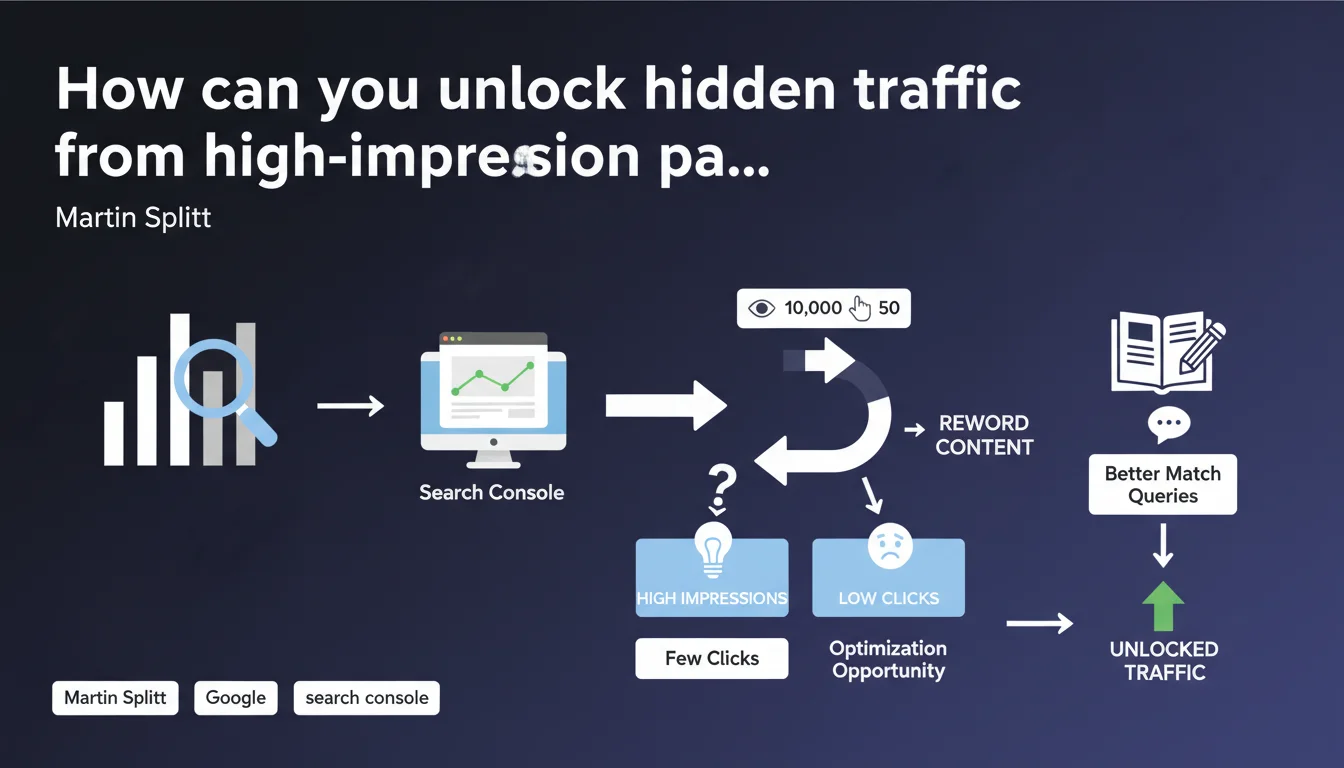
Google confirms that Search Console helps identify pages generating many impressions but few clicks — a clear signal of mismatch between content and user expectations. These pages represent priority optimization opportunities where rewording content can unlock dormant traffic without needing to improve rankings.
What you need to understand
What exactly is a page with untapped click potential?
A page that accumulates high impressions but a low CTR appears often in search results, yet users don't click on it. It's not a ranking problem — the page is visible. It's a perceived relevance problem.
Search Console exposes this gap through the Performance report. When a page displays 10,000 times a month with a 0.5% CTR, the diagnosis is clear: the title, meta description, or URL aren't convincing. Or perhaps the content doesn't actually answer the query triggering the display.
Why does Google emphasize this metric?
Because the click-through rate remains an indirect indicator of perceived quality for a result. Google has never officially confirmed it as a direct ranking factor, but a page generating few clicks despite good visibility sends a signal: it doesn't match user expectations.
Martin Splitt points out a practical reality here: before chasing position 1, verify whether your pages in positions 3-7 are converting their impressions into clicks. It's often a faster and more profitable lever.
What are the main causes of low CTR?
- Title and meta description poorly formulated, generic, or truncated in search results
- Snippet that doesn't reflect the page's actual content
- URL that's long, complex, or unclear
- Search intent misunderstood — the page answers the wrong question
- Visual competition in search results (featured snippets, People Also Ask, ads) that captures attention
SEO Expert opinion
Is this recommendation truly new?
No. It's a documented SEO practice for years. What's interesting is that Google formalizes it publicly through a team member. This validates an approach many already apply: optimize CTR before chasing higher positions.
Let's be honest — Google gives no indication here about the impression threshold where a page becomes "priority," nor what an "acceptable" CTR looks like. It's up to each business to define its own KPIs based on sector and average positions.
Does CTR actually influence rankings?
Google has always maintained an ambiguous position on this. Officially, CTR is not a direct ranking factor. Unofficially, empirical tests show that sustained CTR improvement can trigger a rise in results — but it's impossible to separate correlation from causality.
What's certain: a page generating few clicks despite good visibility loses potential traffic. Whether Google uses it as a signal or not, it's already a business problem. [To verify]: the real impact of CTR improvement on ranking remains unclear in official statements.
When does this approach not work?
On navigational queries where a competitor dominates intent (e.g., "facebook login"). Rewriting your title won't help if the user explicitly seeks another site.
Another edge case: pages ranking for off-target queries. If you rank for "sports shoes" when you sell industrial safety footwear, the problem isn't CTR — it's semantic targeting.
Practical impact and recommendations
How do you identify these pages in Search Console?
Open the Performance report, display the Pages view, then sort by Impressions in descending order. Spot pages with high impression volume (define your threshold based on your traffic) and a CTR below your category or site average.
Cross-reference this data with average positions. A page ranking 8th with 2% CTR might be normal. A page in position 3 with the same CTR reveals a problem.
What should you prioritize optimizing?
- Rewrite the title to directly address the search intent visible in queries
- Craft a meta description that's compelling and focused on user benefit
- Verify the URL is clear and descriptive — avoid unnecessary parameters
- Check the queries triggering impressions: is there a gap between what users search for and what your page offers?
- Test rich snippets (FAQ, How-to, Product) to increase visual footprint in search results
- Compare your snippet with competitors ranking 1-3: what makes theirs more clickable?
What mistakes should you avoid?
Don't focus solely on CTR while ignoring bounce rate or time on page. A sensationalist title might boost CTR short-term, but if content disappoints, Google will eventually demote the page.
Another trap: changing the title without checking position impact. An overly specific title can reduce semantic coverage and tank your impression volume.
❓ Frequently Asked Questions
Quel CTR moyen viser selon la position dans Google ?
Combien de temps pour voir l'impact d'un nouveau title sur le CTR ?
Google peut-il réécrire mes meta descriptions même si je les optimise ?
Faut-il optimiser toutes les pages à faible CTR ou prioriser ?
🎥 From the same video 4
Other SEO insights extracted from this same Google Search Central video · published on 09/11/2023
🎥 Watch the full video on YouTube →
💬 Comments (0)
Be the first to comment.