
Official statement
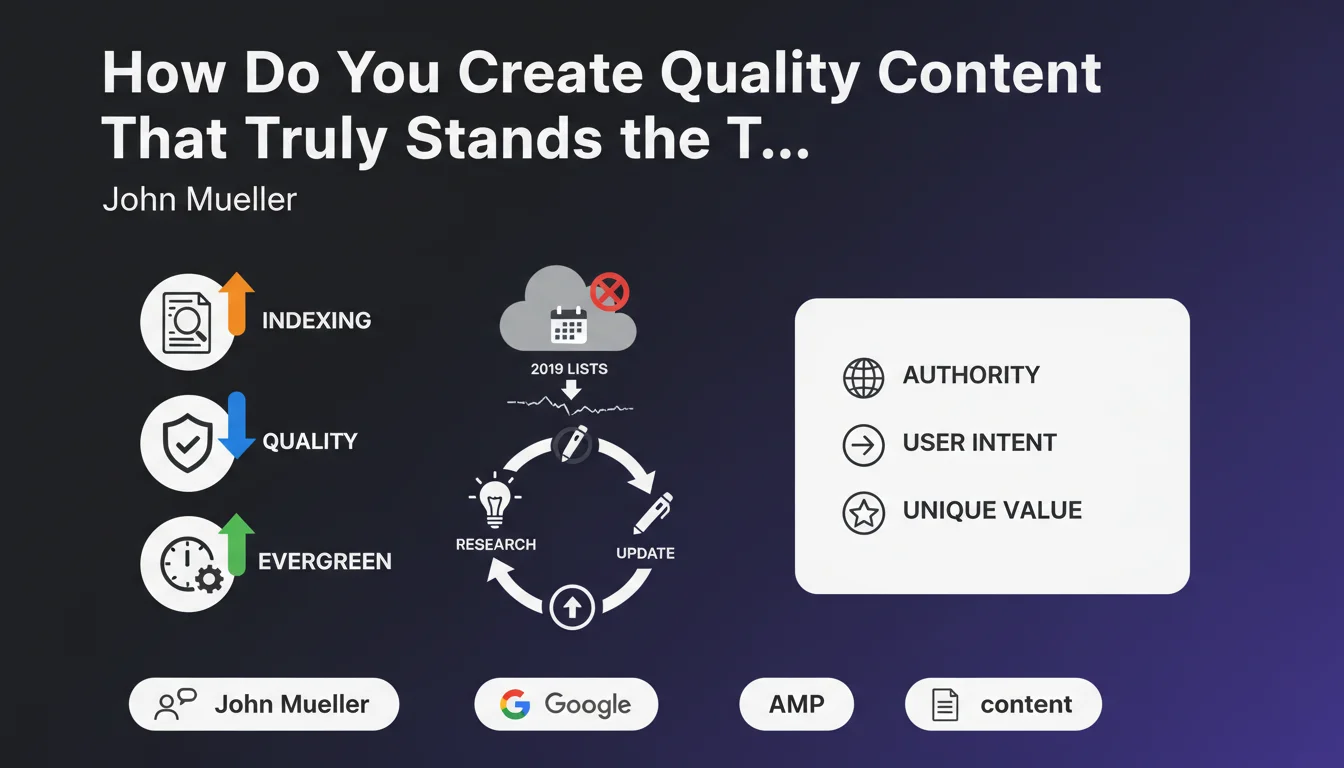
My recommendation would be to delete the site and start from scratch with unique, compelling, high-quality content that you'll spend time working on. Choose a topic you're passionate about and knowledgeable in, and work on creating your own content, something that can stand the test of time, and that stands out from *all* competitors as clearly the best of its kind. Do something impressive, don't just create a website.
What you need to understand
What Triggered This Public Intervention from Google?
A webmaster saw his site partially indexed by Google and sought help on an official forum. The Googler's uncompromising analysis reveals major content quality issues.
The site in question displayed several obvious spam signals: "top 10 in 2019" lists published before the year even started, and most importantly content rewritten from other sites. This practice is clearly identified as spam by Google.
- Partial indexing of a site is normal, but it can reveal quality issues
- Copied or rewritten content is considered spam by Google
- Publishing prematurely dated content damages the site's credibility
- Google recommends starting from scratch rather than trying to fix a heavily penalized site
Why Does Google Insist So Much on Content Quality?
Google's response doesn't just point out mistakes. It establishes a clear vision of what quality content is: unique, compelling, on a topic mastered by the author.
Google explicitly asks to create something that stands out from all competitors as being "clearly the best of its kind." This requirement goes far beyond simple technical optimization.
- Content must stand the test of time, not just generate immediate traffic
- The author's passion and expertise must be perceptible
- You must aim for absolute excellence, not industry average
What Does "Do Something Impressive" Really Mean to Google?
The final phrase "don't just create a website" summarizes Google's philosophy. It's not about filling pages to exist, but about building a reference resource.
This approach requires considerable time and effort investment. Google explicitly rejects quick and superficial content strategies, even if they're technically optimized.
SEO Expert opinion
Is This Statement Consistent with Google's Recent Developments?
Absolutely. This intervention fits perfectly in line with Helpful Content updates and Google's anti-spam systems. The message has been consistent for several years.
What's remarkable here is the unambiguous tone: recommending deleting a site and starting from scratch is rare. This indicates that Google considers certain sites as beyond recovery when content is fundamentally problematic.
- Current algorithms effectively detect rewritten or paraphrased content
- The notion of "best content in its category" has become a standard, not an ideal
- Google now values demonstrated expertise (E-E-A-T) more than ever
What Are the Practical Limitations of These Recommendations?
While the principle is clear, its application poses real challenges. Creating the "best content of its kind" requires considerable resources that not all publishers have.
The recommendation to "choose a topic you're passionate about" is relevant for a personal blog, but can be complex for commercial sites that must cover various topics out of business necessity.
In Which Contexts Is This Radical Recommendation Justified?
Starting from scratch is justified when a site accumulates too much quality debt. If most of the content is duplicated, rewritten, or of low value, fixing it page by page will be more costly than a complete overhaul.
This approach particularly applies to sites created with a pure volume logic: hundreds of pages generated quickly, without real expertise, hoping to capture long-tail traffic.
Practical impact and recommendations
How Can You Objectively Evaluate Your Own Content Quality?
The first step is to apply the direct comparison test: for each important page, identify the 3-5 best competing results on Google. Be honest: is your content truly superior?
Also check engagement signals: time spent on page, bounce rate, social shares. Mediocre content generates weak signals, even with SEO traffic.
- Factually compare your content to the top 5 Google results for your target queries
- Identify the unique value you bring (expertise, original data, different angle)
- Search for your content on Google with quotation marks to detect potential duplicates
- Analyze your engagement metrics page by page in Google Analytics
- Ask outside people for their unfiltered opinion on your content
What Concrete Actions Should You Take Following This Statement?
If your site contains rewritten or paraphrased content, the absolute priority is to identify and address it. Delete it or completely rewrite it with an original approach.
For content to be created, adopt a demanding editorial approach: each new piece of content must demonstrate real expertise, provide information that competitors don't have, or present a truly different angle.
- Audit your existing content to identify low-quality pages to delete or rewrite
- Establish strict quality criteria before publishing new content
- Invest in real expertise: expert interviews, original studies, experience feedback
- Document your expertise through detailed and credible author biographies
- Favor depth on a few topics rather than surface coverage of many themes
- Implement an editorial review process before publication
- Delete obsolete dated content or systematically update it
How Can You Implement These Changes Without Risking Your Current Traffic?
The transition to high-quality content must be gradual and strategic. Start by identifying your pages generating the most traffic and prioritize their improvement.
For pages to be deleted, plan intelligent 301 redirects to better quality content covering similar topics. Never delete massively without a redirect strategy.
In summary: Google explicitly asks to create content that is the best in its category, not simply optimized. This requirement represents a major paradigm shift for many publishers accustomed to producing in volume.
Implementing these recommendations requires a profound overhaul of the editorial approach, investments in expertise, and time. These transformations can be complex to orchestrate alone, particularly for established sites with hundreds of existing pages.
Faced with these strategic and technical challenges, support from a specialized SEO agency can prove valuable for establishing a precise diagnosis, prioritizing actions, and implementing a truly differentiating content strategy adapted to your sector.
💬 Comments (0)
Be the first to comment.