
Official statement
What you need to understand
Why Does Google Downplay the Weight of Hn Tags in SEO?
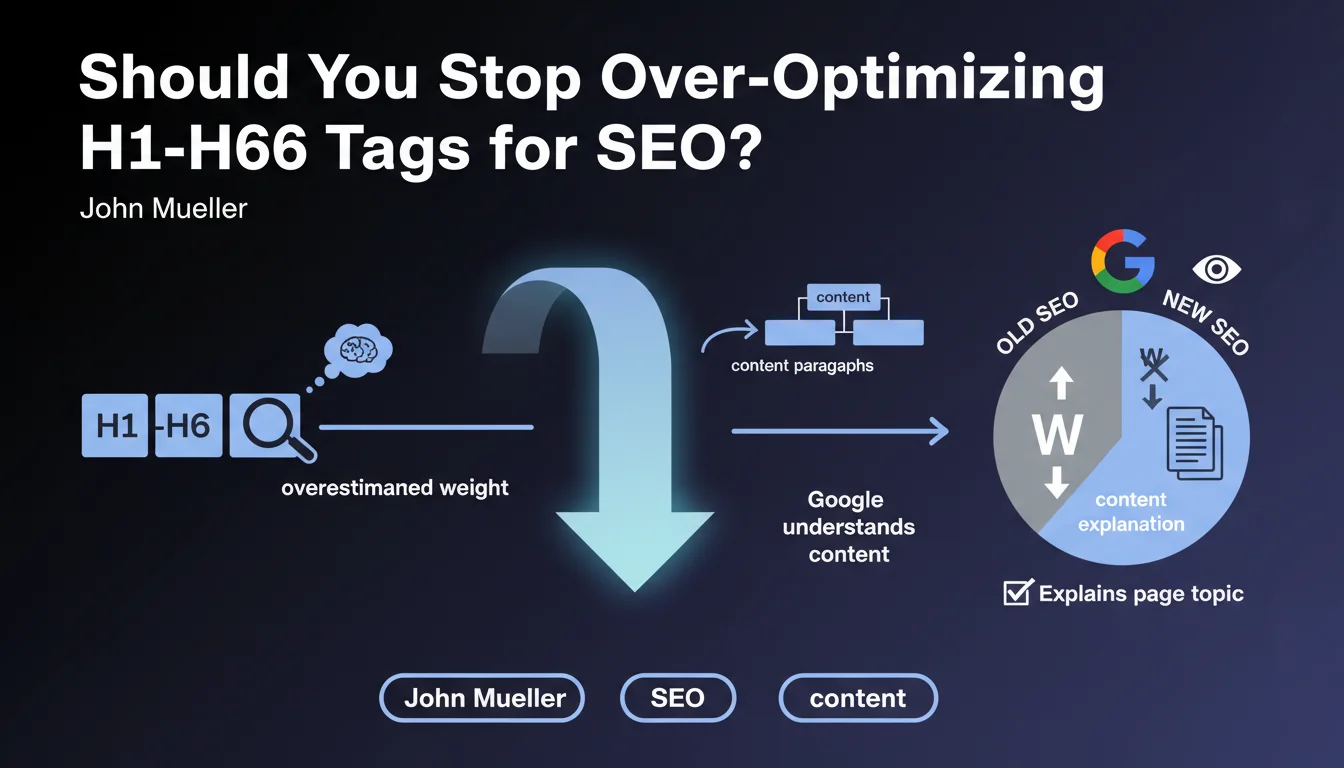
Google has clarified its position: H1-H6 tags have lost importance as a direct ranking criterion over the years. The evolution of algorithms, particularly with machine learning and semantic understanding, now allows Google to comprehend content without relying heavily on these structural markers.
However, these tags remain essential for contextual understanding. They primarily serve to identify the logical structure of a page and to understand what the different sections following them are about.
What Is the Actual Function of Hn Tags for Google Today?
Heading tags act as semantic context markers. They help algorithms segment content and assign each block of text to a specific topic.
Google uses this hierarchy to better grasp the information architecture of your page. This is particularly useful for featured snippets and separately indexed passages.
How Can You Tell If Your Hn Tags Are Properly Optimized?
The test is simple: extract only your H1-H6 tags and check whether you can understand the complete topic of the page. If so, your structure is coherent.
Conversely, if your tags contain elements unrelated to the main topic (parasitic tags), this creates confusion for algorithms and dilutes thematic relevance.
- Reduced SEO weight: Hn tags are no longer a major ranking criterion
- Primary function: understanding the structure and context of content
- Thematic coherence: all tags must be related to the page's topic
- Simple test: tags alone should allow content comprehension
- Progressive evolution: their importance decreases as Google's NLP improves
SEO Expert opinion
Is This Statement Consistent with Practices Observed in the Field?
My experience with hundreds of audits confirms this analysis, but with an important nuance. While the direct weight of Hn tags has indeed decreased, their indirect impact remains significant in certain competitive sectors.
A/B testing shows that optimizing Hn tags still improves performance, particularly for long-tail queries and featured snippets. It's not so much the algorithmic weight as the semantic clarity that makes the difference.
What Nuances Should Be Added to This Recommendation?
The strategy mentioned (main query in H1, H2, and H3) does work effectively, but for reasons that go beyond simple HTML markup. It forces natural semantic repetition and structures content logically.
Be careful, however, not to confuse intelligent repetition with keyword stuffing. Using lexical variations and synonyms remains preferable to exact repetition of the same term.
In What Cases Do Hn Tags Retain Strong Impact?
On long, structured content (guides, in-depth articles), Hn tags play a crucial role in breaking content into indexable passages. Google can extract and rank specific sections thanks to this structure.
For informational queries and direct questions, a match between the query and an H2 or H3 significantly increases the chances of appearing in position zero. The impact is also notable for accessibility and screen readers, which indirectly influences user signals.
Practical impact and recommendations
What Should You Actually Do to Optimize Your Hn Tags?
Adopt a balanced approach: don't neglect Hn tags, but don't over-optimize them either. Focus on semantic coherence and readability rather than keyword density.
Use your main keyword naturally in the H1, then variations and related terms in H2s and H3s. Each subheading should provide clear information about the content that follows.
Build a logical hierarchy: H1 for the main title (only one), H2 for major sections, H3 for subsections. Don't skip levels (no H4 directly after an H2).
What Critical Mistakes Must You Absolutely Avoid?
The most common error is using Hn tags to style text rather than to structure content. Heading tags have a semantic function, not an aesthetic one (use CSS for styling).
Avoid parasitic tags unrelated to the main topic, such as "About Us" or "Contact Us" as H2 on a product page. Each tag should contribute to thematic understanding.
Don't multiply H1s (even though technically HTML5 allows it). In SEO, one H1 per page remains the best practice for maximum clarity.
How Do You Check and Audit Your Site's Hn Structure?
Use tools like Screaming Frog or browser extensions to extract all Hn tags from your pages. Analyze whether reading only the tags allows you to understand the content.
Check for the absence of pages without H1 or with multiple H1s. Verify that the hierarchy is respected (no level skipping) and that each tag is relevant to the content.
- Use one clear and descriptive H1 per page
- Naturally integrate the main keyword into the H1
- Structure content with H2s for each major section
- Employ lexical variations in H2s and H3s
- Respect the logical hierarchy (H1 > H2 > H3...)
- Eliminate all parasitic tags unrelated to the theme
- Test comprehension by reading only the Hn tags
- Verify that each tag clearly announces the content that follows
- Optimize for featured snippets with H2s in question form
- Regularly audit the Hn structure of the entire site
💬 Comments (0)
Be the first to comment.