
Official statement
Other statements from this video 4 ▾
- □ Can Google Trends really generate actionable SEO content ideas for your strategy?
- □ Should you really be monitoring Google Trends to anticipate search peaks before your competitors do?
- □ Should you prioritize real search volume over search interest to build your content strategy?
- □ Should you really align your Trending Now time window to your editorial objective?
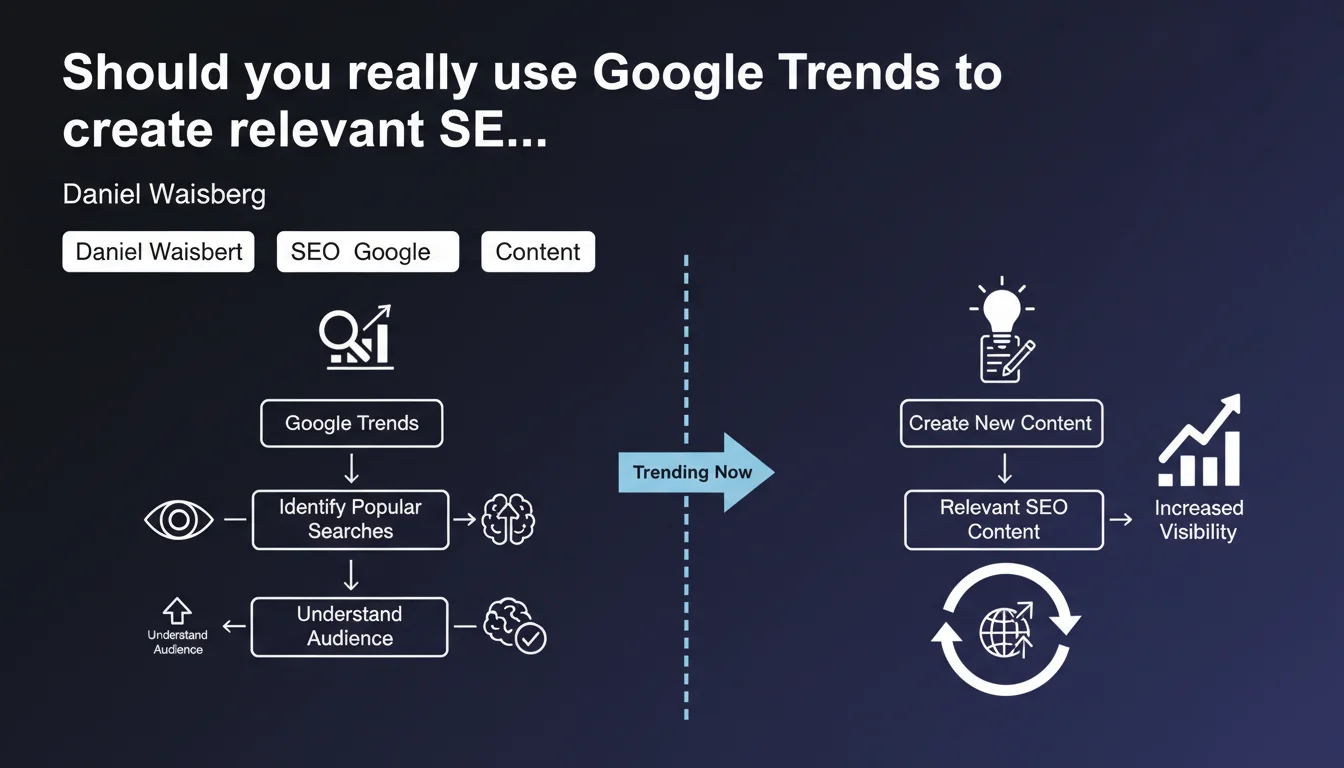
Google confirms that Trending Now (Google Trends) is a key tool for identifying popular topics and creating content aligned with current user searches. The objective: understand your audience in real-time and anticipate demand rather than blindly following past trends.
What you need to understand
Why does Google specifically highlight Trending Now?
Daniel Waisberg emphasizes that Trending Now is not just a simple monitoring tool: it's a lever to anticipate informational demand. By identifying what is being searched right now, you can create content that responds to an active query, rather than relying solely on historical search volumes.
The distinction is important. Google doesn't say "use any trend", but rather those that are currently popular on Search. This implies synchronization between search peaks and content publication.
What's the difference between general trends and exploitable SEO trends?
Not all trends are equal. A Twitter or TikTok trend does not necessarily equate to Google search volume. Waisberg insists on identifying what is being searched on Google Search, nowhere else.
Concretely, this means filtering data by region, category, and time period to isolate real content opportunities. A global trend may be unexploitable for your local niche — and vice versa.
How does this change traditional editorial approach?
Traditionally, you plan an editorial calendar for 3-6 months. Here, Google is pushing toward a reactive and opportunistic approach: publish quickly on an emerging topic to capture traffic during the search peak.
This requires agility — and accepting that not all content will have a long lifespan. Some articles can spike in 48 hours then become obsolete. Others fit into recurring seasonal trends.
- Trending Now allows you to identify topics currently being searched on Google Search
- The goal is to synchronize publication with peaks in informational demand
- Not all trends are exploitable: you must filter by geographic and sector relevance
- The recommended approach combines traditional editorial planning and opportunistic reactivity
- Some trending content has a short lifespan — this is normal and intentional
SEO Expert opinion
Is this statement consistent with practices observed in the field?
Yes, and it's even an official validation of what high-performing SEOs have been doing for years. Sites that exploit trending topics — news, tech, lifestyle — regularly see massive traffic spikes on articles published at the right time.
But — and this is a big but — this strategy works mainly if your site already has established authority and sufficient crawl budget. A new site publishing on an ultra-competitive trend will struggle to index and rank fast enough to capture the spike.
What nuances should be made to this recommendation?
Google doesn't specify which types of sites should prioritize this approach. A B2B e-commerce site selling industrial machinery has no interest in following mainstream trending topics. Sector relevance always comes first.
Furthermore, Waisberg talks about "new content" without addressing updating existing content. Yet, refreshing an old article around a recurring trend (like "taxes 2025", "summer sales") is often more effective than creating from scratch.
Finally, nothing is said about indexing speed. If your content takes 3 days to be indexed, the trend will be gone. This assumes your site is technically sound and has high crawl frequency. [To verify]: Google has never confirmed that publishing on a trend accelerates indexing.
In what cases does this strategy not apply?
Niche B2B sites, high-value evergreen content, sites slow to index, and topics where search intent changes little over time can safely ignore this recommendation.
Let's be honest: chasing every trend often dilutes your site's thematic coherence. If you specialize in technical SEO, publishing about "trending TikTok pancake recipes" under the pretext that they're being searched won't provide anything — neither authority nor qualified audience.
Practical impact and recommendations
What concretely should you do to leverage Google Trends for SEO?
First, integrate daily monitoring into your workflow. Check Trending Now every morning, filter by your region and sector, and identify topics aligned with your theme. Don't scatter your efforts.
Next, prepare quick content templates: H1-H4 structure, pre-filled text zones, available stock images. The goal is to reduce the time between trend detection and publication to a few hours maximum.
Finally, monitor indexing. Use the URL inspection tool in Search Console and request manual indexing if necessary. For sites with high trending potential, consider a dynamic sitemap that prioritizes new URLs.
What mistakes should you absolutely avoid?
Don't publish hollow content just to ride a trend. Google still values depth and relevance — a rushed 200-word article won't rank, even on an emerging trend.
Also avoid creating incoherent thematic silos. If you regularly publish trends unrelated to your core business, you send contradictory signals to Google about your actual expertise.
And most importantly, don't neglect evergreen content. A 100% trending strategy is fragile: traffic fluctuates wildly, your audience is volatile, and you're entirely dependent on news cycles. Balance is key.
How do you verify your trending strategy is working?
Analyze in Search Console the "New" queries generating impressions and clicks. If your trending articles don't appear in this category, they're being indexed too late or are poorly optimized.
Also measure bounce rate and reading time. Trending content that attracts traffic but retains zero visitors is a negative signal to Google — and to your reputation as a publisher.
- Set up daily Google Trends monitoring filtered by sector and region
- Prepare content templates to reduce publication delay
- Manually index new URLs via Search Console if necessary
- Maintain a 70% evergreen / 30% trending balance to stabilize traffic
- Cross-reference Google Trends with volume tools to validate real opportunities
- Analyze performance in Search Console (new queries, bounce rate)
- Never sacrifice editorial quality for publication speed
❓ Frequently Asked Questions
Google Trends montre-t-il des volumes de recherche réels ou relatifs ?
Combien de temps après publication un contenu trending doit-il être indexé ?
Peut-on utiliser Google Trends pour du SEO local ou B2B de niche ?
Faut-il supprimer les contenus trending une fois la tendance passée ?
Les contenus trending impactent-ils positivement l'autorité globale du site ?
🎥 From the same video 4
Other SEO insights extracted from this same Google Search Central video · published on 11/09/2024
🎥 Watch the full video on YouTube →
💬 Comments (0)
Be the first to comment.