
Official statement
Other statements from this video 4 ▾
- □ Do Google Doodles really affect your website's search rankings?
- □ Why does Google optimize the file size of its Doodles to such an extreme degree?
- □ Does Google really use clicks on its Doodles as a ranking signal?
- □ Does Google's 'push' vs 'pull' distinction really shape your SEO content strategy?
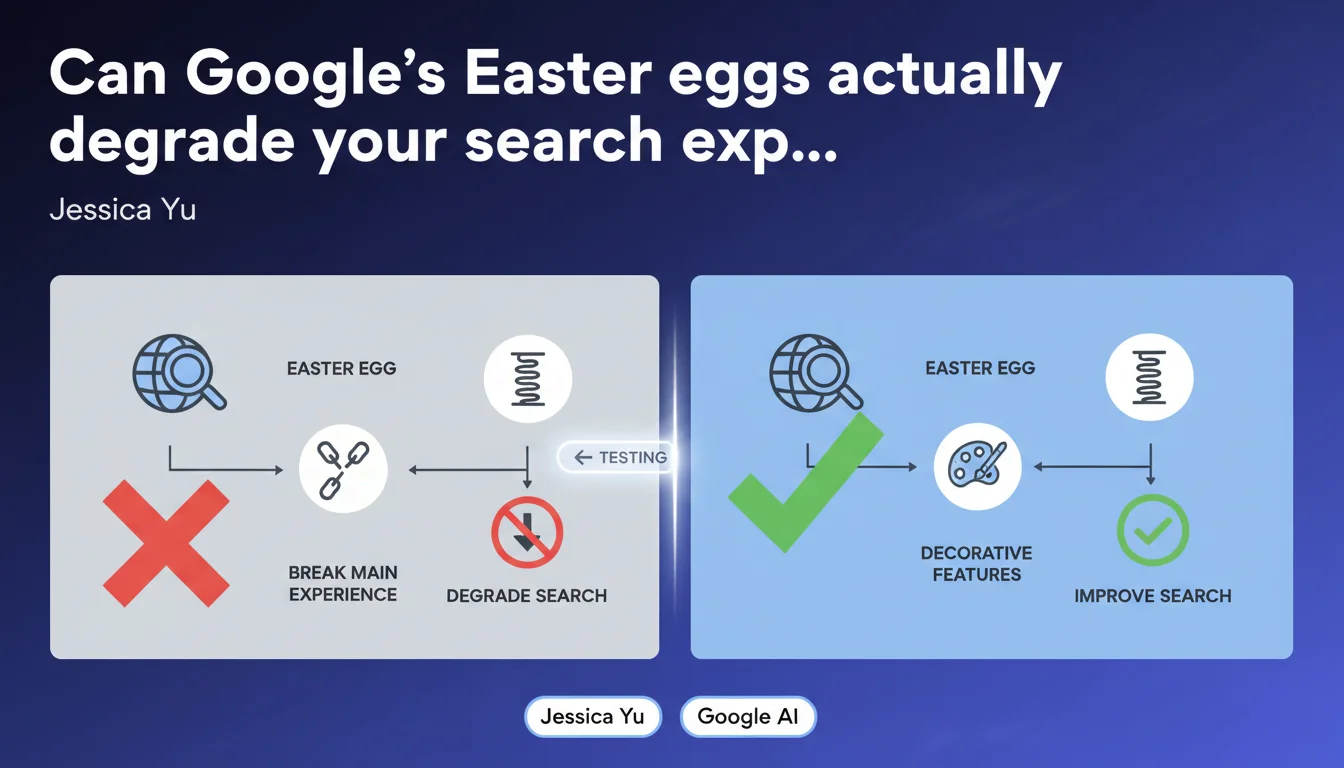
Google claims to rigorously test its Easter eggs and animations to prevent any interference with the main search function. Decorative elements are only deployed if they don't break the user experience. A reassuring statement, but one that raises questions about the precise validation criteria.
What you need to understand
What exactly are these Easter eggs Google is talking about?
Easter eggs refer to those little animations or hidden features that Google occasionally deploys on its search results pages. Clicking on certain terms triggers visual effects, interactive games, or themed animations.
These elements are purely decorative — they provide no functional value to the search. Google uses them to create engagement during special events or to humanize its interface.
Why does Google insist that they don't affect search?
Because any degradation of the main experience would have a direct impact on user trust. If an animation slows down results loading or hides content, users might turn to a different search engine.
Google therefore claims to perform thorough testing before each deployment to ensure the search function remains intact. But the definition of "not interfering" remains vague — is it only about technical performance or also about visual distraction?
What's the logic behind this public statement?
This communication likely aims to reassure users that Google isn't sacrificing service quality for gimmicks.
It may also respond to past criticism where certain Easter eggs actually caused slowdowns or bugs — even though Google never publicly admits this.
- Google tests its Easter eggs before deployment to avoid breaking main search
- Animations are implemented only if they don't interfere with the search function
- The precise definition of "not interfering" remains vague — technical performance alone or also visual experience?
- This statement seems to address concerns about user experience quality
SEO Expert opinion
Is this statement consistent with real-world observations?
Overall, yes. Google's Easter eggs remain anecdotal and temporary — they disappear quickly and have never caused observable major degradation in the long term.
However, some users have reported occasional slowdowns during complex animations, particularly on less powerful devices. Google probably tests on state-of-the-art infrastructure that doesn't always reflect the reality of the user base.
What nuances should be added to this claim?
The notion of "not interfering" is subjective. An animation can technically not block search while diverting user attention — which remains a form of interference.
Moreover, Google doesn't specify which precise criteria are used during testing. Is it only loading speed, browser compatibility, or also behavioral analytics? [To verify]
Why does Google communicate about such a marginal topic?
Because even seemingly minor details can impact the perception of search engine quality. Google knows that trust is built partly on these peripheral elements as well.
This statement may also serve as a legal precedent in case of future complaints related to service degradation caused by an Easter egg — Google can always say it communicated about its validation processes.
Practical impact and recommendations
What should SEO professionals take away from this statement?
Honestly, not much that's actionable. Easter eggs don't affect your rankings, crawl budget, or Core Web Vitals metrics.
This statement concerns exclusively user experience on Google's side, not your site optimization. It simply confirms that Google pays attention to not degrading its own product.
Are there indirect risks for your site?
The only theoretical risk would be an Easter egg distracting users enough to reduce CTR on your organic results. But the impact would be marginal and temporary.
If you observe a sudden CTR drop coinciding with a major Easter egg, document it — but don't expect Google to acknowledge the causal link.
What concrete actions should you take?
- No action required — this statement has no direct impact on SEO optimization
- Continue monitoring your Core Web Vitals on your own site, independent of Google animations
- If you notice a CTR anomaly during an Easter egg, document it for later analysis
- Don't waste time optimizing for these animations — they're ephemeral and uncontrollable
❓ Frequently Asked Questions
Les Easter eggs de Google peuvent-ils affecter mon classement SEO ?
Dois-je m'inquiéter d'une baisse de CTR pendant un Easter egg ?
Google teste-t-il vraiment tous ses Easter eggs avant déploiement ?
Puis-je désactiver les Easter eggs sur mon navigateur ?
🎥 From the same video 4
Other SEO insights extracted from this same Google Search Central video · published on 17/10/2024
🎥 Watch the full video on YouTube →
💬 Comments (0)
Be the first to comment.