
Official statement
Other statements from this video 4 ▾
- □ Les Google Doodles peuvent-ils influencer le référencement de votre site ?
- □ Pourquoi Google optimise-t-il la taille des fichiers de ses Doodles à l'extrême ?
- □ Les Easter eggs de Google peuvent-ils dégrader votre expérience de recherche ?
- □ Google utilise-t-il les clics sur ses Doodles comme signal de classement ?
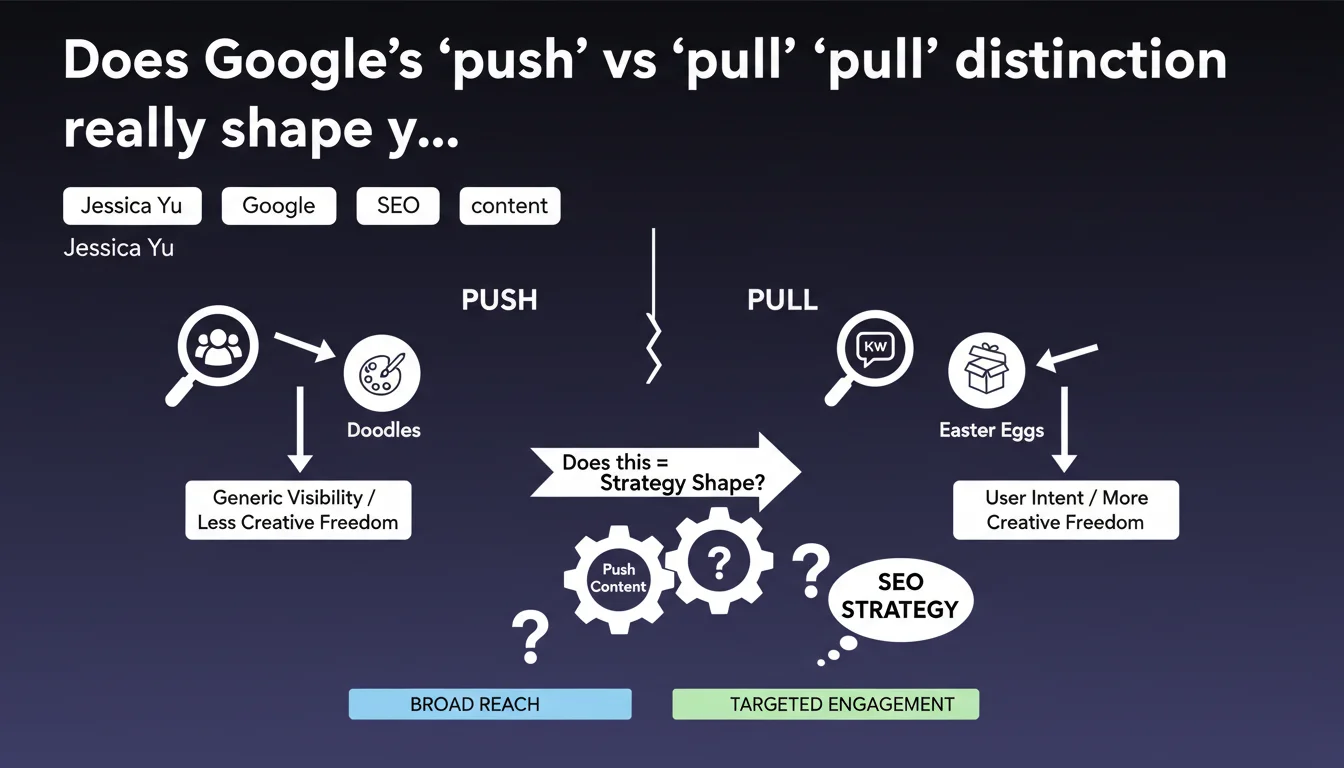
Google differentiates between Doodles (visible to everyone, 'push' approach) and Easter eggs (activated by specific searches, 'pull' approach). This distinction offers more creative freedom for 'pull' content because the user demonstrates targeted interest. For SEO, this underscores the importance of aligning search intent with the type of content offered.
What you need to understand
What's the concrete difference between 'push' and 'pull' approach according to Google?
The 'push' approach refers to content presented to all users without them explicitly requesting it. Doodles are the typical example: they appear on the homepage, visible to millions of internet users.
Conversely, the 'pull' approach relies on voluntary user action. Easter eggs trigger only when a specific search query is made. The user expresses targeted interest, and Google responds with content adapted to that intent.
Why does this distinction give more creative freedom for Easter eggs?
When a user actively searches for something, they express a clear intent. Google can then afford more creative boldness — the user has 'signed up' to receive a potentially original response.
With Doodles, visibility is total but unsolicited. Google must remain cautious: the content must appeal to the broadest audience without offending. Editorial constraints are stronger.
What lesson should you take for your SEO content strategy?
This logic applies directly to web content. The more specific a search query, the more users accept niche, technical, or creative content.
For broad searches (head terms), stick with consensual and well-structured content. For long-tail searches, you can personalize more, take editorial risks, propose a different tone.
- 'Push' approach corresponds to broad, default-visible content (homepages, main categories)
- 'Pull' approach corresponds to targeted content, activated by a specific search query (expert guides, technical FAQs)
- The more precise the intent, the greater the creative freedom without risk of disappointing
- Aligning content type with search intent improves perceived relevance
SEO Expert opinion
Does this statement really reflect how Google currently operates?
In principle, yes. Google has always differentiated between generalist content (exposed to everyone) and contextual content (triggered by a query). Featured Snippets, People Also Ask, Knowledge Panels all function on a 'pull' model.
But let's be honest: this statement remains very conceptual. Jessica Yu talks about Easter eggs, not directly about SEO. The extrapolation to organic content strategy is logical, but [To verify]: no hard data confirms that Google consciously applies this distinction in its ranking.
What biases does this approach introduce for smaller sites?
A site with high brand traffic can afford 'push' content because users already come there. A small site must rely almost exclusively on 'pull' — ultra-targeted content to capture specific queries.
The risk? Missing the broad audience. If you only produce niche content, you never build brand awareness. The balance is delicate: you need 'pull' for immediate traffic, 'push' for long-term brand building.
Does this creative freedom on specific queries really apply in YMYL?
Not really. On Your Money Your Life topics (health, finance), even a hyper-specific query demands maximum editorial caution. Google won't allow creative but imprecise content on 'female heart attack symptoms'.
Creative freedom exists mainly in non-sensitive verticals — entertainment, culture, tech. In YMYL, specific intent never exempts you from strict E-E-A-T.
Practical impact and recommendations
How do you adapt your content strategy to this push/pull logic?
Start by mapping your content according to intent. Homepages, main categories: 'push' approach, neutral tone, classic structure. Blog articles, expert guides, technical FAQs: 'pull' approach, personalization possible.
On long-tail queries, allow yourself varied formats: more direct tone, case studies, experience feedback. The user typing a precise query accepts (and often appreciates) an original angle.
What mistakes should you avoid when applying this distinction?
Don't fall into the all-niche trap. A site producing only ultra-specific 'pull' content lacks overall coherence and visibility on strategic queries.
Conversely, don't drown your important pages under a bland, consensual tone. Even in 'push', you can have personality — it's just more structured.
How do you measure the effectiveness of this approach?
Analyze bounce rate by query type. A creative 'pull' content on a specific query should have low bounce (the user finds exactly what they want). A generalist 'push' content must convert broadly but with less depth.
Also look at time spent and user journeys: 'pull' content engages more intensely, 'push' content distributes across other pages.
- Identify 'push' pages (homepage, categories) and 'pull' pages (guides, FAQs)
- Allow more personal tone on 'pull' content targeting specific queries
- Maintain consensual and clear structure on 'push' content visible by default
- Never sacrifice E-E-A-T, even on creative 'pull' content
- Measure engagement (bounce, time, journeys) to validate intent/content alignment
❓ Frequently Asked Questions
Les Easter eggs de Google ont-ils un impact SEO direct ?
Faut-il créer plus de contenu 'pull' que 'push' pour ranker ?
Cette approche s'applique-t-elle en B2B comme en B2C ?
Un contenu 'pull' créatif risque-t-il de nuire à l'E-E-A-T ?
Comment identifier si une page doit être 'push' ou 'pull' ?
🎥 From the same video 4
Other SEO insights extracted from this same Google Search Central video · published on 17/10/2024
🎥 Watch the full video on YouTube →
💬 Comments (0)
Be the first to comment.