
Official statement
Other statements from this video 4 ▾
- □ Do Google Doodles really affect your website's search rankings?
- □ Why does Google optimize the file size of its Doodles to such an extreme degree?
- □ Can Google's Easter eggs actually degrade your search experience?
- □ Does Google's 'push' vs 'pull' distinction really shape your SEO content strategy?
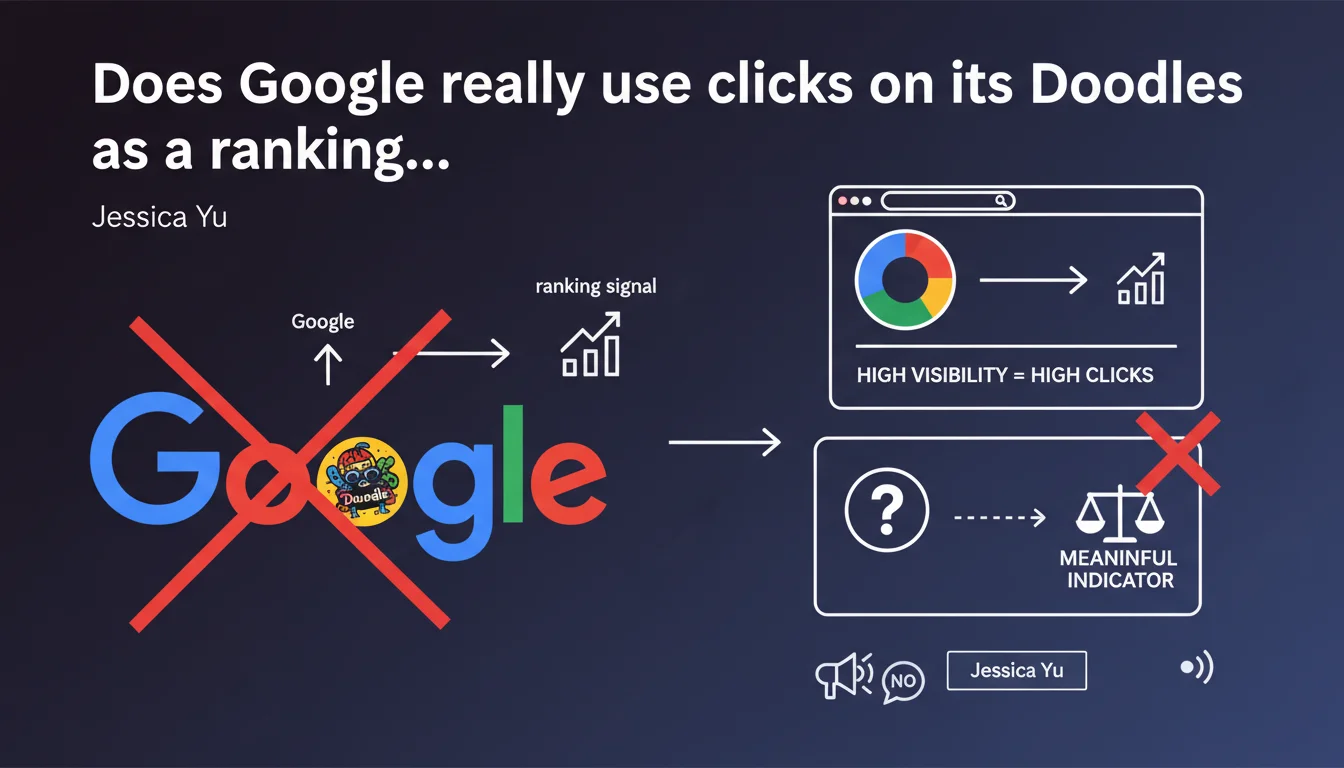
Google confirms that it does not monitor the search volume generated by clicks on its Doodles as an SEO performance metric. The reason: these ultra-visible buttons generate too much bias to be considered reliable indicators of genuine user interest.
What you need to understand
This statement from Jessica Yu sheds light on a poorly documented aspect: how Google handles interaction data with its own interface elements. The message is clear — Doodles, those animated illustrations that sometimes replace the Google logo, play no role in evaluating organic performance.
Why does Google discard these interaction data?
Doodles occupy considerable visual real estate on the homepage. Their central position and attractive nature mechanically generate clicks that do not reflect genuine search intent.
Google considers these interactions to be biased by the simple fact that the element is impossible to ignore. Using this volume as a metric would be like measuring the popularity of a button placed in the middle of a mandatory corridor — everyone presses it, but that says nothing about genuine interest.
What does this reveal about Google's measurement philosophy?
This position illustrates a fundamental principle: Google seeks to distinguish authentic signals from artifacts created by its own design. An interaction only has value if it translates genuine user intent, not a reaction to a dominant visual stimulus.
It is consistent with what we observe elsewhere — engagement metrics are only relevant when they reflect a deliberate choice in a neutral context.
- Clicks on Doodles are not used as SEO metrics
- Excessive visibility of an element creates bias that makes data unusable
- Google privileges authentic intent signals over mechanical interactions
- This approach likely applies to other dominant interface elements
SEO Expert opinion
Does this statement change our understanding of user signals?
Not really. We already knew that Google does not treat all clicks the same way. What is interesting is the explicit confirmation that an element can be too visible to generate usable data.
This reinforces the hypothesis that behavioral signals are only relevant in a context where the user has a choice. A forced or obvious click has no predictive value on content quality.
Can we extrapolate this logic to other elements?
Probably. If Google disregards Doodles due to excessive visibility, it likely applies the same reasoning to featured snippets, Knowledge Panels, and other dominant SERP elements. [To be verified] — Google has never explicitly confirmed that these interactions are neutralized, but the logic is identical.
In practice? Clicks on a featured snippet may not validate a page's relevance as much as we assume. The user clicks because it is in position zero, not necessarily because the content is objectively better.
Should we worry if we generate traffic via "overly visible" elements?
No. This statement only concerns Google's internal use of this data, not its value for you. A click remains a click — it generates traffic, visibility, potentially conversions.
What matters for your SEO is what the user does after the click: do they stay on the page, interact with the content, come back seeking a better answer? These post-click behaviors are not biased by initial positioning.
Practical impact and recommendations
What should we take away to optimize our pages?
This statement calls for no tactical change. Google is not asking you to optimize for or against Doodles — it is simply clarifying that it does not count them in its own internal evaluations.
The lesson: focus on authentic intent signals. The metrics that matter are those where the user made a deliberate choice among several equivalent options.
Which indicators should you prioritize monitoring?
Forget raw click volume. Look at post-click satisfaction metrics: time spent on page, navigation depth, adjusted bounce rate according to context. These metrics reflect perceived content quality, not the effectiveness of visual packaging.
If you generate traffic via dominant SERP elements (featured snippets, People Also Ask), measure what happens next. Does the user find what they are looking for or leave immediately to rephrase their query?
- Do not attempt to manipulate dominant visual elements to artificially inflate your metrics
- Focus on post-click experience rather than raw click volume
- Analyze genuine engagement behaviors: read time, scroll depth, interactions
- If you capture traffic via prominent SERP elements, ensure your content delivers on its promise
- Test the clarity of your titles and meta descriptions in a multi-choice context
This statement confirms that Google prioritizes intent signals over visual artifacts. No specific action required, but a validation of strategy: optimize for user satisfaction, not vanity metrics.
These behavioral optimizations — fine-grained user journey analysis, content adjustments based on engagement signals, contextual interpretation of metrics — require specialized expertise and appropriate tools. If you lack internal resources to deploy this approach systematically, support from a specialized SEO agency can help you establish a sustainable methodology and avoid dead ends.
❓ Frequently Asked Questions
Les clics sur un featured snippet sont-ils également ignorés par Google ?
Cette déclaration signifie-t-elle que Google n'utilise aucun signal comportemental ?
Faut-il éviter d'apparaître dans des éléments SERP visuellement dominants ?
Comment savoir si mes métriques d'engagement sont fiables ?
🎥 From the same video 4
Other SEO insights extracted from this same Google Search Central video · published on 17/10/2024
🎥 Watch the full video on YouTube →
💬 Comments (0)
Be the first to comment.