
Official statement
Other statements from this video 4 ▾
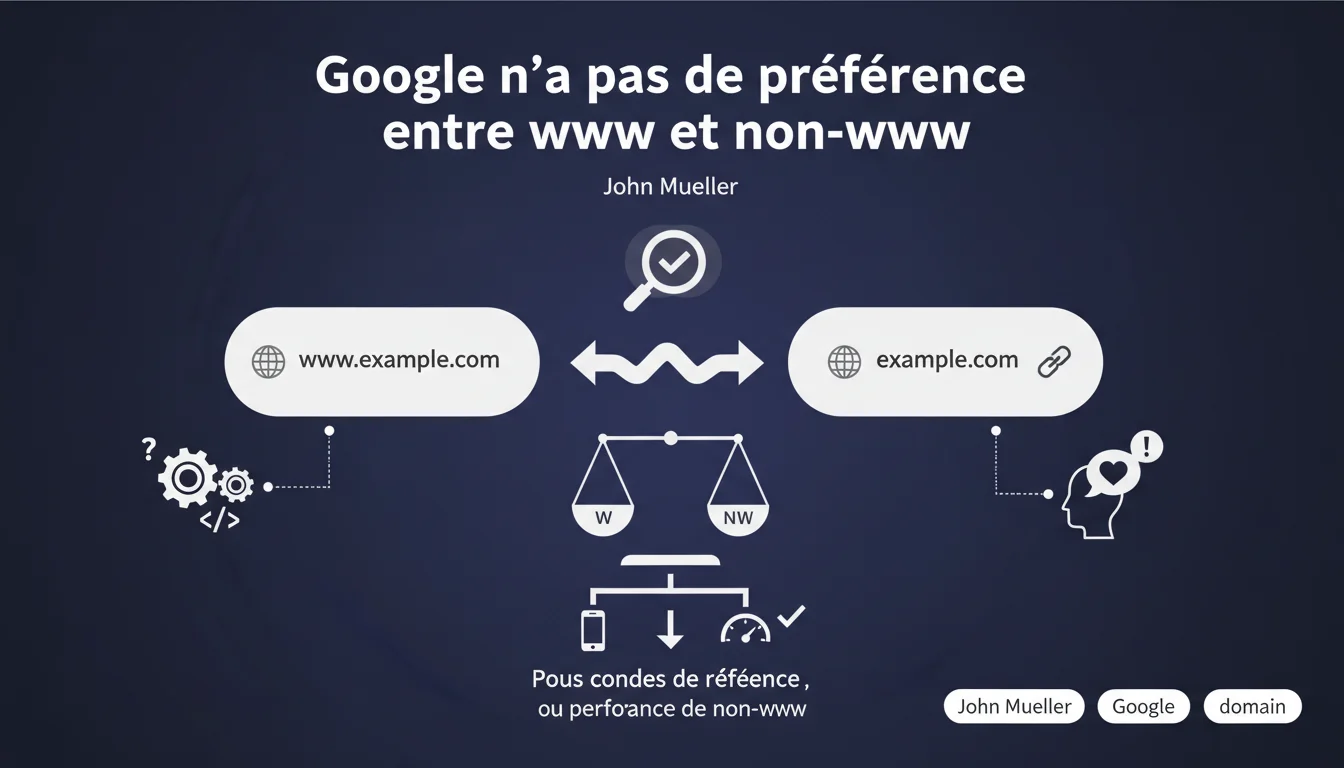
Google has no preference between www and non-www. The choice between the two versions is a matter of personal preference or specific technical constraints. The key is to define a clear canonical version and maintain it consistently in Search Console and redirects.
What you need to understand
Why does this question keep coming up among SEOs?
Since the early days of the web, the www prefix has long been considered a standard. Some practitioners still believe it influences rankings in the SERPs, while others prefer the non-www version for shorter URLs.
The confusion also stems from duplicate content issues: if both versions are accessible without redirection, Google may index both, diluting ranking signals. Hence the importance of this official clarification.
What does “no preference” really mean for Google?
In practice, the search engine neither favors nor penalizes one version over the other. Algorithms treat www.example.com and example.com as two distinct entities, unless you explicitly specify your choice.
What really matters: define a unique canonical URL via Search Console, implement consistent 301 redirects, and maintain this configuration over time. The rest is cosmetic.
What technical reasons might influence this choice?
Some use cases justify one choice over another. CDN configurations sometimes work better with www, as this allows cookies to be separated from the root domain and subdomains.
Conversely, the non-www version simplifies DNS management and provides more concise URLs — a minimal SEO advantage but appreciated for branding and sharing on social networks.
- Google does not favor either version in its ranking algorithms
- The choice of www/non-www is a matter of personal preference or technical constraints
- The key is to define a unique canonical version and maintain it
- Without proper 301 redirection, both versions create duplicate content
- Search Console allows you to declare your preferred domain
SEO Expert opinion
Is this statement consistent with observed practices in the field?
Absolutely. For years, real-world tests have shown no correlation between the choice of www/non-www and performance in the SERPs. Sites that rank on the first page use both configurations without observable patterns.
The real problem arises when the configuration is shaky: chain redirects, inconsistent declaration in Search Console, or worse, complete lack of canonical redirection. In these cases, fluctuations in ranking and dilution of link equity are observed.
In what cases might this recommendation be nuanced?
Mueller talks about “technical reasons,” but remains intentionally vague. In practice, some complex architectures require www: multi-CDN, advanced cookie management, or strict separation between the main domain and functional subdomains.
[To be verified] — Google does not specify whether this principle applies equally to international domains with multiple ccTLDs, nor how algorithms handle migrations from www to non-www (or vice versa) on very large sites with a long history.
What traps should be avoided at all costs?
The first trap: changing versions without a proper migration. Switching from www to non-www (or vice versa) without permanent 301 redirects creates an SEO disaster. Google treats this as a new site, and you temporarily lose your positions.
Another frequent mistake: declaring a preferred version in Search Console while leaving the other version accessible without redirection. The bot crawls both, indexes duplicate content, and you end up competing against yourself.
Practical impact and recommendations
What should you do concretely to implement the correct configuration?
First step: choose your canonical version. It doesn’t matter which one, but stick to it. Then, configure a permanent 301 redirection at the server level (htaccess, nginx, or equivalent) from the non-preferred version to the preferred one.
Declare this version in Search Console as the primary domain. Check that all your internal links point to this unique version, and audit the main backlinks to request corrections if necessary.
How to verify that the configuration is correct?
Manually test both URLs (www and non-www) in a browser in private browsing mode. The non-preferred version should immediately redirect to the preferred one with an HTTP 301 status code.
Use Search Console to verify that Google is indexing only one version. If you see URLs from both versions in the index, your configuration has a problem. Correct the redirects and request a re-indexing of the affected pages.
What common mistakes must be absolutely avoided?
Never leave both versions accessible simultaneously without redirection. This is the number one source of avoidable duplicate content. Do not solely rely on canonical tags — they are a help, not a complete solution.
Also, avoid chain redirects: www to non-www to HTTPS creates three requests instead of one. Consolidate everything into a single direct 301 redirect. And do not change your preferred version every six months — stability matters.
- Choose definitively between www and non-www according to your technical constraints or preferences
- Configure a permanent 301 redirect from the non-preferred version to the preferred one
- Declare the preferred domain in Search Console
- Check that all internal links point to the canonical version
- Audit the main backlinks and request corrections if necessary
- Test both URLs to confirm the immediate redirect
- Monitor indexing in Search Console to detect any duplicate content
- Avoid chain redirects (www → non-www → HTTPS)
- Maintain this configuration permanently and consistently
❓ Frequently Asked Questions
Dois-je changer ma configuration actuelle si j'utilise déjà www ou non-www ?
Les redirections 301 de www vers non-www font-elles perdre du PageRank ?
Peut-on avoir www pour le site principal et non-www pour un sous-domaine ?
La balise canonical suffit-elle à gérer www vs non-www ?
Comment migrer de www vers non-www sans perdre de trafic ?
🎥 From the same video 4
Other SEO insights extracted from this same Google Search Central video · published on 05/01/2022
🎥 Watch the full video on YouTube →
💬 Comments (0)
Be the first to comment.