
Official statement
What you need to understand
Google is gradually rolling out its AI mode in search, a major evolution that is generating serious concerns among web publishers. This feature allows users to obtain synthesized answers directly in search results, potentially without clicking through to source sites.
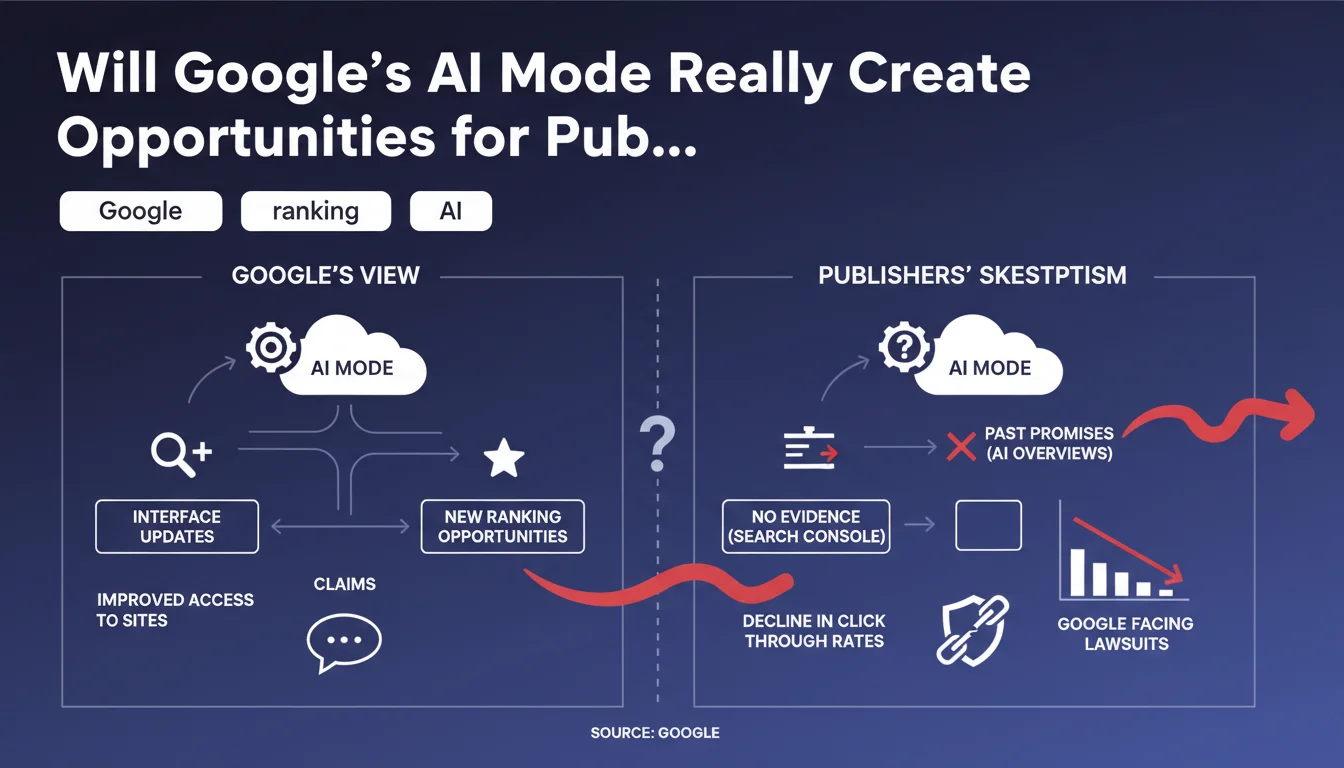
Robby Stein, VP of Google Search, is attempting to reassure the industry by stating that interface updates will improve access to publisher sites. He also promises that AI will open up new ranking opportunities for quality content.
However, publishers are expressing legitimate skepticism. They recall that similar promises had accompanied the launch of AI Overviews, without Google providing concrete data via Search Console to demonstrate a positive impact.
- AI mode synthesizes information directly in results without requiring visits to sites
- Independent studies show a decline in CTR (click-through rate) since the introduction of these features
- Google is facing lawsuits regarding the impact of AI on publisher traffic
- No official metrics are provided by Google to validate its positive claims
SEO Expert opinion
With 15 years of experience analyzing Google's evolutions, I must observe a significant gap between official discourse and ground reality. The data we've been collecting since the rollout of AI Overviews indeed shows a measurable erosion of organic traffic for many sites, particularly on informational queries.
The promise of "new ranking opportunities" remains extremely vague and undocumented. Google specifies neither the criteria, nor the mechanics, nor especially the metrics for measuring these opportunities. This lack of transparency is concerning for our industry.
SEO strategy must now incorporate a scenario of structural decline in clicks coming from Google. Sites dependent on Google for more than 70% of their traffic are particularly vulnerable and must urgently diversify their acquisition sources.
Practical impact and recommendations
- Diversify your traffic sources immediately: invest in email marketing, social media, partnerships, and communities to reduce your dependence on Google
- Optimize to appear in sources cited by AI: structure your content with clear data, precise definitions, and authoritative citations that AI can reference
- Strengthen your E-E-A-T expertise: publish content signed by identifiable experts, with evidence of real experience and unique perspectives that AI cannot synthesize
- Create transactional and high-value-added content: purely informational content is most vulnerable to AI, focus on content that requires action or interaction
- Implement advanced traffic source tracking: precisely monitor the evolution of traffic coming from Google Search versus AI features to anticipate trends
- Develop proprietary formats: interactive tools, calculators, exclusive databases that force users to visit your site
- Optimize for complex and long-tail queries: AI handles simple questions well, position yourself on nuanced issues requiring in-depth expertise
- Invest in brand building: a user who knows your brand will search directly for your site rather than settling for the AI answer
💬 Comments (0)
Be the first to comment.