
Official statement
Other statements from this video 11 ▾
- □ Does Google really transcribe your video audio to rank them?
- □ Does Google really analyze the text displayed in your videos for SEO rankings?
- □ Does Google really analyze video visual content for SEO purposes?
- □ Why do video structured data markups remain indispensable despite Google's AI advances?
- □ Why does Google require the video file URL in structured data to boost your rankings?
- □ Could blocking your video files be secretly destroying your search visibility?
- □ Does URL cache-busting really prevent Google from indexing your videos?
- □ Should you really use reverse DNS verification to authorize Googlebot?
- □ Should you always prioritize content URL over embed URL in video structured data?
- □ Does Google really analyze video content or does it just rely on page text?
- □ Why is Google finally making Googlebot IP addresses publicly available?
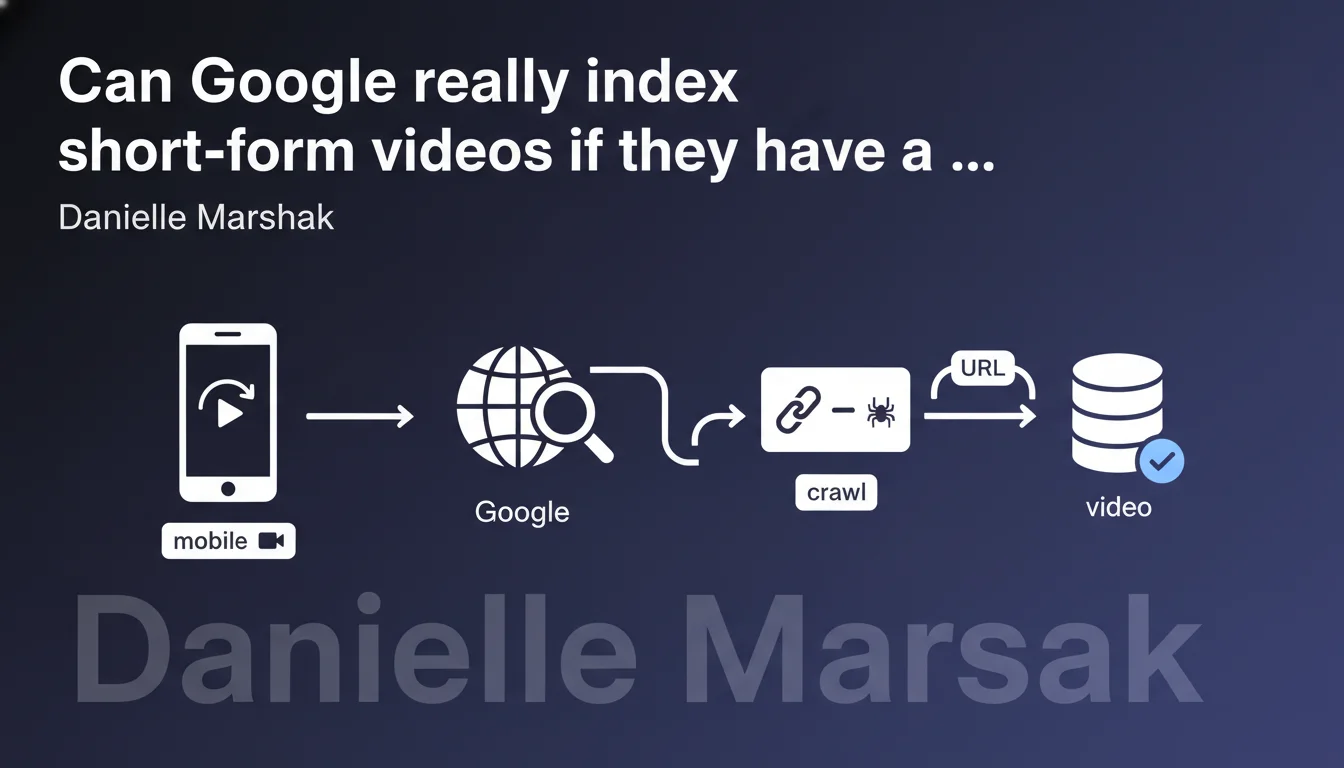
Google confirms that short-form videos can be indexed if they have a URL accessible to crawl, even when they are primarily distributed through mobile applications. This statement opens the door to organic visibility for short-form content, provided that technical accessibility prerequisites are met. It remains to be verified what Google actually means by "indexed" and what real visibility these contents actually achieve in SERPs.
What you need to understand
Why is Google now clarifying that short-form videos can be indexed?
The context is straightforward: TikTok, Instagram Reels, YouTube Shorts have exploded. These formats dominate mobile video consumption, but their indexability remained unclear.
Traditionally, these videos live in closed application feeds, without stable URLs or classic HTML structure. Google is clarifying its position here: if you expose these contents via a crawlable URL, they can enter the index.
What does "crawlable URL" concretely mean for a short-form video?
A crawlable URL is an address accessible to Googlebot that returns identifiable content. Not a blocked application deep-link, not a redirect to an app store.
In practice: a web page with an embedded video player, structured metadata, and ideally schema.org VideoObject markup. The content must be servable to the bot, even if the bulk of traffic comes from the mobile app.
Does this statement fundamentally change video indexation rules?
No, it reinforces an existing principle: Google indexes what it can crawl and understand. Short-form videos do not deviate from this rule.
What changes is the official recognition that the short-form format is not an obstacle in itself. If your technical infrastructure allows it, these contents can join the index just like any long-form video.
- Short-form videos are not excluded from indexation by nature
- Sine qua non condition: a crawlable URL for Googlebot
- Mobile-first format does not prevent indexation if technical structure is adequate
- No guarantee of visibility in classic SERPs — indexation ≠ ranking
- Structured VideoObject markup remains recommended to maximize content understanding
SEO Expert opinion
Is this statement consistent with practices observed in the field?
Yes and no. We do observe that YouTube Shorts with dedicated URLs can appear in Google search results — not systematically, but it happens. Instagram Reels or TikTok, on the other hand, remain largely invisible in classic organic SERPs, even when they have public URLs.
The issue: Google says "can be indexed," not "will be visible." Indexation is one thing, actual ranking is another. [To be verified]: what types of queries actually trigger the display of short-form videos in organic results, outside of specific video carousels?
What nuances should be added to this statement?
Let's be honest: "can be indexed" is cautious wording. Google guarantees neither systematic crawling, nor priority in crawl budget allocation, nor visibility in results.
If your site hosts 10,000 short-form videos with distinct URLs, expect Googlebot to ignore a good portion of them — especially if your crawl budget is already tight. The statement remains vague about how these contents are prioritized compared to classic pages.
In what cases does this rule not apply effectively?
If your short-form videos are only distributed via native app without web equivalent, they have no chance of being indexed. Application deep-links are not crawlable URLs in Google's sense.
Another problematic case: videos embedded in heavy JavaScript players without HTML fallback or exploitable metadata. Googlebot can technically see them, but understanding remains unpredictable. Without schema.org VideoObject, you're playing roulette.
Practical impact and recommendations
What do you need to do concretely to index your short-form videos?
First, create a dedicated web page per video with a clean, canonical URL accessible without blocking JavaScript. The content must be servable to Googlebot in standard headless mode.
Then, implement schema.org VideoObject markup with all relevant fields: name, description, thumbnailUrl, uploadDate, duration, contentUrl. Google needs this metadata to understand and categorize the content.
Finally, submit a dedicated XML video sitemap to explicitly signal these URLs to Google. Don't rely on organic discovery alone, especially if your video pages have few internal links.
What mistakes should you absolutely avoid?
Don't create crawlable URLs if the video content is not actually accessible on that page — Google hates closed doors. A URL that redirects to the app store or requires mandatory login will not be indexed correctly.
Also avoid massively duplicating the same video content across multiple URLs without clear canonicalization strategy. You risk cannibalizing your own crawl budget and diluting relevance signals.
How do you verify that your short-form videos are actually indexed?
Use Search Console: check the indexation status of your video URLs in the coverage report. Also look at the "Enhancements" > "Videos" report to identify structured markup errors.
Test the URL with the URL Inspection tool to see how Googlebot renders the page and if video content is detected. If rendering is empty or partial, you have a technical issue to resolve.
- Create a crawlable URL dedicated to each short-form video
- Implement schema.org VideoObject with complete metadata
- Submit an XML video sitemap via Search Console
- Verify that the video player works without blocking JavaScript for Googlebot
- Monitor actual indexation in Search Console (coverage report)
- Evaluate ROI: don't create thousands of URLs if crawl budget is limited
- Properly canonicalize to avoid duplication
❓ Frequently Asked Questions
Une vidéo courte hébergée uniquement sur TikTok peut-elle être indexée par Google ?
Le format vertical des vidéos courtes pose-t-il un problème pour l'indexation ?
Faut-il créer une page distincte pour chaque vidéo courte ou peut-on les regrouper ?
Les vidéos courtes indexées bénéficient-elles d'un affichage spécifique dans les SERP ?
Le schema.org VideoObject est-il obligatoire pour indexer une vidéo courte ?
🎥 From the same video 11
Other SEO insights extracted from this same Google Search Central video · published on 10/03/2022
🎥 Watch the full video on YouTube →
💬 Comments (0)
Be the first to comment.