
Official statement
Other statements from this video 4 ▾
- □ Should you stop using the site: operator to verify Google indexation?
- □ Is the URL Inspection Tool Really the Only Way to Verify Whether a Page Is Indexed?
- □ Does Google's Search Console live test really replace Google's cache for verifying your updates?
- □ Why does Google prioritize HTML rendering over screenshots for indexing?
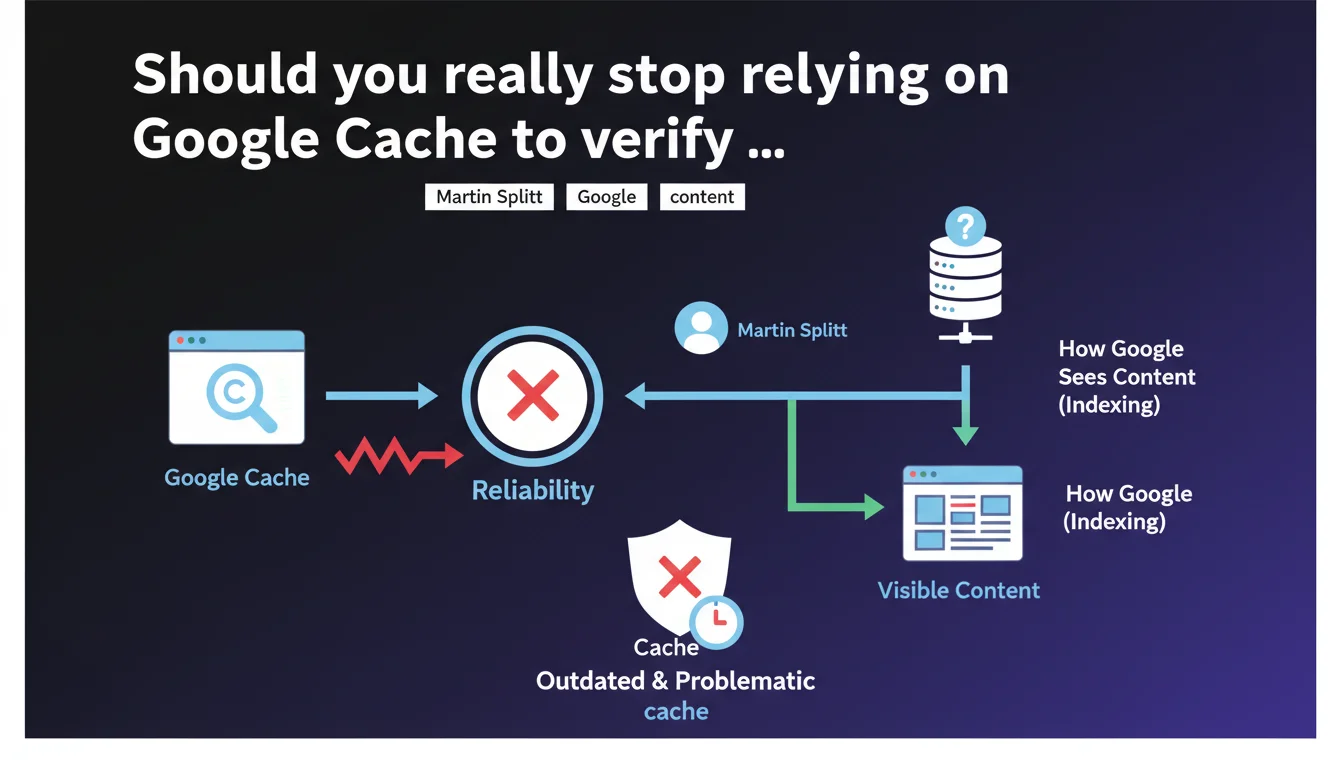
Martin Splitt claims that Google's cache function is unreliable for checking how the search engine sees your content. This method, deeply embedded in SEO practices for years, creates problems and doesn't necessarily reflect the reality of crawling and indexing.
What you need to understand
Why is Google questioning the use of cache?
The Google cache function has long served as a reference point for SEOs trying to understand how Googlebot interprets a page. The logic: if the cache displays content correctly, then Google has crawled and indexed it properly.
Except this logic no longer holds up. Splitt specifies that this method creates problems without detailing which ones — typical of these Google statements that raise more questions than they answer. The cache may display an outdated version, a partial one, or simply different from what the indexing systems have actually processed.
What's the difference between cache and actual indexation?
The Google cache is a timestamped screenshot of your page. Indexation, on the other hand, goes through multiple layers: initial crawl, JavaScript rendering, semantic extraction, ranking. These processes don't perfectly synchronize with what's stored in cache.
Concretely? You can see your content in the cache but find that it doesn't appear in search results. Or the opposite: content missing from cache but perfectly indexed and ranked. The cache is merely a residual snapshot, not an indicator of SEO health.
What concrete problems does this approach generate?
First issue: diagnostic confusion. Clients panic because the cache doesn't display their latest update, while Google has already recrawled and reindexed. Wasted time, unnecessary stress.
Second point: certain elements critical for SEO — such as structured data after JavaScript rendering or dynamic modifications — may never appear correctly in the cache. You're then basing your decisions on truncated information.
- Cache doesn't always reflect the indexed version of your page
- Significant time gaps can exist between cache and current crawl
- JavaScript rendering may not be correctly represented in the cache
- Using cache as a diagnostic tool leads to incorrect conclusions
- Other tools (Search Console, URL inspection tests) are more reliable
SEO Expert opinion
Is this statement consistent with field observations?
Yes and no. In principle, Splitt is right: cache has never been an official diagnostic tool. But for years, in the absence of solid alternatives, it was the best we had. Search Console arrived later with tools like URL inspection that finally provide a more reliable view of actual rendering.
Where it gets tricky: Google still doesn't detail which specific problems the cache poses. Latency? Desynchronization with live indexes? Incomplete JS rendering? [To verify] — we'd like concrete data rather than vague warnings.
In which cases does cache remain relevant?
Let's be honest: cache retains limited utility for quickly comparing a page's evolution over time or for historical audits. If a client tells you "my competitor changed their page three months ago", the cache can give you a snapshot — not 100% reliable, but better than nothing.
However, for anything involving active indexation, ranking, or technical diagnosis, forget it. The Google Search Console tools — URL inspection, rich results test, coverage report — provide far more actionable data.
What nuances should be added to this recommendation?
Google loves simplifying its messages, but SEO reality is rarely binary. Cache is not completely useless, it's just inadequate for precise diagnostics. The mistake would be to abandon it entirely without understanding why.
Another nuance: this statement doesn't clarify whether the progressive disappearance of cache (already underway in certain interfaces) is linked to these problems. If Google plans to remove it permanently, it's best to anticipate and migrate your workflows now to more sustainable tools.
Practical impact and recommendations
What should you do concretely right now?
First step: stop recommending cache to your clients as a verification tool. Instead, train them on URL inspection in Search Console — it's the official tool, reliable, and directly connected to Google's indexation systems.
Next, audit your own processes. If your SEO workflows still include systematic cache verification, replace them with tools that actually crawl your site (Screaming Frog, DeepCrawl, etc.) or with the Search Console API to automate checks.
Which mistakes should you absolutely avoid?
Don't panic if the cache displays an old or incomplete version of your page. This indicates nothing definitive about your indexation. Instead, check with the URL inspection tool: that's what will tell you whether Google has properly crawled and indexed your latest version.
Also avoid confusing absence of cache with deindexation. Google may very well have indexed a page without caching it — or vice versa. Cache is a by-product, not an indicator of presence in the index.
How do you verify that your site is properly indexed?
Use the URL inspection tool in Search Console. It shows you the last crawled version, with HTML and JavaScript rendering, plus any detected issues (loading errors, blocked resources, etc.). This is THE reference diagnostic.
Supplement with third-party crawling to identify structural inconsistencies: orphaned pages, excessive depth, chained redirects. Cross-reference this data with Search Console coverage reports to spot known but non-indexed URLs.
- Train your teams and clients on using the Search Console URL inspection tool
- Remove any reference to cache from your SEO validation guides and processes
- Automate indexation checks via Search Console API if possible
- Use third-party crawlers (Screaming Frog, OnCrawl) for comprehensive technical audits
- Always cross-check multiple data sources before making critical decisions
- Never base a deindexation diagnosis on Google cache alone
❓ Frequently Asked Questions
Peut-on encore utiliser le cache Google pour quelque chose ?
Quel outil remplace fiablement le cache Google ?
Si le cache affiche une vieille version, mon contenu est-il désindexé ?
Le cache va-t-il disparaître définitivement ?
Comment automatiser la vérification d'indexation sans le cache ?
🎥 From the same video 4
Other SEO insights extracted from this same Google Search Central video · published on 18/10/2023
🎥 Watch the full video on YouTube →
💬 Comments (0)
Be the first to comment.