
Official statement
Other statements from this video 27 ▾
- 13:31 Can your slow pages drag down the rankings of your entire site?
- 13:33 Do Core Web Vitals really affect your entire site or just your slow pages?
- 13:33 Can you really block the collection of Core Web Vitals using robots.txt or noindex?
- 14:54 Why does CrUX collect your Core Web Vitals even if you block Googlebot?
- 15:50 Does Google really underplay the true importance of Page Experience in rankings?
- 16:36 Is Page Experience really just a secondary ranking signal?
- 17:28 Does LCP truly measure the speed perceived by the user?
- 19:57 Do Core Web Vitals really measure continuously throughout the user session?
- 20:04 Do Core Web Vitals really change after the initial page load?
- 21:22 How does Google estimate your Core Web Vitals when CrUX data is lacking?
- 22:22 How does Google estimate a page's Core Web Vitals without sufficient CrUX data?
- 27:07 How does Google now assign AMP cache's CrUX data to the origin?
- 29:47 Is AMP still necessary to rank in Top Stories on mobile?
- 32:31 How can you leverage server logs to uncover 4xx errors in Search Console?
- 34:34 Why do new sites experience extreme volatility in indexing and ranking?
- 34:34 Should you really analyze server logs to diagnose 4xx errors in Search Console?
- 34:34 Why does your new site fluctuate like a yo-yo in the SERPs?
- 40:03 Should you really report copied content from your site using Google's spam form?
- 40:20 How can you effectively report copied content spam to Google?
- 43:43 Are your franchise pages considered doorway pages by Google?
- 45:46 Is duplicate content really harmless to your SEO?
- 45:46 Is it true that duplicate content won't penalize your SEO?
- 51:52 Does the http:// or https:// namespace in an XML sitemap really affect crawlability?
- 52:00 Does using HTTPS for your XML sitemap namespace hurt your SEO ranking?
- 55:56 Is it really sufficient to include only one version, mobile or desktop, in your XML sitemap?
- 56:00 Should you really submit both mobile AND desktop versions in your sitemap?
- 61:54 Should you give up on AMP if you’re using GA4 to measure your performance?
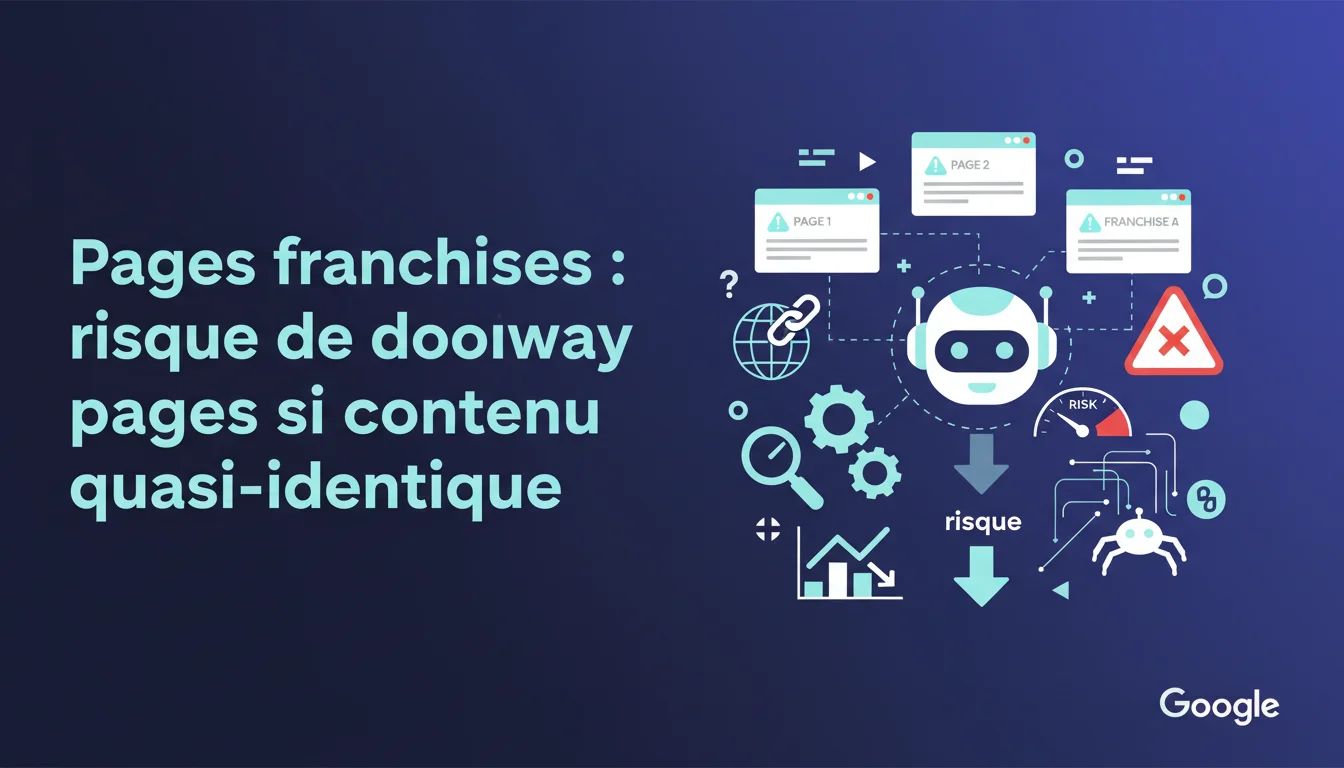
Google warns: franchise pages with nearly identical content (only the city name changes) may be treated as doorway pages. The solution? Add unique content for each page: local customer reviews, detailed store presentation, location-based blog. Otherwise, beware of the algorithmic filter that could devalue the entire network.
What you need to understand
What is a doorway page according to Google?
A doorway page (satellite page) is a page created primarily to rank for specific queries and redirect users to another destination. Google has considered them to be manipulative spam for years.
In the context of franchise networks, the problem arises when the template is mechanically duplicated for each city: same text, same offer; only the title tag and city name change. To the algorithm, it looks like an artificial multiplication of entry points without real added value.
Why does Google penalize this type of content?
Google's objective remains simple: to prevent SERPs from being filled with nearly clone variations of the same page. If 50 franchises publish the same text with just “Paris,” “Lyon,” “Marseille” changing, the user experience deteriorates.
The anti-doorway filter seeks to detect these geolocated duplication patterns. The result: either the pages are downgraded individually, or — worse — the entire domain loses trust. This is where the problem lies for multi-site networks.
What signals differentiate a legitimate franchise page from a doorway?
Google relies on several criteria to distinguish an authentic local page from an empty shell. The first indicator: the presence of unique verifiable information (specific hours, local team, photos of the store).
The second signal: geolocated customer reviews and their native integration into the page. The third element: editorial content specific to the area (local news, events, regional partnerships). If none of these markers are present, the page becomes suspicious.
- Doorway pages: 90%+ duplicated content, only the city name changes, no real local anchor
- Legitimate franchise pages: unique content by location (reviews, team, photos, hours, local blog)
- Algorithmic risk: individual page downgrades OR domain-wide penalty
- Vigilance threshold: once you exceed 10-15 franchise pages with identical templates, the risk activates
- Recommended solution: at least 30-40% unique content per local page to get out of the danger zone
SEO Expert opinion
Is this statement consistent with field observations?
Absolutely. Franchise networks that have massively duplicated their local pages have experienced significant traffic drops in recent years. Documented cases show losses of 40-60% organic visibility on geolocated queries.
The key nuance: Google does not automatically penalize all duplication. The problem arises when the duplicated content/unique content ratio exceeds a critical threshold — which no one knows precisely, but is estimated to be around 70-80% similarity. Below this threshold, with genuine localization effort, pages pass.
What mistakes should be avoided in interpreting this advice?
First mistake: believing that adding three unique sentences per page is enough. Google measures the proportion of differentiating content, not just its symbolic presence. If 95% of the page remains identical, the three sentences won't save anything.
Second trap: bombarding with geolocated keywords artificially (“our franchise in Lyon, best service in Lyon, experts Lyon”). This does not create unique value, just stuffing. What Google seeks is a real adaptation to the local context — not a mechanical variation of keywords.
[To be verified]: Google remains vague about the exact threshold of tolerated similarity. Field tests suggest aiming for 30-40% of genuinely distinct content, but no official confirmation exists. The risk also varies according to industry competitiveness and domain authority.
In what cases does this rule apply differently?
Established brands with strong domain authority benefit from slightly greater tolerance — but this is not a free pass. They can allow for higher similarity without immediate triggering, but the risk remains.
Another special case: franchises with truly standardized offers (fast food, banking services). Even there, Google expects minimal localization: team presentation, news from the point of sale, integration of customer reviews. The standardized business model does not excuse the total lack of adaptation.
Practical impact and recommendations
What concrete steps should you take to secure your franchise pages?
First action: audit the similarity rate between your local pages. Tools like Copyscape, Siteliner, or custom scripts allow you to measure the percentage of duplicated content. Aim for less than 70% similarity between two franchise pages.
Second lever: implement a geolocated customer review system directly on each page (not just a Google Reviews widget, but a real integrated section with Schema LocalBusiness markup). Reviews constitute unique natural content that Google highly values.
What unique sections to integrate per franchise page?
At minimum: a section “Our Team [City]” with photos and mini bios. Then, a block “Local News” (3-4 posts per quarter are enough: events, partnerships, community actions). Then, an authentic photo gallery of the point of sale — no stock images.
More ambitious but very effective: a mini local blog with 2-3 articles per month on geolocated topics (“How to choose X in [City],” “The specifics of Y in the [Z] region”). This creates a continuous flow of unique content and strengthens territorial anchoring.
How to check that you are out of the risk zone?
First indicator: do your franchise pages rank for their specific local queries (“franchise X + city”) or only the brand name? If they only appear for the brand, that's a bad sign.
Second test: analyze impressions and average positions in Search Console per page. Franchise pages with low impressions and positions >30 on their target keywords signal a perceived quality problem. Third check: monitor fluctuations during algorithm updates — sites in the gray area experience violent yo-yos.
These optimizations may seem straightforward on paper, but implementing them across a network of several dozen points of sale requires complex editorial coordination and a solid technical architecture. Many networks underestimate the time needed to produce authentic local content and maintain its quality over time. If your internal resources are limited or if you find that your pages are stagnating despite your efforts, assistance from an SEO agency specialized in multi-site issues can significantly accelerate leaving the risk zone and structuring a sustainable local content strategy.
- Audit the similarity rate between pages (goal:
❓ Frequently Asked Questions
À partir de combien de pages franchises le risque doorway devient-il critique ?
Est-ce que changer juste la balise title et H1 avec le nom de ville suffit ?
Les avis Google My Business intégrés via widget comptent-ils comme contenu unique ?
Peut-on utiliser du contenu auto-généré pour créer des variations locales ?
Quel pourcentage de contenu unique faut-il viser par page franchise ?
🎥 From the same video 27
Other SEO insights extracted from this same Google Search Central video · duration 1h07 · published on 28/01/2021
🎥 Watch the full video on YouTube →
💬 Comments (0)
Be the first to comment.