
Official statement
What you need to understand
Why doesn't Google consider a video and its transcript as duplicate content?
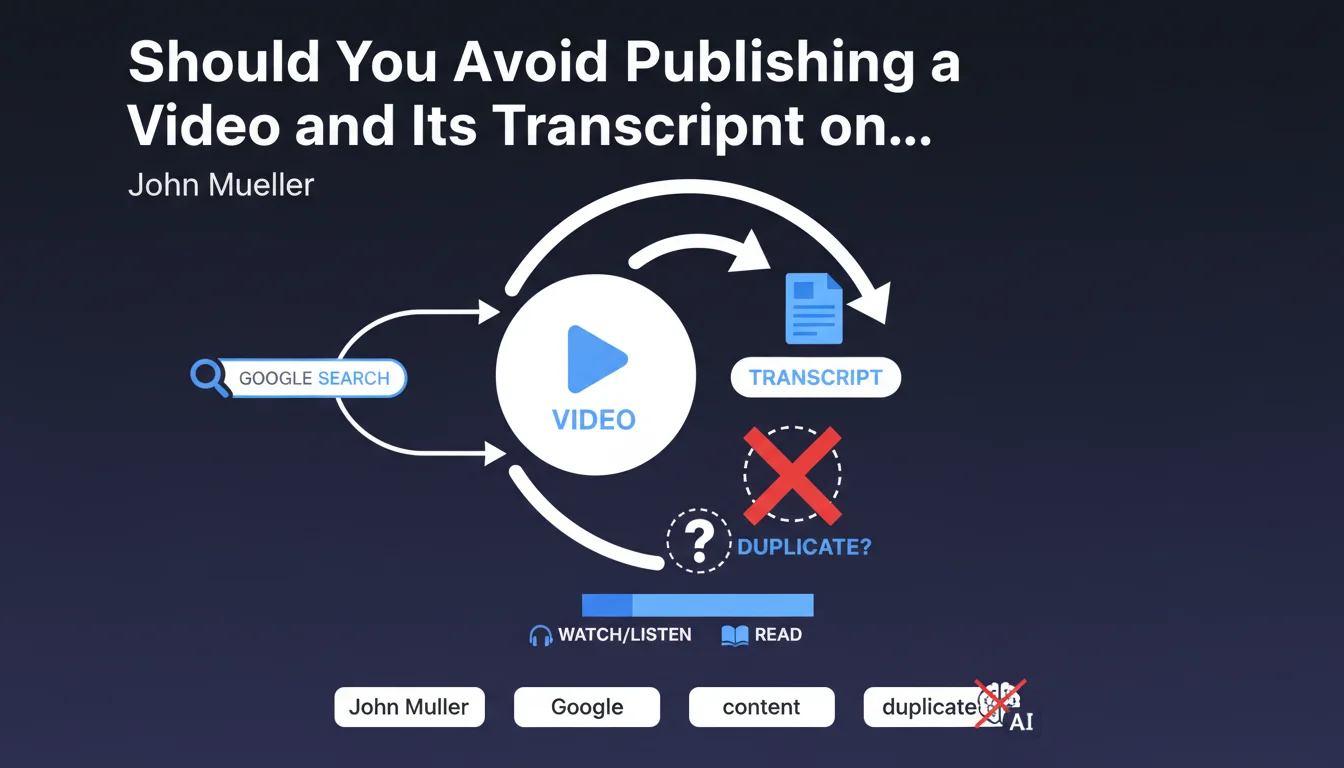
Google does not perform textual analysis of videos to compare them with the written content of web pages. The search engine treats these two formats as distinct and complementary entities.
This distinction is explained by the different search intents of users. Some internet users prefer to read an article, while others are looking to watch or listen to content. Google seeks to satisfy both types of needs.
What does this mean concretely for my content?
You can publish a video and its transcription simultaneously without fearing a penalty for duplicate content. These formats coexist harmoniously in Google's algorithm.
This opens up the possibility of maximizing the distribution of your content across different channels without compromising your natural search rankings. You thus reach multiple audience segments with the same message.
What are the advantages of this multi-format approach?
- Expanded accessibility: you respond to the varied consumption preferences of your audience
- SEO optimization: text allows keyword indexing, video improves engagement
- Rich user experience: some visitors prefer to read quickly, others to watch in detail
- Increased visit time: the presence of multiple formats can extend the user session
- No risk of cannibalization: both formats don't compete with each other in search results
SEO Expert opinion
Is this statement consistent with practices observed in the field?
After 15 years of practice, I confirm that this position from Google corresponds to field observations. Sites offering videos and transcriptions indeed suffer no penalty for duplication.
I've even noticed that this multi-format strategy often generates better overall SEO results. Text enriches semantic understanding by Google, while video improves engagement metrics such as time spent on page.
What important nuances should be added to this rule?
Be careful though: this tolerance concerns only the video/text relationship. If you republish the same text on several different pages, this does constitute classic duplicate content.
Similarly, publishing the same video on multiple pages of your site without text content variation can dilute your authority. Each page must retain a unique value proposition, even if the format varies.
In which cases is this approach particularly recommended?
This strategy excels for educational content, tutorials, and training. Users appreciate being able to alternate between quick reading and in-depth viewing depending on their context.
It also works very well for interviews, testimonials, and case studies. The transcript improves indexing while the video reinforces the credibility and authenticity of the message.
Practical impact and recommendations
What needs to be implemented concretely on your site?
Start by identifying your existing video content that would deserve a complete transcription. Prioritize high-value videos with good positioning potential on strategic keywords.
Integrate transcriptions in a structured and optimized manner. Don't just settle for a raw text dump: add titles, paragraphs, bullet lists to improve readability and user experience.
Think about Schema.org markup with VideoObject types and the transcript field to explicitly signal the relationship between video and text to Google. This strengthens the semantic understanding of your content.
What common mistakes should you absolutely avoid?
- Don't hide the transcript behind an accordion or tab closed by default: the text must be directly accessible
- Avoid unreviewed automatic transcriptions: errors harm credibility and indexing
- Don't republish exactly the same text on multiple pages, even accompanied by different videos
- Don't forget to optimize the video metadata (title, description) in addition to the text
- Don't neglect internal linking: link your video/text content to other relevant resources
How can you verify that this strategy is working for your site?
Monitor the evolution of your positions on targeted keywords after deploying transcriptions. Use Google Search Console to identify new queries that generate impressions.
Analyze engagement metrics: time spent on page, bounce rate, scroll depth. The joint presence of video/text should significantly improve these indicators.
Examine rich results in the SERPs: does your content appear with a video thumbnail? Does the transcript allow Google to better understand the topic for featured snippets?
💬 Comments (0)
Be the first to comment.