
Official statement
What you need to understand
What is Google's official position on press relations and link building?
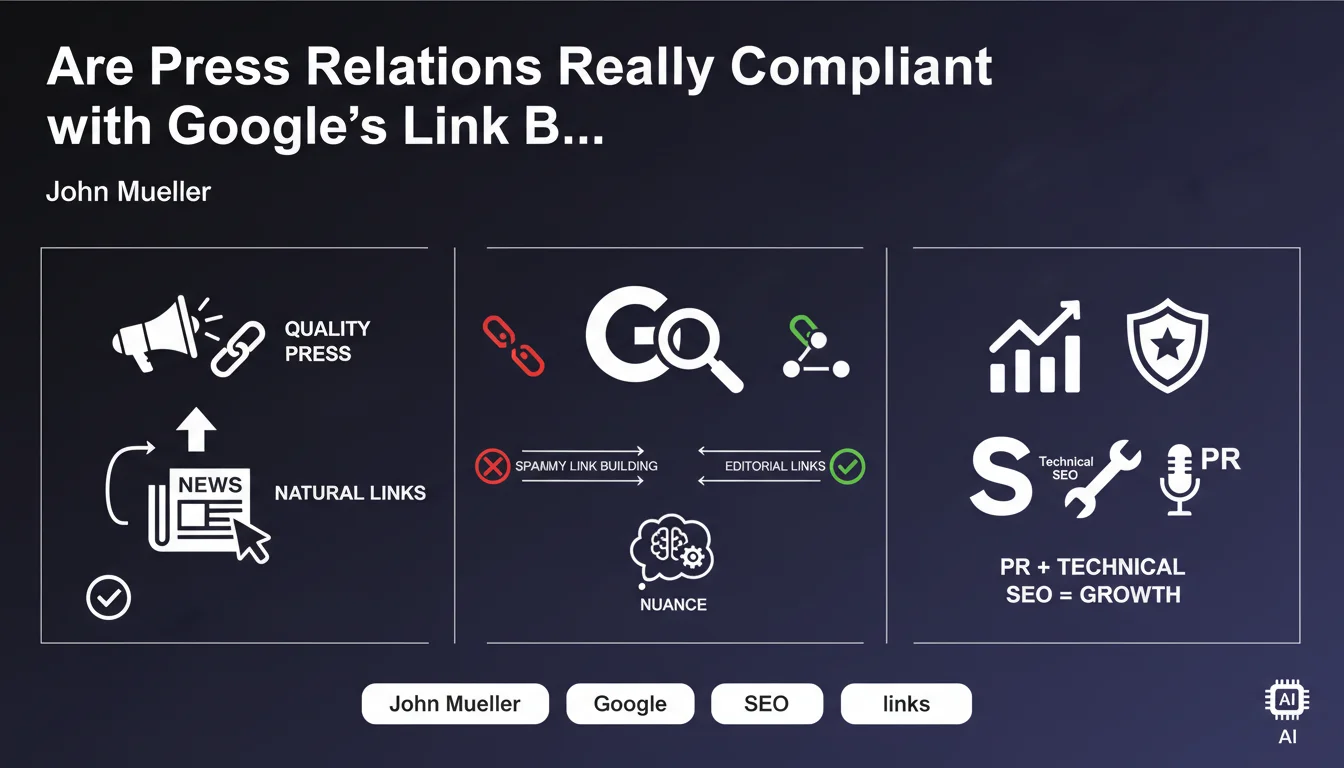
John Mueller, Google's spokesperson, has clarified a widespread confusion in the SEO community: conducting quality press relations to obtain links is not contrary to Google's guidelines. On the contrary, he considers this practice essential, sometimes even more important than technical SEO.
The problem arises when legitimate press relations are mixed with link spam practices. This confusion has created a misconception that all link building would automatically be penalizable.
Why does confusion exist around link building?
The oversimplification of the message "link building = guideline violation" has created an anxiety-inducing grey area for SEO practitioners. Many now hesitate to conduct legitimate campaigns for fear of penalties.
Mueller emphasizes that an important nuance must be brought: it's not the acquisition of links itself that poses a problem, but the way these links are acquired. Authentic press relations create real value and natural mentions.
What differentiates legitimate press relations from link spam?
Quality press relations involve creating newsworthy content, sharing relevant information with journalists, and generating natural mentions based on the value provided.
Conversely, practices to avoid include buying links in articles with no editorial value, publishing press releases stuffed with optimized links, or using automated distribution platforms solely to generate backlinks.
- Legitimate PR aims for visibility and brand awareness, links are a natural consequence
- Link spam seeks only to manipulate rankings via artificial backlinks
- Quality and editorial relevance are the key differentiation criteria
- Google values links earned naturally through content merit
SEO Expert opinion
Is this statement consistent with practices observed in the field?
Absolutely. In my 15 years of experience, I've observed that sites with a structured and authentic PR strategy achieve lasting results without risk of penalty. Google's algorithms are now sophisticated enough to distinguish natural editorial links from artificial patterns.
Penalized sites are systematically those that have conducted aggressive campaigns with over-optimized anchors, links from thematically unrelated sites, or massive link purchases. Authentic PR never corresponds to these suspicious patterns.
What nuances should be added to Google's position?
The boundary can sometimes seem blurry. For example, sending a free product to a journalist for review is not "black hat," as long as the journalist remains free to form their own opinion. This is a standard PR practice.
However, directly paying for an article with dofollow links without a "sponsored" mention clearly crosses the red line. The determining criterion remains editorial independence: the link must result from a free editorial decision, not a disguised commercial transaction.
In what contexts does this approach not work?
Press relations are not suitable for all sectors. For highly technical niches or ultra-specialized B2B markets, media interest may be limited. In these cases, other visibility strategies are more relevant.
Additionally, PR requires considerable time and resources. An SME without significant news or without an angle of interest for journalists will struggle to obtain meaningful results without a solid content strategy upfront.
Practical impact and recommendations
How do you implement a compliant and effective press relations strategy?
Start by identifying relevant media angles: exclusive studies, market data, product innovations, expertise on current topics. Journalists seek value-added information, not disguised advertising.
Build authentic relationships with journalists in your sector. Follow their work, share their articles, offer yourself as an expert source without expecting immediate returns. Reciprocity is built over the long term.
Prioritize quality over quantity. An article in a reference media outlet in your sector is worth more than 50 mentions in general sites without authority. SEO impact naturally follows editorial relevance.
What mistakes should you absolutely avoid?
Never overload your press releases with optimized links on exact match anchors. A single link to your site is sufficient, and it should point to a contextual information page, not a commercial product page.
Avoid automated distribution platforms that publish your content on hundreds of sites with no editorial value. Google identifies these duplication patterns and can devalue all these links at once.
Never lie about your data or results to obtain media coverage. Editorial integrity is fundamental, and a revelation of manipulation can destroy your reputation and generate negative SEO via critical articles.
- Create an editorial calendar with potential PR angles aligned with your sector's news
- Build a database of qualified media contacts segmented by theme
- Develop quality PR assets: studies, infographics, exclusive data
- Train a spokesperson capable of intervening as an expert with media outlets
- Track and measure PR results beyond simple backlinks (referral traffic, brand awareness, conversions)
- Document your process to prove the natural and editorial character of obtained links
- Avoid any direct transactional relationship: no payment for links without appropriate disclosure
- Diversify your link sources: media, expert blogs, sector partners
Press relations represent a major opportunity for compliant and high-performing link building, but their implementation requires specific expertise and considerable time investment.
The boundary between legitimate practices and manipulation can sometimes be subtle, requiring a fine understanding of Google's guidelines and media practices. These complex strategies, combining editorial, relational, and SEO skills, can prove difficult to orchestrate internally without dedicated resources.
For companies wishing to develop a structured PR-SEO strategy without risk, guidance from a specialized SEO agency can provide the methodology, media contacts, and expertise necessary to maximize results while ensuring full compliance with Google's requirements.
💬 Comments (0)
Be the first to comment.