
Official statement
What you need to understand
What is Google Discover and how does it work?
Google Discover is a personalized content feed available on the Google app and mobile homepage. It displays recommended articles and pages to users based on their interests and browsing history.
Unlike traditional search, Discover requires no query from the user. The system automatically pushes content deemed relevant, thus generating qualified traffic for selected websites.
Why do Core Updates also affect Discover?
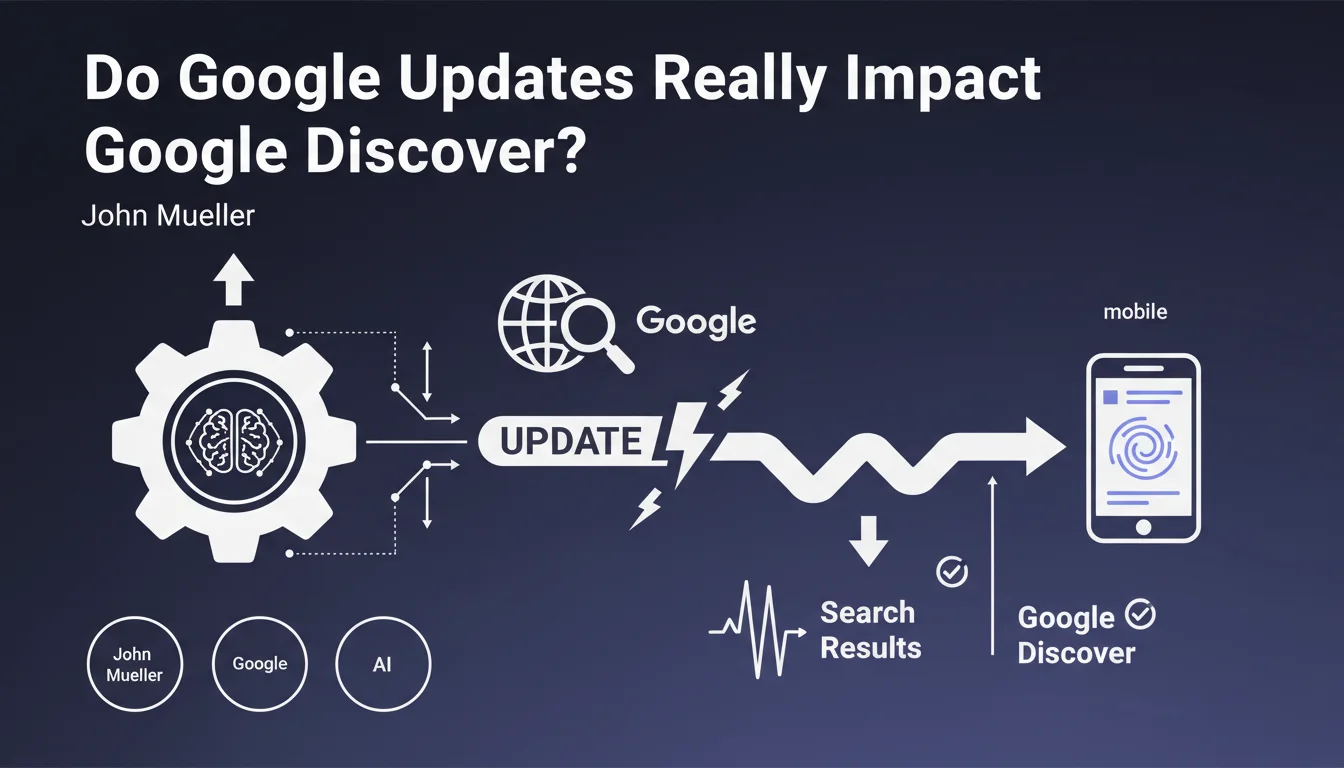
Discover relies on the same algorithm as traditional Google search. When an algorithm update is deployed, it modifies the evaluation criteria for content quality and relevance.
These algorithmic modifications therefore naturally affect all Google products using this search engine, including Discover. A page losing visibility in traditional SERPs is also likely to see its Discover traffic decrease.
What signals are common between Search and Discover?
Both systems evaluate similar criteria: content quality, E-E-A-T expertise, information freshness, and user engagement.
- Quality and expertise: content must demonstrate real added value
- Thematic relevance: consistency with the target audience's interests
- Engagement signals: click-through rate, reading time, interactions
- Content freshness: regular updates and current information
- Technical performance: loading speed, Core Web Vitals, mobile-first
SEO Expert opinion
Is this statement consistent with field observations?
John Mueller's assertion perfectly matches the empirical observations of SEO professionals. During major Core Updates, Discover traffic fluctuations consistently follow the same trend as organic search variations.
Sites that benefit from a Core Update generally see a simultaneous increase in traffic across both channels. Conversely, penalized sites experience a joint decline. This correlation validates the unity of the core algorithm.
What nuances should be added to this statement?
While the algorithm is common, the selection criteria differ slightly. Discover favors more visual-rich, recent content aligned with users' personalized interests.
A site can therefore perform differently depending on the channel. Solid evergreen content will shine in traditional search, while a news article with quality images will excel in Discover. Publishing velocity and freshness matter more in Discover.
In what cases does this correlation not apply?
Some sites eligible for Discover may never appear there despite good performance in traditional search. Eligibility criteria include sufficient content volume, optimized mobile indexing, and compliance with Google News content policies.
Furthermore, updates specific to Discover can occur independently of Core Updates. Google regularly adjusts personalization and recommendation parameters without official communication.
Practical impact and recommendations
How can you monitor a Core Update's impact on Discover?
Start by enabling the Discover report in Google Search Console. This separate report displays impressions, clicks, and CTR specific to this channel.
During a Core Update, compare traffic variations between traditional search and Discover over a 28-day period. Analyze which content is affected and identify common patterns.
- Enable and regularly consult the Discover report in Search Console
- Create separate Analytics segments for Discover vs organic search traffic
- Monitor traffic fluctuations over the 7-14 days following a Core Update
- Identify the most impacted content (positively or negatively)
- Verify the correlation between Discover and traditional search variations
What optimizations should you prioritize to maximize your presence?
Focus on quality content meeting E-E-A-T criteria. Regularly publish in-depth articles on trending topics within your niche.
Optimize the visual dimension: use high-resolution images (minimum 1200px wide), original visuals, and properly set the max-image-preview tag. Ensure mobile performance and Core Web Vitals are optimized.
- Publish expert and in-depth content on trending topics
- Include high-quality images (1200px minimum) with appropriate attributes
- Add the meta tag max-image-preview:large in the header
- Optimize Core Web Vitals, particularly LCP and CLS
- Structure content with catchy and informative titles
- Maintain a regular publishing rhythm
What should you do concretely after a Core Update?
If you notice a simultaneous traffic drop across both channels, conduct a quality audit of your content. Identify underperforming pages and improve them according to E-E-A-T criteria.
In case of an increase, capitalize on this momentum by analyzing what works. Replicate winning patterns and intensify your production of similar content.
In summary: Core Updates simultaneously impact traditional search and Google Discover because they share the same core algorithm. Monitor both channels during each major update and adjust your strategy accordingly.
Joint optimization of these two channels requires deep technical expertise and constant monitoring of algorithmic evolutions. Since these cross-optimizations are particularly complex to orchestrate, especially for coordinating editorial quality, technical performance, and data analysis, support from a specialized SEO agency can prove valuable for deploying a coherent strategy and obtaining measurable results across your entire visibility ecosystem.
💬 Comments (0)
Be the first to comment.