
Official statement
Other statements from this video 5 ▾
- □ Does the Search Console Verification API Really Transform Property Management at Scale?
- □ How can you effectively debug Core Web Vitals using your browser's DevTools?
- □ Should you really start with Search Console before investing in complex SEO tools?
- □ Will Google's generative AI in Search Labs completely reshape your SEO strategy?
- □ Is Google really updating its search standards, or is it all just noise?
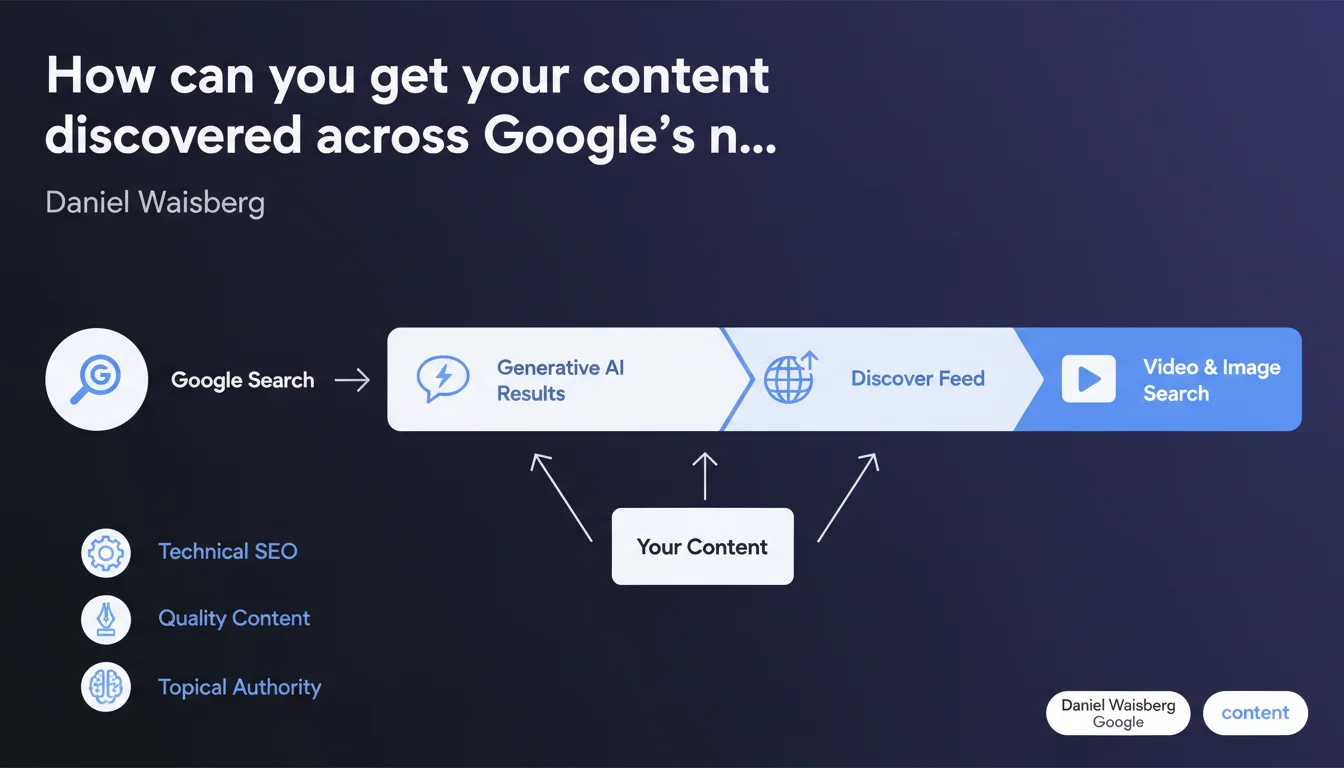
Google is expanding its ecosystem beyond classic SERPs with emerging search surfaces (Discover, Perspectives, AI Overviews). To appear there, content must meet SEO fundamentals while adapting to each surface's technical requirements. Optimization is no longer single-channel but multi-surface.
What you need to understand
What exactly are these new search surfaces?
Google is no longer limited to the classic search results page. Emerging search surfaces include Google Discover (personalized feed), Google Perspectives (real user reviews), AI Overviews (AI-generated answers), and other interfaces like Google Shopping or Google News.
Each surface has its own eligibility criteria and algorithms, even though they share common foundations with traditional organic search. In practice? An article might rank at position 3 for a standard query and never appear in Discover.
Why is Google pushing this diversification now?
User behavior is evolving: fewer keyword-based searches, more passive discovery and conversational interactions. Google is anticipating this shift by creating alternative entry points to content.
For publishers, it's an opportunity to capture qualified traffic outside saturated SERP territory. But it's also a fragmentation of visibility that complicates SEO management.
What are the technical prerequisites for eligibility?
Google emphasizes the fundamentals: indexable content, crawlable site, compliance with quality guidelines. No revolution then, but heightened attention to E-E-A-T signals and data structuring.
Emerging surfaces heavily exploit structured data (Schema.org) to understand context and content type. An article without proper markup has less chance of being selected for Perspectives or AI Overviews.
- Indexability: content must be crawlable and indexable (obvious but often neglected on new formats)
- Structured data: Schema.org markup required for certain surfaces (NewsArticle, Product, FAQPage)
- E-E-A-T signals: Google prioritizes expert and verifiable sources on high-visibility surfaces
- Mobile-first: all these surfaces are mobile-native, desktop experience is secondary
- Freshness and frequency: Discover favors recent content and sites that publish regularly
SEO Expert opinion
Does this announcement really bring anything new to the table?
Let's be honest: Google is reformulating already-known principles here. Indexability, structured data, E-E-A-T… nothing revolutionary. What's changing is the multiplication of surfaces and the lack of visibility into the specific eligibility criteria for each.
The problem? Google remains deliberately vague about the selection algorithms for Discover or Perspectives. We know these surfaces use behavioral signals (engagement rate, time spent), but it's impossible to measure their relative weight. [To verify] in the field with A/B tests.
Do field observations confirm these recommendations?
Partially. We do see that sites with rigorous Schema.org markup appear more frequently in rich snippets and AI Overviews. But be careful: correlation is not causation.
However, the claim that "following guidelines is enough" to appear on all surfaces is debatable. In practice, Discover heavily favors major media publishers with an engagement history. An expert blog can be technically flawless and never appear there.
What are the blind spots in this communication?
Google says nothing about display quotas by source type. Is there a limit to how many articles from the same domain can appear in Discover? Probably, but no official data.
Another blind spot: the impact of user signals. We know Google measures post-click engagement (time on page, return to SERPs), but their influence on emerging surfaces remains unclear. [To verify] with cohort analysis.
Practical impact and recommendations
What should you audit first on your content?
Start by verifying complete indexability of your strategic pages. Use the URL inspection tool in Search Console to detect blockers (robots.txt, noindex, misconfigured canonicals).
Next, audit your structured data markup. Google Structured Data Testing Tool (or Schema.org validator) should return zero critical errors. Prioritize content types aligned with your goals: NewsArticle for Discover, Product for Shopping, FAQPage for AI Overviews.
How do you optimize specifically for each surface?
For Google Discover: focus on high-resolution visuals (min 1200px wide), compelling headlines without clickbait, and regular publishing frequency. Enable Discover in Search Console to measure performance.
For Google Perspectives: highlight personal expertise, use authentic tone (first person), and structure content with concrete experience reports. Author markup and verified profiles are a plus.
For AI Overviews: structure content as question/answer, use lists and tables, and markup FAQs with Schema.org. Factual and synthetic content is prioritized.
What errors block access to these surfaces?
Classic mistake: neglecting mobile-first. Content perfect on desktop but unreadable on mobile gets eliminated outright. Systematically test your templates on smartphones.
Other trap: publishing content without semantic context. A technical article without clear introduction, definitions, or internal links to complementary resources will be ignored by selection algorithms.
- Verify indexability of all strategic pages via Search Console
- Implement and validate appropriate structured data (NewsArticle, Product, FAQPage, Author)
- Optimize visuals for Discover (high resolution, 16:9 or 4:3 ratio)
- Audit mobile experience (Core Web Vitals, readability, navigation)
- Strengthen E-E-A-T signals (author bios, cited sources, outlinks to authorities)
- Structure content in logical blocks (H2/H3, lists, tables) to facilitate AI extraction
- Enable Discover and Perspectives tracking in Search Console (if available)
- Test content across multiple devices and screen sizes before publishing
❓ Frequently Asked Questions
Mon contenu peut-il apparaître dans Google Discover sans être en position 1 dans les SERP classiques ?
Le structured data est-il vraiment obligatoire pour les AI Overviews ?
Comment savoir si mon site est éligible à Google Perspectives ?
Faut-il créer des contenus spécifiques pour chaque surface ou optimiser les existants ?
Les Core Web Vitals impactent-ils le ranking sur ces nouvelles surfaces ?
🎥 From the same video 5
Other SEO insights extracted from this same Google Search Central video · published on 29/12/2023
🎥 Watch the full video on YouTube →
💬 Comments (0)
Be the first to comment.