
Official statement
What you need to understand
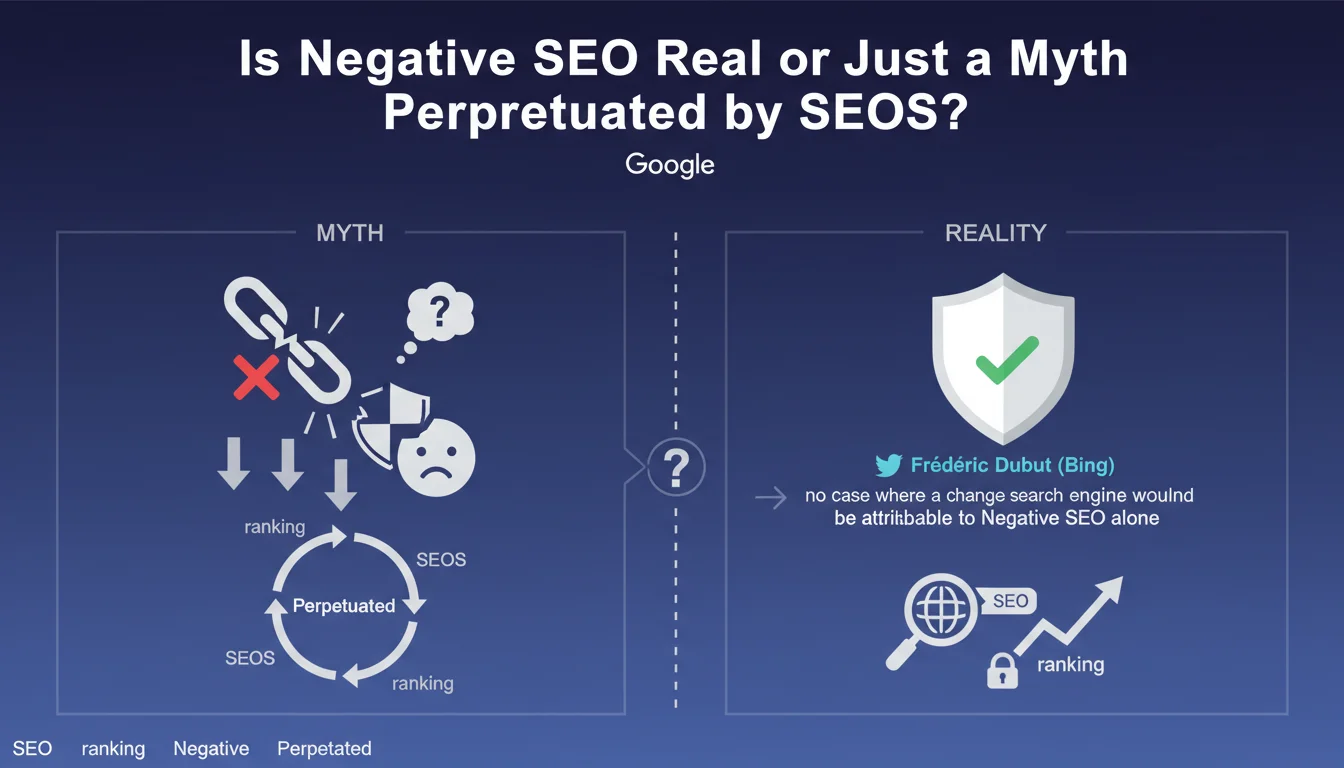
Frédéric Dubut, Head of Search Quality at Bing, recently stated that he has never observed any case where a ranking drop would be solely attributable to Negative SEO. This position aligns with that of Google spokespeople.
Negative SEO refers to all malicious techniques aimed at harming a competitor's site ranking: massive creation of toxic links, duplicate content, availability attacks, or hacking. According to search engines, their algorithms would be robust enough to neutralize these attempts.
Yet many SEO experts, particularly in the French black hat community, regularly claim at conferences that these techniques actually work. This discrepancy creates a grey area where practitioners and search engine publishers don't agree.
- Official position: Search engines claim to ignore or neutralize artificial negative signals
- Field experience: Some SEOs observe correlations between attacks and ranking drops
- Ambiguity: Difficult to prove that a drop is solely due to Negative SEO
- Protection: Google and Bing encourage the use of link disavowal tools
SEO Expert opinion
After 15 years of observation, I find that the truth lies between these two positions. Search engines have indeed developed sophisticated protections, but they're not 100% infallible.
The important nuance: it's extremely rare for a ranking drop to be exclusively caused by Negative SEO. In the majority of observed cases, the victim site already presented vulnerabilities (borderline link profile, thin content, weak user signals). The attack simply amplified latent problems.
My analysis: focus on strengthening your own SEO rather than fearing Negative SEO. A site with strong authority, a natural and diversified link profile, and excellent user signals will resist nearly all malicious attempts.
Practical impact and recommendations
- Monitor your link profile monthly via Search Console and third-party tools to detect abnormal spikes in toxic backlinks
- Build a solid authority foundation with quality natural editorial links that will dilute the potential impact of negative links
- Don't panic at the first spam link: a few questionable links won't affect a healthy site with a good overall profile
- Use disavowal sparingly: only in case of massive and documented attack (several hundred/thousands of toxic links in a short time)
- Technically secure your site: HTTPS, regular updates, protection against scraping and hacking which are Negative SEO vectors
- Document your KPIs: traffic, rankings, link profile, to quickly identify an anomaly and understand its origin
- Diversify your traffic sources to avoid 100% dependency on SEO and limit the impact of a potential attack
- Invest in quality: expert content, user experience, loading time, engagement signals that strengthen your immunity
💬 Comments (0)
Be the first to comment.