
Official statement
What you need to understand
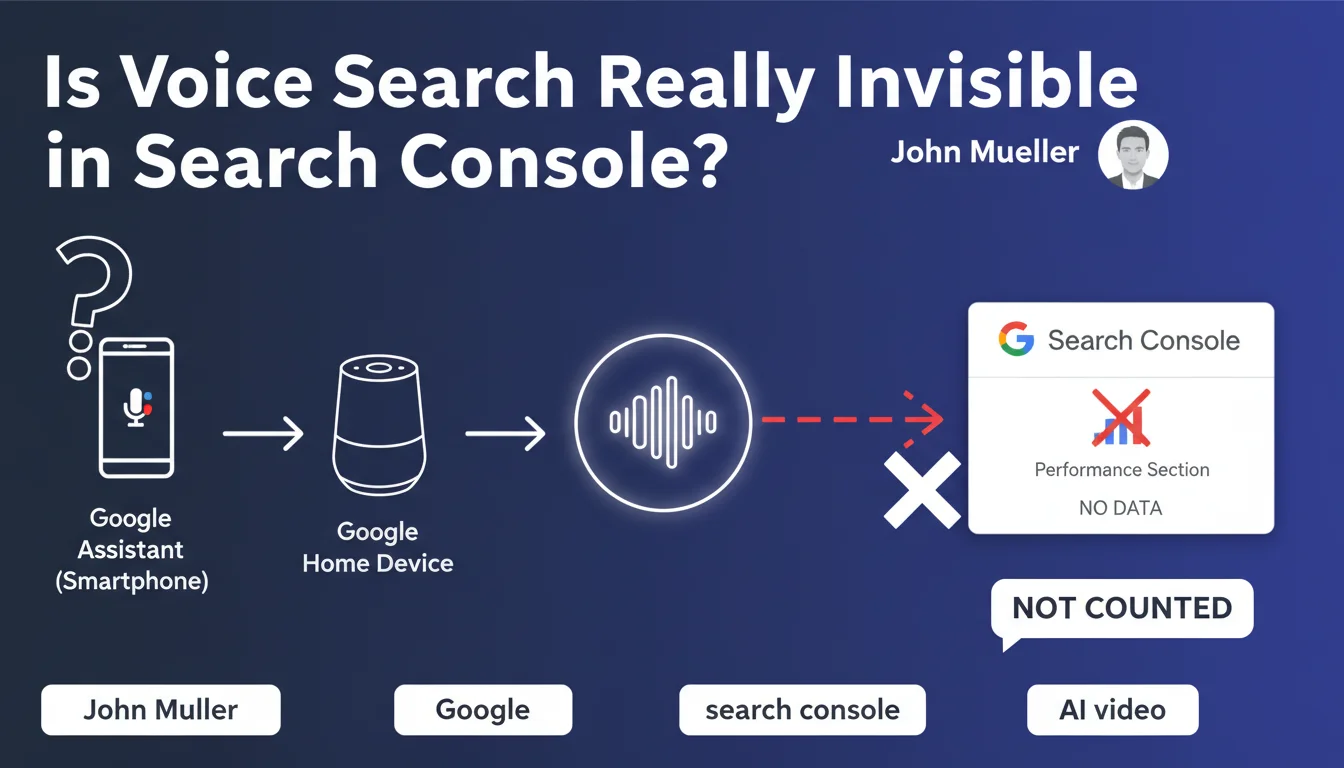
Google officially confirms that voice queries made via Google Assistant are not counted in Search Console performance reports. Whether on smartphone or via a Google Home device, these interactions remain invisible to website owners.
This statement reveals a major blind spot in our ability to measure the real impact of our content. While voice search represents a growing share of interactions with Google, we are blind to its influence on our visibility.
Concretely, this means you could be generating significant voice traffic without even knowing it. Your content optimized for conversational questions may be performing excellently, but you'll have no trace of it in your usual data.
- Google Assistant voice queries are excluded from Search Console statistics
- Impossible to measure voice SEO performance with standard tools
- Analytics gap between traffic reality and available data
- Voice optimizations difficult to validate due to lack of concrete data
SEO Expert opinion
This situation is particularly frustrating from an analytics perspective. We invest in optimization for conversational queries and featured snippets, without being able to verify the real impact of these efforts on voice search.
However, this needs to be nuanced: voice results often come from the same algorithms as traditional search. Good positioning in position 0 or in the top results remains an indirect indicator of voice performance. Observed correlations suggest that sites ranked well traditionally also capture voice traffic.
The likely evolution would be future integration into Search Console, but in the meantime, we must optimize "blindly" based on best practices and available indirect signals.
Practical impact and recommendations
- Don't rely solely on Search Console to assess your overall visibility on Google
- Optimize for featured snippets which often serve as voice answers, even without direct tracking
- Structure your content in Q&A format with FAQ Schema markup to maximize voice capture opportunities
- Favor natural and conversational phrases in your titles and content
- Monitor unexplained direct traffic spikes that could come from voice search
- Use Google Analytics 4 to attempt identifying behavioral patterns specific to voice traffic
- Test your content yourself via Google Assistant to validate its voice relevance
- Focus on local queries particularly solicited in voice (hours, directions, availability)
In summary: The absence of voice data in Search Console shouldn't slow down your optimizations. Adopt a proactive strategy based on conversational best practices and featured snippet positioning.
Voice search represents a complex ecosystem requiring a specific technical approach: advanced structured markup, semantic optimization, indirect behavioral analysis. Faced with this complexity and the absence of direct measurement tools, working with a specialized SEO agency can prove valuable to develop a coherent voice strategy, identify hidden opportunities, and implement customized tracking adapted to your business sector.
💬 Comments (0)
Be the first to comment.