
Official statement
Other statements from this video 4 ▾
- □ Should you really anticipate seasonal search peaks with an SEO editorial calendar?
- □ Should you analyze topics instead of individual keywords in Google Search Console?
- □ Should you really sacrifice SEO planning time to cover breaking news in real time?
- □ Are you leaving regional search trends on the table? Here's how to leverage geographic data for massive local content wins
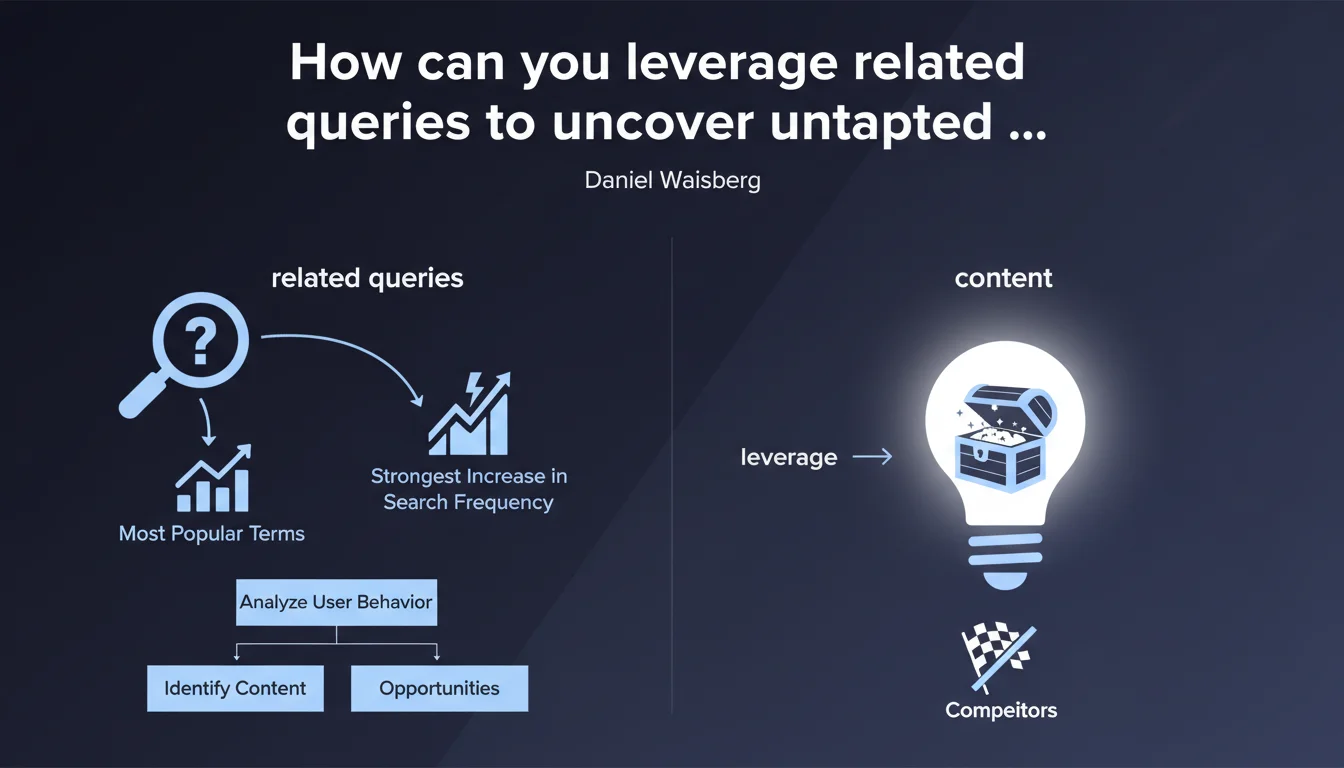
Google recommends analyzing related queries by combining two key dimensions: the most popular AND those experiencing the strongest growth. This dual approach lets you spot content opportunities your competitors haven't identified yet. The goal: anticipate trends while capitalizing on established search volumes.
What you need to understand
What exactly are related queries in Google Search Console?
Related queries refer to all search terms generating impressions for your site. They reveal how real users actually formulate their search intentions — often quite different from your initial assumptions.
Daniel Waisberg emphasizes a two-dimensional analysis: don't settle for the top 10 queries by volume. Also examine those whose frequency is skyrocketing, even if their absolute volume remains modest. That's where weak signals with real potential hide.
Why does Google distinguish between volume and growth?
A popular query reflects an established need — your current playground. A rapidly growing query signals a shift in interest or the emergence of a new problem. Focusing only on the first axis means driving by looking in the rearview mirror.
Growth can reveal semantic changes (new phrasings), technological evolution (new use cases), or contextual events. Anticipating these shifts positions you before competitive saturation sets in.
Concretely, how does this analysis feed into content strategy?
Analyzing related queries lets you detect three types of opportunities: unexploited editorial angles on your existing pages, thematic gaps you haven't covered yet, and priority reformulations requiring vocabulary adjustments on your content.
This approach transforms Search Console into a predictive rather than retrospective tool. You shift from reactive logic ("which pages underperform?") to proactive thinking ("which content should we create first?").
- High volume: content to optimize/expand to consolidate your established rankings
- Strong growth: emerging opportunities to tackle quickly before competitors catch on
- Intersection of both: absolute priorities combining immediate potential with momentum
- Regular analysis necessary: trends evolve, your content must follow
SEO Expert opinion
Is this recommendation truly applicable across all site types?
On low-traffic sites (fewer than 1,000 clicks/month), analyzing growth becomes statistically fragile. Going from 2 to 8 impressions represents +300% but often means nothing. Data volatility obscures the signal. [Verify] based on your actual volume.
Conversely, on large sites (e-commerce, media), the challenge lies in information noise. You might have 50,000 related queries — impossible to manually analyze all of them. You must then segment by category, page type, or search intent to make the exercise practical.
What nuances does Google deliberately omit?
Waisberg doesn't specify how to qualify growth: over which period? A seasonal spike? A lasting trend? Search Console shows 3/6/12-month comparisons, but correctly interpreting these changes requires contextualizing them — industry events, seasonality, internal cannibalization.
Another blind spot: traffic quality. A rapidly growing query can generate low-value visits (high bounce rate, no conversions). Google doesn't tell you to cross-reference these behavioral metrics with Search Console data. Yet it's essential for intelligent prioritization.
In which cases does this method show its limits?
Ultra-long-tail queries (unique searches) largely escape this analysis. Yet they represent a significant share of overall traffic. Focusing solely on identifiable queries creates a bias toward generic terms.
Next, this approach remains reactive by nature: you're analyzing what Google has already served. For true semantic breakthroughs or new topics, you often arrive after early adopters. Predictive keyword research tools (trends, forums, social networks) usefully complement this method.
Practical impact and recommendations
What should you concretely do to leverage this data?
Start by exporting your queries over the last 12 months from Search Console. Segment by page type if your site allows it (blog, product sheets, landing pages). Separately identify the top 50 by volume and the top 50 by growth — then look for overlaps.
For each priority query, check which page currently ranks. If it's the wrong page (cannibalization), optimize your internal linking. If no page truly covers the topic, create dedicated content. If a page exists but underperforms, enrich it by integrating the semantic variants you've detected.
What errors should you avoid in this analysis?
Don't focus solely on exact keywords. Group by search intent: "best CRM software," "CRM comparison," "which CRM should I choose" express the same intent despite different phrasings. Overly granular analysis causes you to miss cumulative volumes.
Another trap: treating growth without looking at absolute volume. A query jumping from 10 to 100 monthly impressions (+900%) remains marginal. Prioritize queries combining growth AND significant volume for your industry first.
How do you integrate this approach into a regular SEO workflow?
Schedule a monthly review of related queries. Create a dashboard automatically comparing periods (Google Sheets + Search Console API, or third-party tools like Looker Studio). Share insights with editorial teams to feed content calendars.
Document actions taken: which query motivated which content, what impact measured 3 months later. This traceability lets you progressively refine your prioritization method and demonstrate the ROI of this data-driven approach.
- Export queries over 12 months, segment by page type
- Identify top 50 by volume + top 50 by growth, find intersections
- Verify relevance of ranking pages (cannibalization?)
- Group by search intent, not exact keywords
- Cross-reference with behavioral metrics (bounce rate, conversion) to qualify value
- Validate real growth via Google Trends (vs algo artifact)
- Plan automated monthly review (dashboard + API)
- Track actions/results to refine prioritization over time
❓ Frequently Asked Questions
Quelle période d'analyse privilégier pour détecter une vraie croissance ?
Comment traiter les requêtes en croissance mais à faible volume absolu ?
Les requêtes associées incluent-elles celles où je n'apparais pas encore ?
Faut-il créer une page par requête en croissance ?
Cette méthode fonctionne-t-elle pour un site neuf sans historique ?
🎥 From the same video 4
Other SEO insights extracted from this same Google Search Central video · published on 23/10/2024
🎥 Watch the full video on YouTube →
💬 Comments (0)
Be the first to comment.