
Official statement
What you need to understand
When a website has multiple language versions, a technical question regularly arises: should image files be duplicated for each version or can resources be shared?
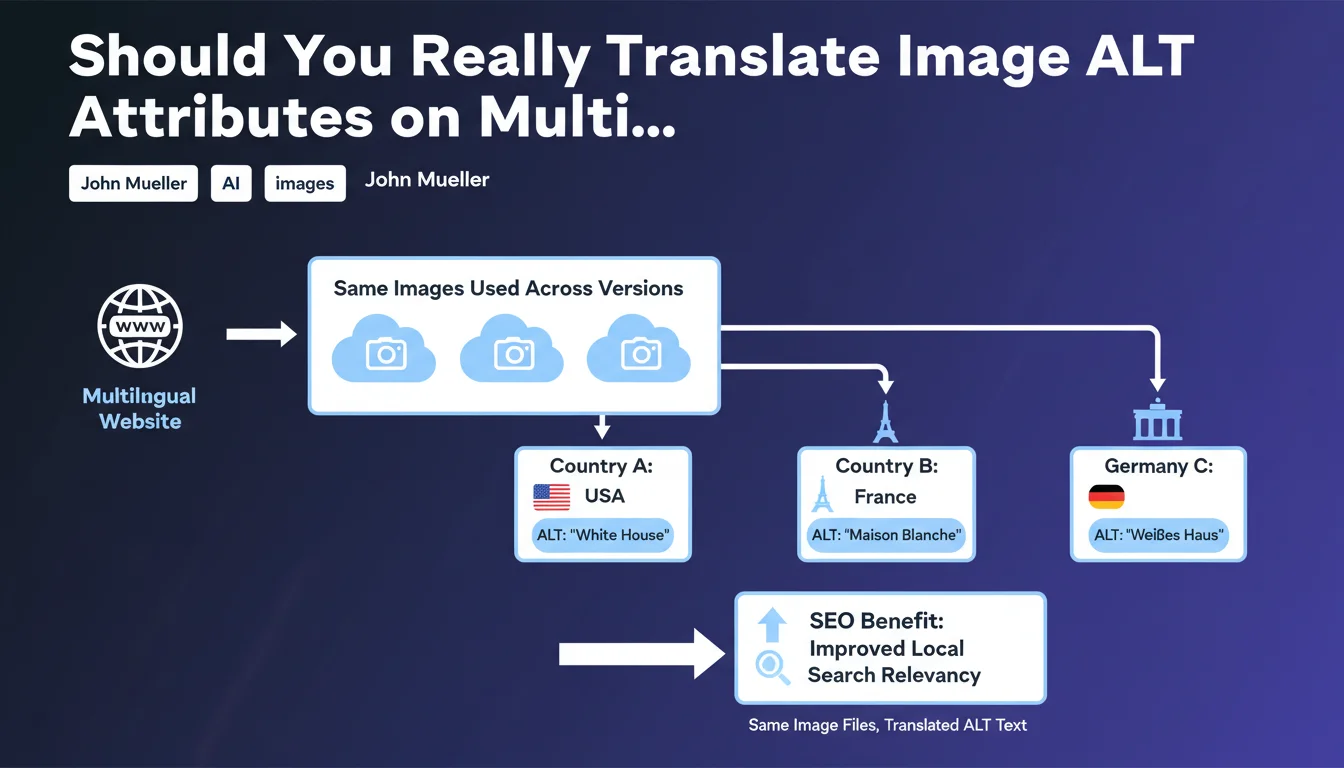
Google confirms that it is perfectly acceptable to use the same image files across all international versions of a site. The image URL can remain identical, which presents obvious technical advantages in terms of cache management and bandwidth.
The essential nuance lies in the ALT attribute: it must absolutely be translated into the language of each version of the site. It is this textual attribute that helps Google understand the context of the image in each language.
- The same image file can be used across all language versions
- The ALT attribute must be translated into each language of the site
- This approach optimizes performance while preserving SEO
- Alternative text remains an important contextual signal for search engines
SEO Expert opinion
This recommendation is perfectly consistent with what we observe in the field. Google treats images as shared resources, but interprets their context through the surrounding textual content, of which the ALT attribute is an integral part.
It is important to nuance this approach for certain specific cases. If an image contains embedded text (for example a graphic with captions), it then becomes necessary to create different versions for each language. Similarly, some images with strong cultural connotations may require adaptations depending on markets.
The other often overlooked advantage concerns Google Images: the same image with translated ALT attributes can rank in image searches from different countries, thus multiplying its international visibility.
Practical impact and recommendations
- Audit your multilingual sites to identify images that already share the same URLs
- Check the translation of ALT attributes across all your current language versions
- Create an editorial process that systematically integrates ALT translation when adding new images
- Identify images containing embedded text that require localized versions rather than just a translated ALT
- Document your image URLs in a centralized repository to facilitate their reuse
- Optimize your CDN to efficiently serve the same images across different international domains
- Avoid automatic translation of ALT attributes: prioritize contextual human translation
- Train your editorial teams on the importance of ALT in each language
Implementing a coherent international SEO strategy requires precise coordination between technical, editorial and linguistic aspects. These multilingual optimizations, although conceptually simple, require sharp technical expertise and rigorous editorial governance to be effectively deployed at scale. For organizations managing multiple international sites, working with a specialized SEO agency in multilingual search optimization allows you to structure these processes sustainably and avoid technical pitfalls that could compromise your international visibility.
💬 Comments (0)
Be the first to comment.