
Official statement
What you need to understand
What exactly is negative SEO and why is Google talking about it?
Negative SEO refers to all malicious practices aimed at harming a competitor's site rankings. The most widespread tactic consists of massively creating spammy links pointing to the target site to trigger an algorithmic or manual penalty.
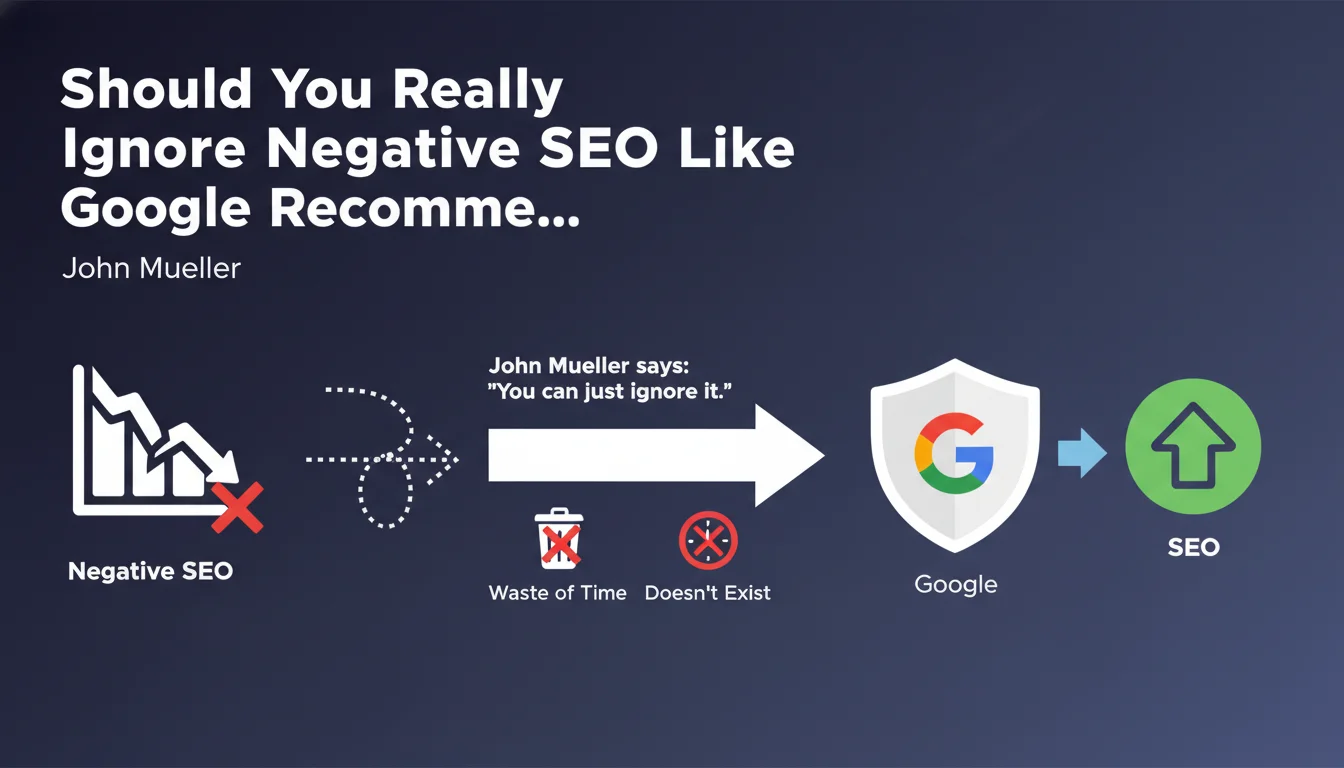
John Mueller reaffirms Google's official position: the search engine would now be capable of automatically ignoring these toxic links without impacting the targeted site's rankings. This statement aims to reassure webmasters who fear becoming victims of these attacks.
How does Google actually handle spammy links today?
According to Mueller, Google's algorithms have considerably evolved to detect and neutralize artificial link patterns. The search engine now applies a principle of devaluation rather than penalization: suspicious links are simply ignored in the PageRank calculation.
The spokesperson emphasizes that he observes very few real cases of negative SEO resulting in a penalty. However, for anxious webmasters, the link disavow tool remains available as a safety net.
Why do contradictions exist in Google's messaging?
The editorial comment raises a crucial point: the contradictions between Google spokespeople. John Mueller suggests using the disavow file preventively, while Vincent Courson states it's useless without a prior manual action.
These inconsistencies create confusion among SEO practitioners who no longer know which strategy to adopt. This situation also fuels debates between white hat and black hat SEO professionals.
- Google claims that its algorithms automatically neutralize negative SEO
- The disavow tool remains available for anxiety-inducing situations
- Very few real cases of negative SEO succeed according to Mueller
- Divergences exist between different Google spokespeople on the use of disavowal
- The principle applied is the devaluation of suspicious links rather than penalization
SEO Expert opinion
Does this statement align with what's actually observed in the field?
My 15 years of experience reveal a gap between official discourse and reality. While Google has indeed progressed in detecting artificial links, negative SEO remains possible in certain specific configurations.
I've witnessed cases where sites with a weak and recent link profile suffered measurable impacts after massive attacks. Established sites with a diversified and natural link profile resist much better. Negative SEO mainly works on vulnerable sites with little authority.
Black hat practitioners confirm that certain sophisticated techniques can still cause temporary damage, particularly by combining multiple simultaneous attack vectors. The truth probably lies somewhere between both positions.
What nuances need to be added to Google's messaging?
The major problem lies in the contradictions between spokespeople. This inconsistency suggests that Google's internal teams don't have the same understanding of the algorithms, or that the messages are deliberately vague.
My analysis: the disavow tool still has its usefulness in specific scenarios, particularly during a domain migration that inherited a bad history, or when facing a documented targeted attack. Waiting for a manual action to use it can be counterproductive.
In which cases can negative SEO still actually work?
Sites most vulnerable to negative SEO generally present these characteristics: new domain with little history, poor and undiversified link profile, highly competitive niche with few alternative quality signals.
The most sophisticated attacks combine multiple levers: massive toxic links, duplicated content, fake negative user signals, scraping-type attacks. A single-vector attack (only spammy links) has little chance of succeeding today against an established site.
The reality: Google probably handles 95% of basic negative SEO attempts well, but the remaining 5% concern sophisticated attacks that can still cause damage, especially short-term.
Practical impact and recommendations
What should you actually do when facing the risk of negative SEO?
The first step consists of regularly monitoring your link profile. Use Google Search Console, Ahrefs, Semrush or Majestic to detect abnormal spikes in new backlinks. A sudden influx of links from suspicious domains should trigger an alert.
Preventively build a solid and diversified link profile. A site with a natural and quality link base will naturally be more resilient when facing an attack attempt. This is your best long-term protection.
Regarding the disavow tool, adopt a pragmatic and measured approach. Use it only if you detect a clear and documented attack, or if you observe a traffic drop correlated with an influx of toxic links. Avoid disavowing out of paranoia.
What mistakes should you avoid when managing toxic links?
The most frequent error is excessive disavowal. Some webmasters panic and disavow hundreds of legitimate domains, which can harm their SEO. The disavow file must be used surgically, not as a nuclear broom.
Don't confuse low-quality link and toxic link. A link from a small blog without authority isn't harmful, it's simply neutral. Real toxic links come from obvious spammy site networks, link farms or pornographic/illegal sites unrelated to your topic.
Also avoid neglecting other attack vectors. Negative SEO isn't limited to backlinks: massive duplicate content, fake negative reviews, or site speed attacks can also impact your SEO.
How can you implement an effective protection strategy?
Establish a monthly monitoring process. Document your current link profile to have a baseline. Each month, compare newly detected links and identify anomalies. This systematic approach will allow you to react quickly in case of an attack.
Invest in proactive authority building. The more your site accumulates positive signals (quality content, user engagement, natural links, brand mentions), the less vulnerable it will be. It's a defensive strategy through offense.
- Set up automatic alerts in Search Console for new links
- Audit your link profile at least once a month with specialized tools
- Document your current link profile as a baseline reference
- Only disavow clearly toxic links in abnormal volume
- Continuously build quality links to strengthen your profile
- Also monitor duplicate content and other attack vectors
- Keep documentation of detected incidents and actions taken
- Assess the real impact before reacting: correlation with traffic drop?
💬 Comments (0)
Be the first to comment.