
Official statement
Other statements from this video 10 ▾
- □ Is Googlebot really rejecting HTML pages larger than 15 MB from being crawled?
- □ Is the title tag still truly a cornerstone of SEO despite modern CMS evolution?
- □ Is Google really replacing First Input Delay with Interaction to Next Paint in Core Web Vitals, and what does that mean for your SEO?
- □ Should you really stop obsessing over Core Web Vitals scores?
- □ Why does Google separate Googlebot and Google-Other in its crawling activities?
- □ Is Google-Extended really just a token and not an active crawler?
- □ Is Google really preparing a universal opt-out for AI training?
- □ Does Google really check 4 billion robots.txt files every single day?
- □ Are Google's AI principles really shaping how search results rank?
- □ How does Google really want to regulate AI usage in content creation?
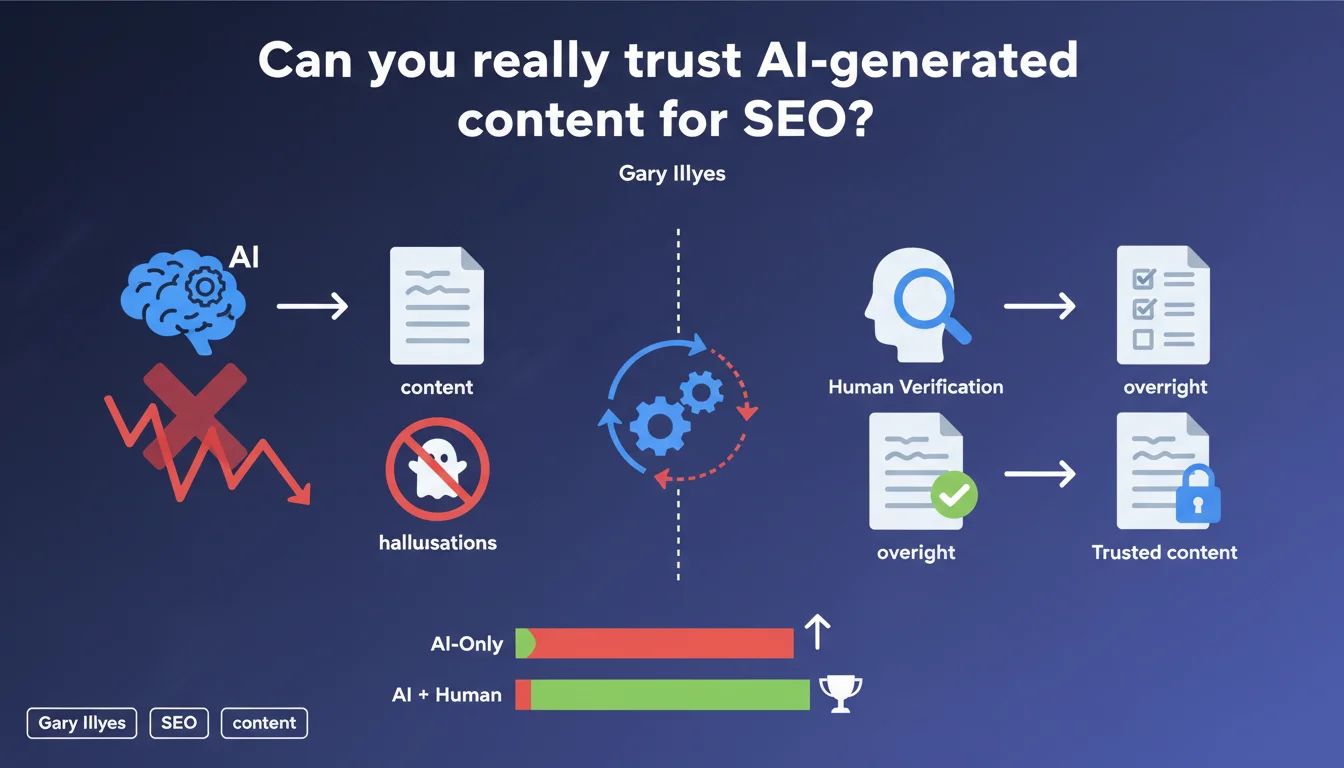
Google officially confirms that AI hallucinations cannot be eliminated with current technology. Even for simple tasks, human verification remains essential. Total automation of SEO content production is therefore a false promise — for now.
What you need to understand
What exactly is an AI hallucination?
A hallucination occurs when a language model generates false information while presenting it with confidence. The model invents data, quotations, links, or facts that don't exist. This isn't a one-off error: it's a built-in characteristic of current LLMs.
The problem? These errors are often formulated credibly, making them difficult to detect without thorough verification. A paragraph can seem perfectly coherent while containing three factually false statements.
Why is Google emphasizing this point now?
Because the massive adoption of generative AI to produce web content poses a direct risk to search result quality. If thousands of sites publish unverified content full of errors, the information ecosystem degrades.
Google has every incentive to remind everyone that its algorithm values reliability and genuine expertise — not raw productivity. It's also a message to publishers: AI can speed things up, but it doesn't replace human judgment.
Is this technical limitation temporary or structural?
Gary Illyes speaks of "current technology," which suggests progress is possible. But let's be honest: since GPT-3, each new generation of models has reduced hallucinations without ever eliminating them.
AI researchers consider this problem fundamental to transformer architecture. These models predict words; they don't "understand" anything — so they can't reliably distinguish true from false. Expecting a zero rate means waiting for a technical revolution that's not on the horizon.
- Hallucinations are a structural characteristic of LLMs, not a temporary bug.
- Each generation of models reduces the error rate but never eliminates it.
- Google explicitly reminds us that human supervision remains mandatory.
- Generative AI is an assistance tool, not a replacement for expertise.
SEO Expert opinion
Is this statement consistent with what we observe in practice?
Absolutely. SEO professionals who heavily automate content production encounter recurring quality issues: outdated information, internal contradictions, unsourced claims. Google's Helpful Content update was precisely designed to penalize this type of shallow content.
What's interesting is that Gary Illyes says this openly. No corporate speak. Current models — including Google's own — are fallible. This validates what practitioners already know: publishing without review is a risky bet.
What nuance is Google missing?
Google talks about "simple tasks" but doesn't define that threshold. Writing a meta description? Rephrasing an H2? Generating 50 product sheets? The complexity varies enormously, and so does the hallucination risk.
In practice, the more factual and verifiable the task (e.g., summarizing existing text), the less likely hallucinations become. But as soon as you ask AI to create new information or synthesize multiple sources, the risk explodes. [To be verified]: Google has never communicated an acceptable error rate or recommended validation method.
Should you abandon AI in SEO altogether?
No. But you need to change your approach. AI excels at accelerating production, structuring ideas, generating variations. It's catastrophic in "publish as-is" mode without control.
The real challenge is establishing validation processes. Who reviews? By what criteria? How much time does it take? If you automate 90% of writing but review takes 80% of the time saved, the real gain is marginal.
Practical impact and recommendations
What do you need to do concretely with AI-generated content?
Implement a systematic verification workflow. Not just superficial proofreading: factual validation with supporting sources. Every numerical claim, every quotation, every link must be verified.
Distinguish low-risk uses (rephrasing, structuring) from high-risk ones (expert content creation, YMYL topics). For the latter, AI must remain an expert's assistant, never the primary writer.
What mistakes must you avoid?
Never publish AI content without qualified human validation. "Qualified" means: a person capable of detecting errors in the relevant field. A general proofreader won't catch a subtle technical inaccuracy.
Also avoid believing that "a better prompt means fewer errors." Hallucinations don't depend solely on request quality — they're inherent to the model. A perfect prompt can still produce a false sentence.
How do you structure an effective validation process?
Create a verification checklist specific to your industry. List the most frequent error types and sensitive points. Measure actual validation time to calibrate your productivity gains.
Integrate a double level of control for strategic content: factual validation then editorial review. Document found errors to refine your prompts and processes.
- Verify every factual claim against a reliable external source.
- Check all figures, dates, proper names, and quotations.
- Test generated links (AI often invents non-existent URLs).
- Have a domain expert review it, not just a general writer.
- Document recurring errors to improve prompts.
- Measure actual validation time to assess net productivity gains.
- Distinguish low-risk tasks (rephrasing) from high-risk ones (YMYL creation).
❓ Frequently Asked Questions
Les hallucinations d'IA vont-elles disparaître avec les prochaines générations de modèles ?
Google peut-il détecter automatiquement les contenus générés par IA contenant des erreurs ?
Peut-on utiliser l'IA pour des contenus YMYL sans risque ?
Combien de temps faut-il consacrer à la vérification d'un contenu généré par IA ?
Les outils d'IA intégrés aux CMS sont-ils plus fiables que ChatGPT ou Claude ?
🎥 From the same video 10
Other SEO insights extracted from this same Google Search Central video · published on 21/12/2023
🎥 Watch the full video on YouTube →
💬 Comments (0)
Be the first to comment.