
Official statement
What you need to understand
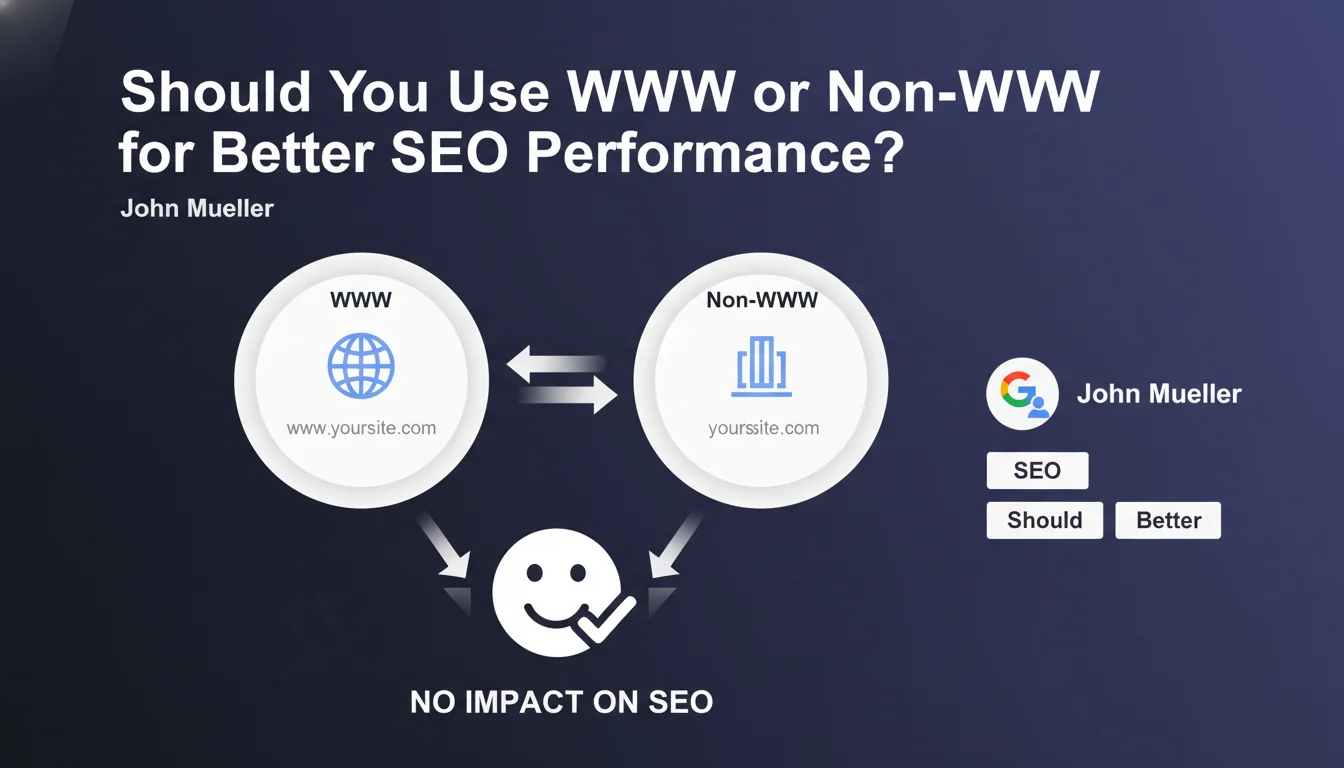
The question of choosing between www.mysite.com and mysite.com frequently comes up among SEO practitioners. Google officially confirms that this decision has no direct impact on search rankings.
Both formats are considered equivalent by search engines. The choice therefore solely depends on technical or communication preferences, not on an SEO strategy.
However, there is a fundamental rule to follow: only one version should be accessible. The other must redirect to the chosen version to avoid duplicate content issues.
- No SEO advantage for www or non-www
- The choice is free and depends on your preferences
- A 301 redirect is mandatory from the unused version to the main version
- Declare the canonical version in Google Search Console
- Consistency needed across all backlinks and citations
SEO Expert opinion
This confirmation from Google is totally consistent with field observations. Thousands of sites perform excellently with or without www, which proves the absence of direct impact on ranking algorithms.
The only nuance concerns technical subdomains. If you use specific subdomains (blog.mysite.com, app.mysite.com), opting for www.mysite.com as your primary domain can facilitate DNS management and wildcard SSL certificates.
Historically, some argued that www facilitated domain migration or CDN management. These arguments are now largely outdated with modern technologies.
Practical impact and recommendations
- Choose a primary version (www or non-www) based on your communication preferences
- Configure a permanent 301 redirect from the unused version to the main version
- Declare your preferred domain in Google Search Console (property with the chosen version)
- Verify that all variants redirect: http://www, http://, https://www, https://
- Update your internal links to systematically use the canonical version
- Use canonical tags to reinforce the preferred version
- Check the sitemap.xml file: all URLs must use the chosen version
- Audit major backlinks and request corrections when possible for the most important ones
- Test with tools (Screaming Frog, curl) that redirects work correctly
- Monitor in Search Console for the absence of crawl errors related to redirects
Properly implementing these redirects and consolidating your technical architecture requires in-depth expertise to avoid mistakes that could impact your visibility. If you want to secure this migration or audit your current configuration, support from a specialized SEO agency can prove invaluable for implementing these best practices optimally and customized to your infrastructure.
💬 Comments (0)
Be the first to comment.