
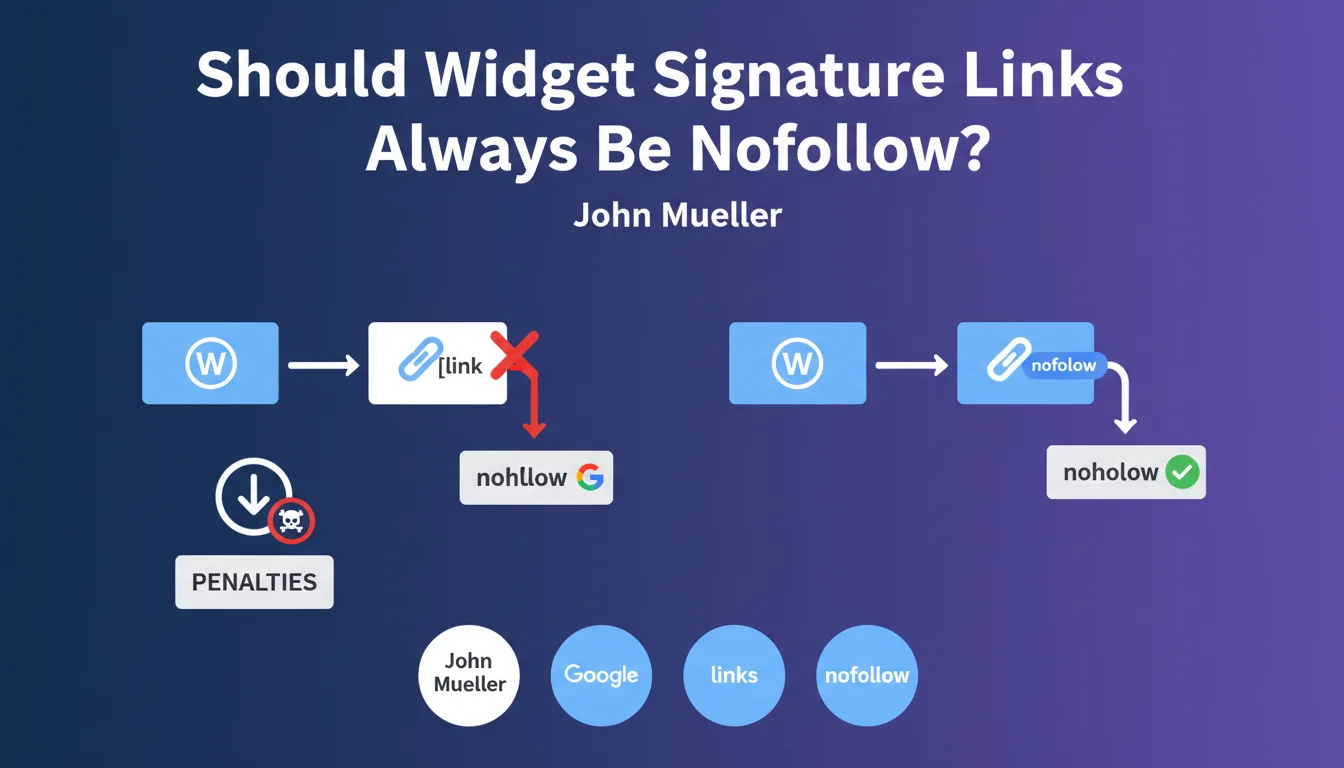
Official statement
What you need to understand
Why does Google care about links in widgets?
Widget signature links have been considered artificial links by Google for many years. When a developer or agency creates a free widget (calculator, social button, photo gallery), it's tempting to include a "Powered by [name]" link to obtain automatic backlinks.
The problem is that these links multiply automatically across hundreds or even thousands of sites, creating an unnatural link pattern. Google considers this an attempt to manipulate PageRank, violating its link guidelines.
What happens if these links aren't nofollow?
According to John Mueller, Google can now automatically devalue these links without manual intervention. The search engine has developed algorithms capable of detecting link patterns from widgets and ignoring them.
Even more concerning, Google has threatened to apply manual penalties to sites that massively distribute widgets with follow links. This means the risk doesn't only concern link ineffectiveness, but a potential penalty on the entire domain.
- Automatic detection: Google identifies and neutralizes widget links without human intervention
- Manual penalty risk: Widget creators may face manual actions
- Nofollow requirement: The nofollow attribute (or sponsored/ugc) becomes mandatory on these links
- Pattern recognition: Algorithms spot identical signatures repeated across numerous sites
How does Google detect these widget links?
Google's algorithms analyze several characteristic signals: identical anchor text across many sites, similar positioning (generally in footer), repetitive HTML code, and targeted domains without thematic relationship.
The scalability of the scheme is the determining factor. A link in a widget installed on 10 sites might go unnoticed, but the same widget on 1000 sites automatically triggers anti-spam filters.
SEO Expert opinion
Is Google's approach consistent with its historical practices?
Absolutely. This statement continues a long-standing war against artificial link schemes. As early as 2013-2014, the first warnings about widget links appeared, followed by massive manual penalties.
What's evolving here is Google's ability to automate detection and neutralization. Previously, manual action was required to penalize these practices. Now, the algorithm handles them routinely, which is more efficient and scalable for Google.
What nuances should be applied to this rule?
Not all links in widgets are problematic. The central question is intent and scale. A developer who creates a unique tool for a client and includes a discreet mention isn't in the same situation as massive distribution.
Additionally, some widgets have genuine editorial value. For example, a financial data widget created by Bloomberg could legitimately contain a follow link if the webmaster voluntarily chose it for its quality. That's the difference between an editorial link and an automated link.
In what cases might this rule not apply strictly?
Genuine partnerships may constitute an exception. If you develop an exclusive widget for a strategic partner as part of a transparent business agreement, the context differs from massive distribution.
However, even in this case, using the rel="sponsored" attribute would be more appropriate to correctly qualify the nature of the link. The boundary between legitimate partnership and link scheme remains thin and subjective.
Practical impact and recommendations
What should you do concretely with your existing widgets?
The absolute priority is to audit all your currently distributed widgets. Identify those containing links to your site and verify whether they have the nofollow, sponsored, or ugc attribute.
If you've distributed widgets with follow links, you must update the code as quickly as possible. Publish a new version with the correct attributes and communicate with users so they update.
- Inventory all widgets you've created and distributed
- Check the presence and type of attribute on each credit link
- Add rel="nofollow" or rel="sponsored" on all credit links
- Publish updated versions of your widgets
- Clearly document in your guidelines that links must be nofollow
- Regularly monitor installations to verify compliance
What mistakes should you absolutely avoid?
The most serious error would be considering that massive widget distribution remains a viable SEO strategy in 2024. Even with nofollow links, this approach provides no direct ranking benefit.
Another trap: using cloaking techniques like adding nofollow via JavaScript or conditioning its appearance. Google can detect these manipulations and they would considerably worsen the situation. Transparency is imperative.
Finally, don't neglect third-party widgets you've installed on your own site. If their links aren't nofollow, your site could be considered as participating in a link scheme, even passively.
How can you ensure your link strategy remains compliant long-term?
Beyond widgets, this statement emphasizes the importance of a rigorous link policy. Document your practices, train your technical teams, and regularly audit your backlink profile to identify potentially suspicious patterns.
Always prioritize creating real value rather than technical shortcuts. An excellent widget can generate natural mentions and editorial links without any forced signature.
💬 Comments (0)
Be the first to comment.