
Official statement
What you need to understand
Why does anchor text length matter to Google?
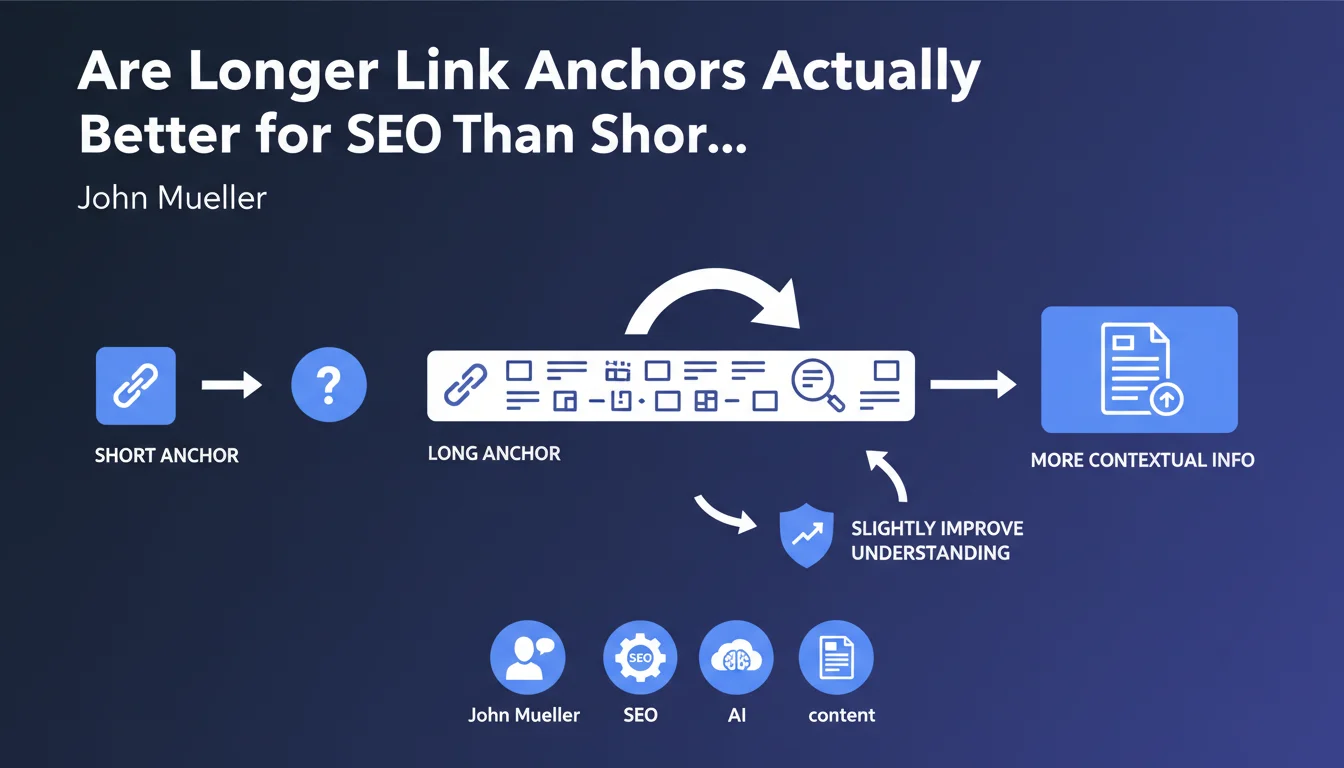
Google uses link anchors as contextual signals to understand the content of the destination page. Contrary to the common belief that anchors should be short, a more descriptive anchor can provide more semantic information to the search engine.
This approach aligns with the evolution of natural language processing algorithms like BERT, which analyze context and relationships between words rather than isolated terms. A long but relevant anchor helps Google better grasp the theme of the target page.
What actually makes a long anchor text effective?
Length alone isn't enough: the anchor must be explicit and descriptive. An anchor like "Click here to learn more" remains ineffective even if it contains several words.
The goal is to provide a natural and informative description of the destination content. For example, "Complete guide to on-page optimization techniques for e-commerce" is much more useful than "Click here".
What are the tangible benefits of this approach?
Descriptive anchors offer a dual advantage: they improve algorithmic understanding while enriching user experience. The visitor knows exactly what they will find when clicking.
- Improved contextual understanding by Google's semantic algorithms
- Better thematic targeting between source page and destination page
- Optimized user experience through clear expectations
- Reduced bounce rate on destination pages
- Consistency with the evolution toward semantic search rather than keyword-based search
SEO Expert opinion
Does this recommendation align with real-world observations?
My 15 years of experience confirms this position. Sites using natural descriptive anchors generally show better performance in SERPs, particularly for long-tail queries.
However, there's an important nuance: this approach works best in a context of natural editorial linking. For internal links in particular, descriptive anchors effectively enrich the site's semantic mesh.
What limitations should you consider with this practice?
Be careful not to fall into the opposite extreme. A 15-20 word anchor becomes counterproductive: it hurts user experience and may seem artificial. The sweet spot is between 4 and 8 words for most cases.
Moreover, the link context remains paramount. A descriptive anchor in low-quality content or on a low-authority site will have limited impact. Overall quality always takes precedence.
In which scenarios is this strategy particularly effective?
Long and descriptive anchors excel in several specific contexts. For internal linking, they reinforce the site's thematic structure and facilitate semantic crawling.
They're also highly relevant for natural editorial links in informative content, guides or blog articles. On the other hand, for commercial CTAs or navigation menus, more concise anchors remain preferable for usability.
Practical impact and recommendations
How can you optimize your link anchors in practice?
Start by auditing your existing internal links. Identify generic anchors ("click here", "learn more") and replace them with descriptive formulations that clearly summarize the destination content.
For your new content, write anchors that naturally integrate the semantic context of the target page. Think about what a user needs to know before clicking rather than stuffing the anchor with keywords.
Vary your formulations to maintain a natural and diversified link profile. Alternate between exact match, partial match and descriptive anchors depending on editorial context.
What mistakes should you absolutely avoid in this approach?
Don't transform your anchors into endless sentences or keyword accumulations. "Best SEO agency Paris specialist natural referencing optimization Google" is counterproductive and seems manipulative.
Also avoid excessive uniformity. If all your anchors follow the same long descriptive pattern, it will appear artificial. Diversity remains a marker of naturalness for Google.
- Identify generic anchors with low informational value on your site
- Write descriptive anchors of 4 to 8 words for main internal links
- Ensure each anchor precisely describes the destination content
- Maintain natural variety in the types of anchors used
- Test readability: the anchor should integrate smoothly into the sentence
- Avoid promotional or over-optimized formulations
- Document your anchor strategy for editorial consistency
- Measure impact on click-through rate and time spent on target pages
How can you verify the effectiveness of your anchor strategy?
Use tools like Screaming Frog or Sitebulb to extract all your internal link anchors. Analyze their distribution and identify patterns to improve.
Track the ranking evolution of target pages for their main queries. Gradual improvement indicates that Google better understands the thematic relevance established by your anchors.
💬 Comments (0)
Be the first to comment.