
Official statement
What you need to understand
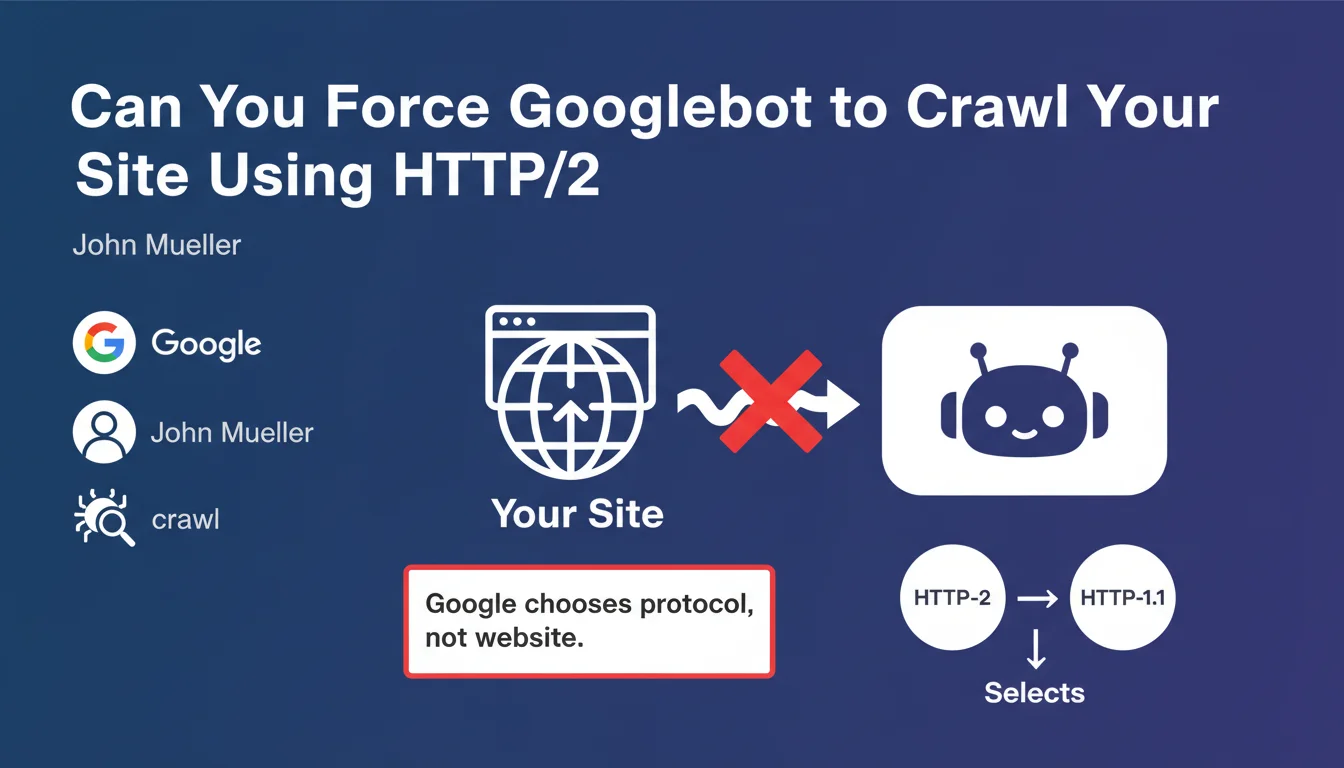
Google has reached a symbolic milestone: more than 50% of crawled URLs now use the HTTP/2 protocol. This evolution marks a turning point in how Googlebot explores websites.
The HTTP/2 protocol enables more efficient crawling thanks to its ability to handle multiple simultaneous requests over a single connection. Concretely, Googlebot can crawl more pages in less time, without overloading servers.
For SEO practitioners, this means that Google is technically capable of exploring more content on HTTP/2-compatible sites. The crawl budget, that limited envelope of URLs that Google agrees to explore on a site, is thus better utilized.
- HTTP/2 improves crawl efficiency through request multiplexing
- More than 50% of URLs are now crawled in HTTP/2 by Googlebot
- This optimization primarily benefits large sites with crawl budget challenges
- Migration to HTTP/2 facilitates exploration without negatively impacting servers
SEO Expert opinion
This statement confirms a trend observed for several years: Google favors modern web standards to optimize its own resources. Googlebot's massive adoption of HTTP/2 is consistent with its efficiency policy.
Be careful though: HTTP/2 is not a direct ranking factor. It's a technical facilitator that allows Google to explore your content more efficiently, but it doesn't guarantee better positioning. The real value lies in the ability to have your new pages or updates discovered more quickly.
Important nuance: For small sites (less than 10,000 pages), the impact will be marginal. Crawl budget is generally not an issue for them. This optimization primarily concerns large e-commerce sites, news portals, and platforms generating massive content.
Practical impact and recommendations
- Check if your site already supports HTTP/2 (use tools like KeyCDN HTTP/2 Test or Chrome DevTools)
- Prioritize HTTP/2 migration if you manage a site with more than 10,000 pages with indexing issues
- Ensure your hosting and CDN support HTTP/2 (most have since 2018)
- Enable HTTPS as a prerequisite because HTTP/2 requires a secure connection to work with browsers
- Monitor your crawl logs before and after migration to measure the impact on the number of pages explored
- Don't expect miracles on ranking: HTTP/2 improves crawling, not positioning directly
- Avoid migrating solely for HTTP/2 if your site doesn't have an identified crawl issue
Migration to HTTP/2 represents a strategic technical optimization for large sites facing crawl budget limitations. It facilitates exploration by Googlebot and potentially accelerates the indexing of new content.
This transition nevertheless requires a thorough preliminary analysis of your technical infrastructure, your server logs, and your specific crawl challenges. The optimal configuration can prove complex depending on your technical stack and architecture. In this context, support from a specialized SEO agency can help you precisely identify the potential gains for your situation, prioritize technical projects, and ensure a risk-free migration for your visibility.
💬 Comments (0)
Be the first to comment.