
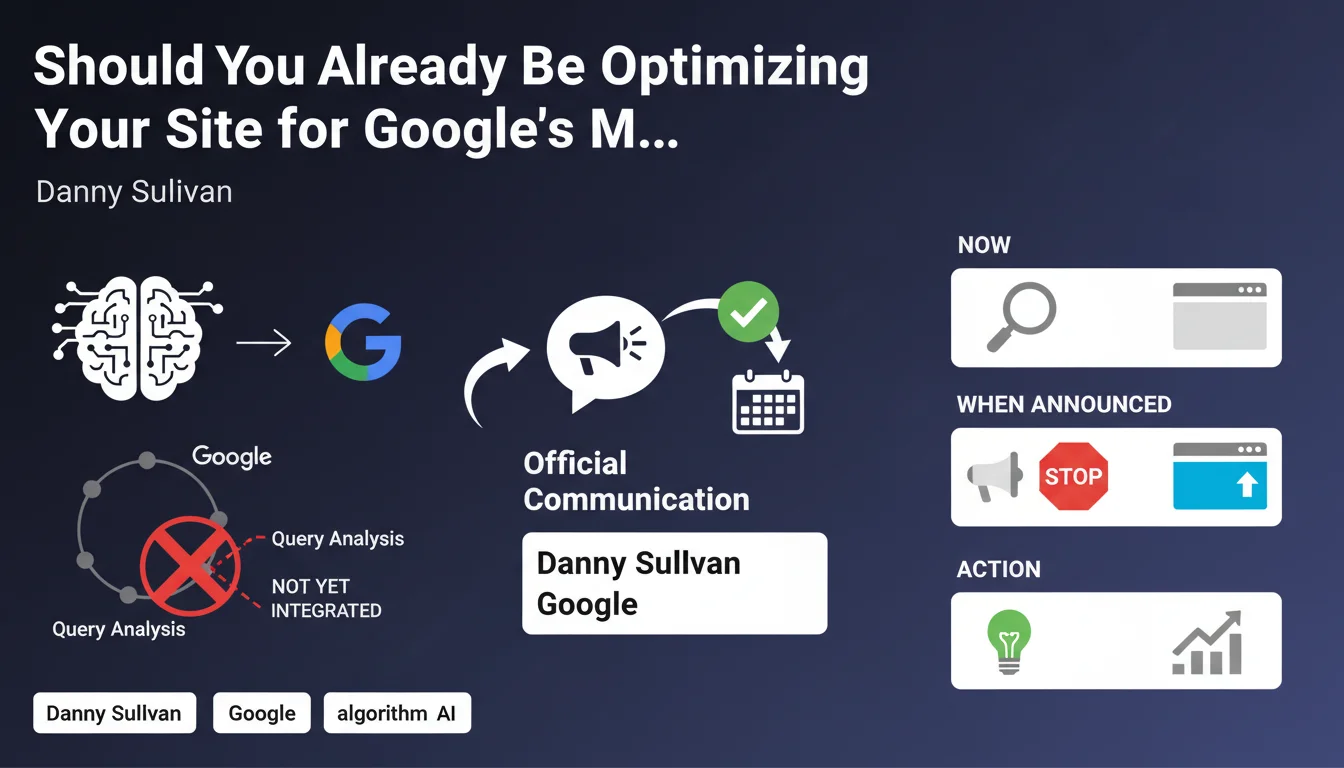
Official statement
What you need to understand
MUM (Multitask Unified Model) is a Google artificial intelligence algorithm designed to understand and process complex queries in a much more sophisticated way than previous technologies. Unlike BERT, which focused on natural language understanding, MUM can analyze multilingual and multimodal content (text, images, videos).
This official statement indicates that MUM was not yet deployed in the search system at the time of the communication. Google is adopting a cautious and transparent approach, promising to officially announce its integration before any rollout.
The parallel with BERT is revealing: we should expect a gradual deployment, probably over several months or even years. This waiting period may seem long, but it offers SEO professionals the opportunity to prepare without immediate pressure.
- MUM is not active in search results at the time of the statement
- Google commits to communicating officially before any deployment
- The estimated timeframe is measured in months or years, not weeks
- Similarity with BERT's rollout: gradual and transparent
SEO Expert opinion
This transparent approach from Google is consistent with their communication strategy observed since 2019. They did indeed announce BERT before its deployment, and have maintained this practice for major updates. This demonstrates a certain maturity in managing communication with the SEO ecosystem.
However, this needs to be nuanced: even if MUM was not "officially" integrated, Google may be conducting small-scale tests on certain queries or specific markets. The absence of a complete rollout does not mean a total absence of experimentation.
Practical impact and recommendations
- Don't panic or rush into a complete overhaul of your SEO strategy for MUM
- Monitor official communications from Google (official blog, conferences) for the announced deployment
- Strengthen content quality: prioritize comprehensive content that answers complex questions
- Work on semantic richness: varied vocabulary, extended lexical fields, in-depth context
- Optimize multimodal content: integrate images, videos and text in a coherent way with detailed descriptions
- Structure information hierarchically: use Hn tags, schema.org markup to facilitate contextual understanding
- Develop in-depth content: address topics from multiple angles rather than superficially
- Avoid speculative optimizations based on unconfirmed assumptions about how MUM works
Preparing for algorithms as sophisticated as MUM requires deep technical expertise and a long-term strategic vision. Between advanced semantic analysis, multimodal optimization and content architecture restructuring, these transformations represent a considerable investment. For businesses wishing to position themselves advantageously before MUM's deployment, collaborating with a specialized SEO agency can prove judicious in order to benefit from personalized support and a strategy adapted to your industry sector.
💬 Comments (0)
Be the first to comment.