
Official statement
What you need to understand
What does this Google statement about videos really mean?
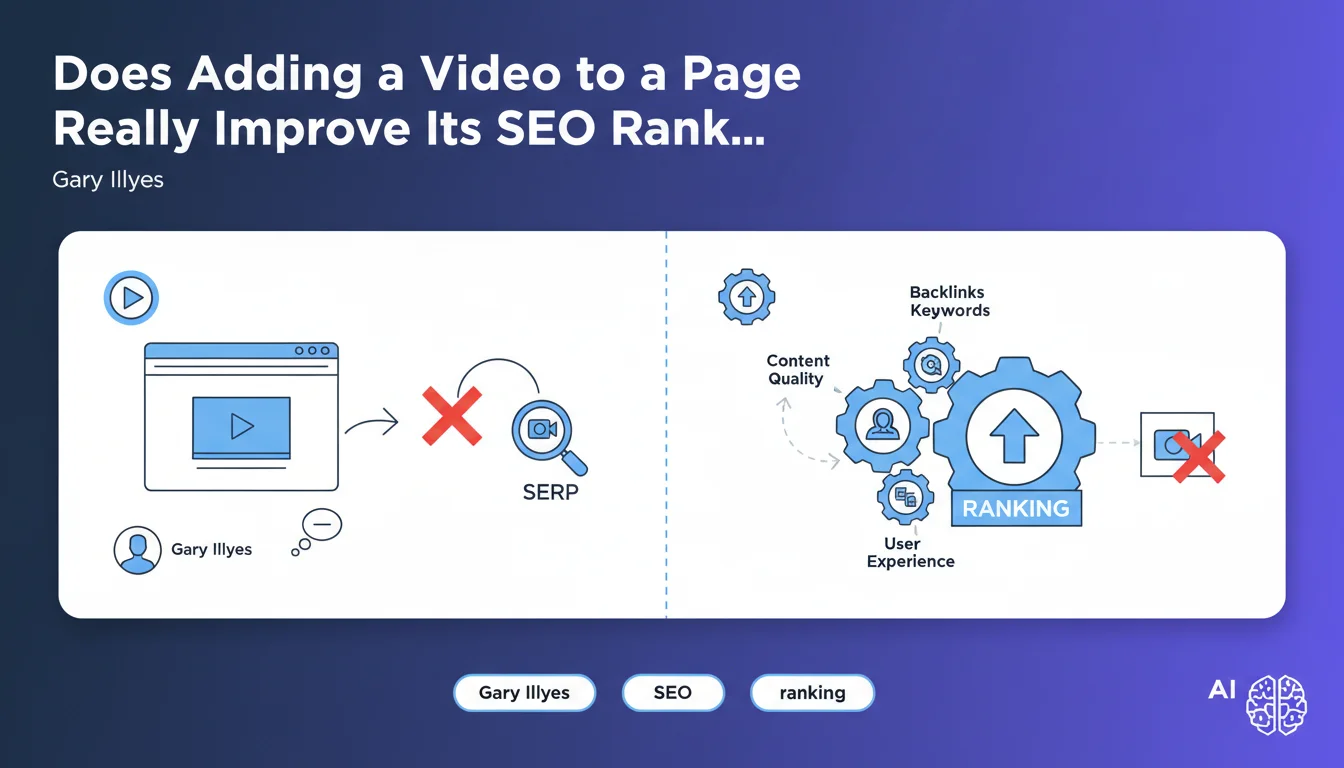
Gary Illyes, an influential member of the Google Search team, clearly stated that adding a video to a web page does not constitute a direct ranking factor. Contrary to popular belief, simply having a video present does not automatically improve a page's position in search results.
This clarification aims to demystify a common practice: some SEO professionals add videos thinking it will mechanically boost their SEO. Google confirms that there is no algorithmic bonus automatically granted to pages containing video content.
Why was this clarification necessary?
Many digital marketing professionals have long considered video as a magical ranking element. This belief likely stems from partial observations: pages with videos often perform better, but for other reasons.
Google wants to remind us that correlation does not imply causation. If pages with videos rank well, it's generally because they offer a better user experience, retain visitors longer, or better match search intent.
What are the real SEO issues related to videos?
Videos influence rankings indirectly, through several measurable mechanisms. They can improve time on page, reduce bounce rate, and increase user engagement.
These behavioral signals are indeed taken into account by Google to evaluate page quality. A relevant video that meets visitor expectations will therefore contribute positively to SEO, but not simply through its presence.
- No automatic bonus: the presence of a video guarantees no direct algorithmic advantage
- Measurable indirect impact: videos influence user engagement metrics
- Quality over quantity: a relevant video is better than a decorative video
- Search intent: the video must match what the user is actually looking for
SEO Expert opinion
Is this statement consistent with real-world observations?
This position from Google is perfectly consistent with the fundamental principles of its algorithm. Google has long prioritized actual user experience over isolated technical elements. The absence of a direct ranking factor for videos fits within this logic.
In practice, I indeed observe that pages with videos that perform well are those where the video provides real added value. "Decorative" or irrelevant videos never significantly improve positioning, confirming this statement.
What important nuances should be added to this rule?
Google's statement deserves to be nuanced in certain specific contexts. For video-intent queries (tutorials, demonstrations, reviews), Google often displays a video carousel in position zero. In these cases, having a video becomes essential for visibility.
Additionally, videos hosted on YouTube benefit from a complementary visibility channel. Since YouTube is the world's second-largest search engine, optimizing your videos for this platform can generate significant traffic that then redirects to your site.
In which cases can videos still impact SEO?
Videos positively influence SEO when they create favorable behavioral signals. A user who watches an explanatory video spends more time on the page, which indicates to Google that the content properly answers their query.
Videos also generate more social shares and natural backlinks. Quality video content attracts inbound links, a recognized ranking factor. The SEO impact therefore exists, but it operates through these indirect mechanisms rather than through an automatic algorithmic bonus.
Practical impact and recommendations
What should you actually do with videos on your site?
Integrate videos only when they provide real value to the user. Ask yourself the question: does this video actually help the visitor understand, decide, or accomplish their goal? If the answer is no, it probably doesn't belong there.
Prioritize relevance to search intent. For an informational blog post, a summary video can help. For a product page, a video demonstration improves conversion. For a technical guide, a video tutorial perfectly complements the text.
Ensure your videos are properly optimized technically: Schema.org VideoObject markup, text transcription, attractive thumbnail, and fast loading time. These elements will allow Google to better understand and index your video content.
What absolute mistakes should you avoid with videos?
Never add videos solely to "do SEO". This approach is counterproductive: an irrelevant video can even degrade user experience and increase bounce rate, thus harming your ranking.
Avoid videos that excessively slow down page loading. Core Web Vitals remains a confirmed ranking factor. A poorly implemented video that degrades technical performance will do more harm than good to your SEO.
Don't neglect accessibility and mobile experience. Videos must be responsive, have subtitles, and not autoplay with sound, which deteriorates user experience on mobile.
How can you optimize your video strategy to maximize indirect benefits?
Focus on creating videos that generate measurable engagement. Analyze the metrics: average watch time, completion rate, post-video interactions. This data will tell you whether your videos truly contribute to user experience.
Develop a complementary YouTube strategy. Publish your videos on YouTube with appropriate SEO optimization (title, description, tags), then embed them on your web pages. You'll benefit from dual visibility: YouTube search and Google search.
- Audit existing videos and remove those that provide no value
- Implement Schema VideoObject markup on all pages with videos
- Add complete text transcriptions for accessibility and indexing
- Measure the impact of videos on engagement metrics (time on page, bounce rate)
- Optimize video loading to preserve Core Web Vitals
- Create videos specifically for queries with strong video intent
- Develop a YouTube presence consistent with your content strategy
- Test the impact of videos on conversion rate, not just on traffic
💬 Comments (0)
Be the first to comment.