
Official statement
What you need to understand
Where Did This Fear of White Spaces in SEO Originally Come From?
A widespread belief in the SEO community claimed that displaying significant white areas on a web page could trigger algorithmic penalties from Google. This theory suggested that empty spaces pushing textual content down the viewport harmed user experience.
This concern developed alongside discussions about above-the-fold content and the importance of quickly presenting relevant content to visitors.
What Does Google Actually Say About White Spaces?
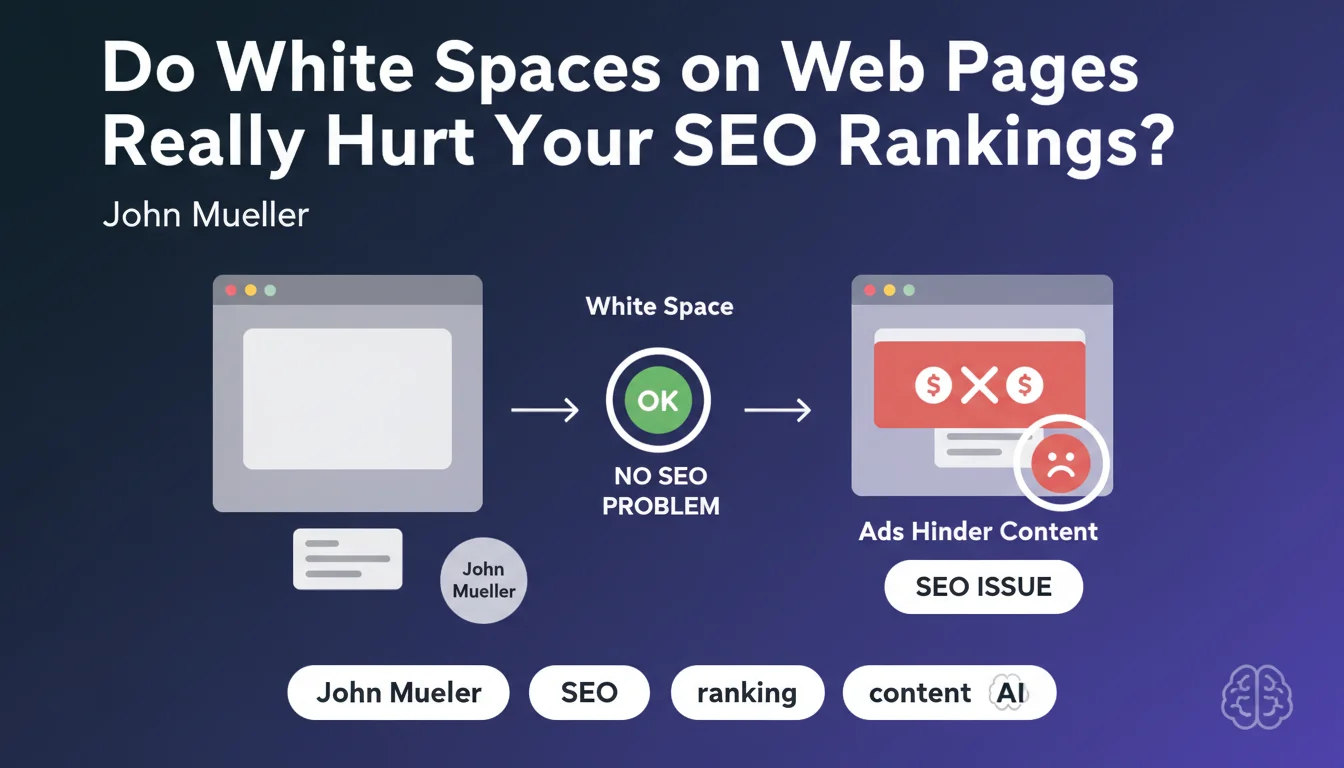
John Mueller clarified Google's official position: white spaces themselves pose no SEO problem. The search engine does not penalize pages containing empty areas, even if they push textual content lower down the page.
The only exception concerns intrusive ads that genuinely impede readability of the main content. In this specific case, it's the impact on user experience that can be problematic, not the white space itself.
Why Did This Confusion Persist in the SEO Industry?
This confusion resulted from a misinterpretation of user experience guidelines. SEOs conflated several distinct concepts: loading time, content accessibility, and the presence of white spaces.
No empirical evidence has ever demonstrated that a site was penalized solely for white spaces. Problematic cases always involved other factors such as aggressive advertising or difficult-to-access main content.
- Pure white spaces (without content) are not penalized by Google
- Only intrusive ads affecting readability pose a problem
- This fear was an SEO urban legend never confirmed by data
- Google evaluates overall user experience, not simply the presence of spaces
SEO Expert opinion
Is This Statement Consistent with Practices Observed in the Field?
Absolutely. After 15 years of experience, I've analyzed thousands of sites presenting different white space configurations. No negative correlation has ever been established between empty spaces and SEO performance.
On the contrary, many high-performing sites use airy designs with generous spacing to improve readability. Luxury sites, creative portfolios, and modern blogs often excel in rankings despite spacious layouts.
What Important Nuances Should Be Added to This Statement?
While white spaces are not penalizing, several situations must be distinguished. An intentional, design-driven white space differs from a space caused by a technical problem like a blocking script or an unloaded resource.
Moreover, if the white space results from an initially present ad but blocked by an ad-blocker, this may indicate excessive dependence on advertising. The algorithm may then detect a degraded user experience for those who see the ads.
In What Contexts Could This Rule Be Misinterpreted?
The main risk is using this statement to justify poor information architecture. If your main content is systematically pushed 3000 pixels down from the top of the page, you won't have a direct algorithmic penalty, but you'll likely lose user engagement.
Behavioral metrics (bounce rate, time on page, scroll depth) can indirectly affect your SEO if users don't quickly find what they're looking for. Google measures these engagement signals, even if they don't penalize white space itself.
Practical impact and recommendations
What Should You Concretely Do with This Information?
Stop worrying about white spaces in your designs. Focus instead on actual user experience and content clarity.
If your design requires generous spacing for aesthetic or readability reasons, go ahead without fear. Prioritize instead optimizing Core Web Vitals and the quality of visible content.
What Concrete Mistakes Should You Avoid?
Don't eliminate useful white spaces to artificially concentrate content at the top of the page. This practice can make your site visually cluttered and harm actual readability.
Also avoid overcompensating by placing irrelevant content just to fill spaces. Stuffing with low-quality content is far more problematic than an elegant empty space.
- Audit your pages to identify spaces caused by technical errors rather than design
- Verify that your ads don't create intrusive interstitials penalized by Google
- Test actual user experience with heatmap tools to understand visitor behavior
- Measure Core Web Vitals, particularly CLS which can be affected by elements loading late
- Analyze your engagement metrics (average time, scroll depth) to identify content accessibility issues
- Maintain a clear visual hierarchy even with generous spacing
- Document intentional white spaces in your style guide to prevent them from being removed by mistake
How Can You Sustainably Optimize Your Page Structure?
Optimizing information architecture requires a holistic approach combining design, technical execution, and content strategy. Each decision should be guided by actual user data rather than SEO myths.
For complex sites, this analysis requires multidisciplinary skills in UX, development, and technical SEO. A poorly calibrated approach can lead to counterproductive modifications affecting your conversions.
💬 Comments (0)
Be the first to comment.