
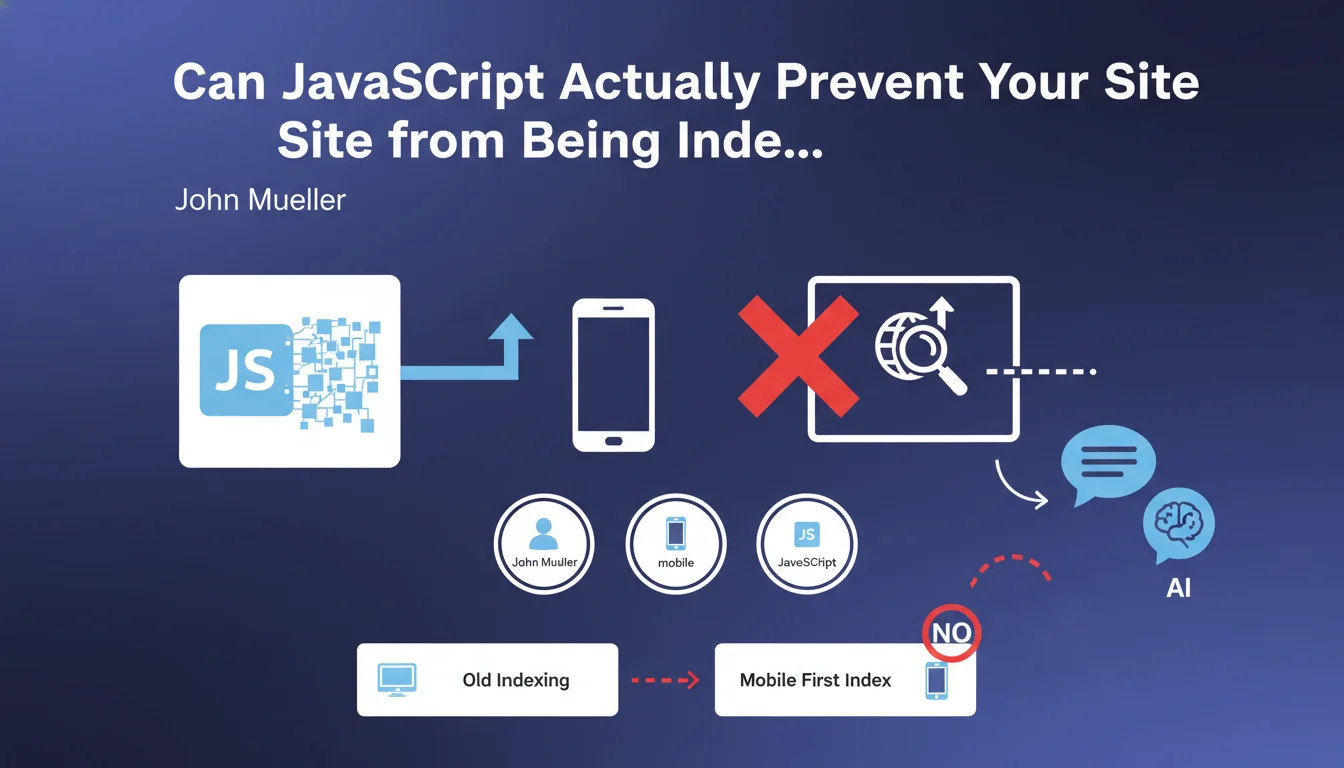
Official statement
What you need to understand
What exactly is the Mobile First index and why does JavaScript create problems?
The Mobile First index means that Google now uses the mobile version of your site as the primary basis for indexation and ranking. This fundamental transition is a game-changer for all websites.
Complex JavaScript poses a particular challenge because Google must execute the code to display the actual content. On mobile, this execution is more demanding in terms of resources and processing time.
Why would Google refuse to switch certain sites to Mobile First?
Google has confirmed that sites with JavaScript-heavy implementations may remain in the old desktop index. This decision isn't arbitrary: it protects the quality of indexation.
If the mobile content isn't properly accessible due to JavaScript, Google prefers to rely on the desktop version rather than index an incomplete or poorly rendered mobile version.
- JavaScript must be crawlable and renderable by mobile Googlebot
- Critical resources (CSS, JS) must not be blocked
- Main content must be available without excessive delay
- Mobile compatibility must be validated with Google tools
- Overly complex sites remain in the old index as a precaution
What are the concrete risks of poorly optimized JavaScript?
A site that remains stuck outside the Mobile First index suffers a significant handicap. With the majority of searches coming from mobile, not being optimized for this index limits your visibility.
Beyond indexation, poorly managed JavaScript causes performance issues: high loading times, content that displays late, and poor user experience that directly impacts your Core Web Vitals.
SEO Expert opinion
Is this statement consistent with practices observed in the field?
Absolutely. As an SEO expert, I regularly observe sites with complex JavaScript frameworks (React, Angular, Vue.js) encountering mobile indexation difficulties. Crawl analyses often show significant discrepancies between the content actually present and what Google manages to extract.
Single Page Applications (SPAs) are particularly affected. Without rigorous implementation of Server-Side Rendering (SSR) or pre-rendering, these sites present almost empty initial content that penalizes their mobile indexation.
What nuances should be added to this recommendation?
Not all sites using JavaScript are problematic. Modern frameworks with SSR (Next.js, Nuxt.js, Angular Universal) can offer excellent Mobile First performance if properly configured.
The real criterion isn't the quantity of JavaScript, but the immediate availability of content. A site with lots of JS but efficient server-side rendering will transition to Mobile First without issues.
In which cases does this rule particularly apply?
The sites most at risk are those that generate 100% of their content via client-side JavaScript. E-commerce platforms with dynamic product loading, news portals with infinite scroll, and complex web applications are on the front line.
Sites built with visual builders that massively inject JavaScript to manage layout are also affected. Their often bloated code slows down execution and compromises mobile indexation.
Practical impact and recommendations
How can you check if your site is affected by this problem?
Start by using the URL Inspection tool in Google Search Console. Test several key pages and compare the rendered HTML with your source code. A significant gap signals a problem.
Also check the Mobile First coverage report in Search Console. Google explicitly indicates whether your site has been switched or not, and documents any mobile crawling errors.
- Test your pages with Google's Mobile-Friendly Test tool
- Analyze JavaScript rendering in Search Console with the "Test live URL" feature
- Compare visible content between desktop and mobile versions
- Check First Contentful Paint and Largest Contentful Paint times on mobile
- Audit blocked resources (robots.txt, meta tags) for mobile Googlebot
- Examine server logs to identify errors specific to the mobile bot
What concrete actions should you implement to solve this problem?
The most effective solution remains implementing Server-Side Rendering (SSR) or Static Site Generation (SSG). These techniques ensure that essential content is present in the initial HTML, even before JavaScript execution.
If SSR is too complex, consider pre-rendering for strategic pages. Services like Rendertron or Prerender.io generate HTML snapshots of your JavaScript pages for crawlers.
Also optimize JavaScript delivery: minification, compression, code splitting, lazy loading of non-critical scripts. Every millisecond saved improves the chances of complete indexation.
What mistakes should you absolutely avoid during optimization?
Never block JavaScript and CSS files with robots.txt. Google must be able to access these resources to properly render your mobile pages.
Avoid cloaking techniques that would serve different content to bots and users. Google detects these practices and can penalize your site severely.
💬 Comments (0)
Be the first to comment.