
Official statement
What you need to understand
How Does Google Handle Different Languages in Its Algorithm?
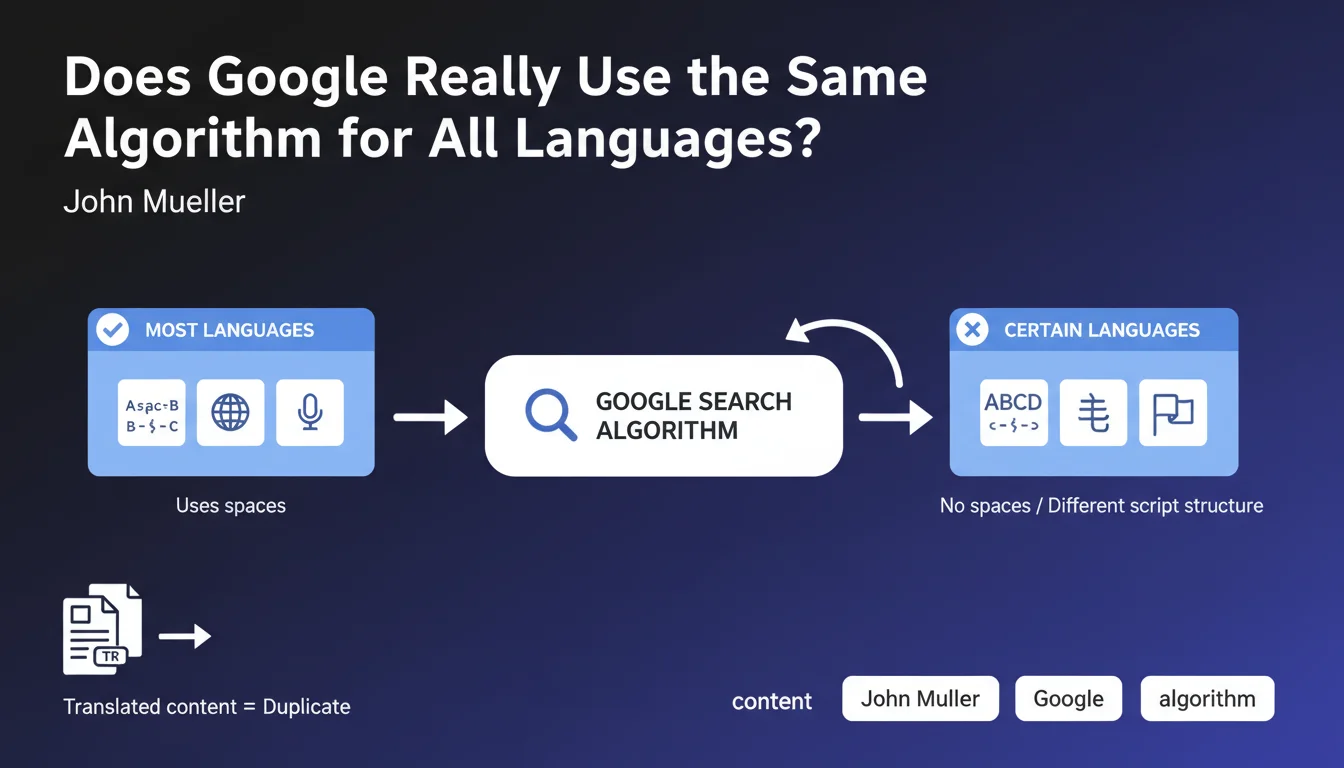
Google uses a single search algorithm for the majority of languages, with a unified index on a global scale. This approach enables consistency in the processing of queries and results.
However, certain languages require specific algorithms to be processed correctly. This is particularly the case for languages that do not separate words with spaces, such as Chinese, Japanese, or Thai. For these languages, Google must use specific segmentation techniques to identify words and understand the meaning of sentences.
Why Aren't Translated Contents Considered Duplicate Content?
Google considers that two pages translated into different languages are fundamentally distinct, even if they convey the same message. Each linguistic version targets a different audience with specific search intents.
The search engine cannot automatically determine that a page in French is the linguistic equivalent of a page in English. Cultural, local, and contextual differences are too numerous to establish this equivalence without explicit indication.
What's the Crucial Role of the Hreflang Tag in This Context?
The hreflang tag is the tool that allows you to indicate to Google that a page is the alternative version of another for a specific language or country. Without this tag, Google cannot establish a relationship of equivalence between your linguistic versions.
This tag becomes essential to avoid cannibalization issues between versions and to serve the right version to users according to their location and language.
- A single main algorithm is used for most languages
- Specific algorithms for languages without space separation
- Translations are never duplicate content according to Google
- The hreflang tag is essential to signal linguistic equivalences
- Google cannot guess relationships between versions without explicit indication
SEO Expert opinion
Is This Statement Consistent with Practices Observed in the Field?
This statement by John Mueller confirms what international SEO experts have been observing for years. The existence of a single main algorithm explains why SEO best practices are generally transferable from one language to another.
However, the nuance concerning specific algorithms for certain languages is rarely mentioned publicly. This explains why sites in Chinese or Japanese may sometimes show different behaviors in terms of ranking, particularly regarding keyword density or content structure.
The emphasis on the role of hreflang also confirms its critical importance. Too many multilingual sites still neglect this implementation, which leads to geographic targeting problems and performance issues in international SERPs.
What Nuances Should Be Added to This Statement?
Although Google claims to use the same algorithm, there are significant regional differences in search results. These differences come not so much from the algorithm as from localization signals and users' behavioral preferences.
For example, ranking factors may have a different weight depending on the markets. In some countries, social signals or customer reviews may have more impact than in others. Google also adapts its results according to local search habits.
In Which Cases Does Algorithm Uniformity Pose Particular Challenges?
For languages with complex segmentation (Chinese, Japanese, Thai, Korean), SEO professionals must adapt their approach to keyword selection and content writing. Density and placement of terms do not work the same way.
Multilingual sites must also face significant technical challenges. Managing URLs, navigation structures, and redirects becomes complex when targeting multiple markets with different cultural expectations.
Practical impact and recommendations
What Should You Do Concretely to Optimize a Multilingual Site?
The absolute priority is the correct implementation of hreflang tags. Each page must point to all its alternative versions, including itself. A single error in this configuration can compromise your entire international strategy.
Next, create truly localized content rather than simply translated. Each linguistic version must respond to cultural specificities and local search intents. A simple word-for-word translation will never perform as well as content designed for the target market.
For languages without space separation, work with native writers who understand the subtleties of segmentation and term selection. Keyword optimization does not follow the same rules in these languages.
What Mistakes Should You Absolutely Avoid in a Multilingual SEO Strategy?
Never use automatic translation without thorough human review. Google is getting better at detecting low-quality content, and automatic translations often produce unnatural texts that harm your user experience.
Avoid creating subdomains or directories for languages without truly differentiated content. If you cannot produce quality localized content, it's better to focus on fewer markets but with a qualitative approach.
Do not neglect technical aspects specific to each language: UTF-8 encoding, text direction (RTL for Arabic or Hebrew), date and currency formats. These details impact user experience and therefore indirectly SEO.
How Can You Verify That Your International Implementation Is Correct?
Use Google Search Console to check your hreflang tags in the "International Targeting" report. This tool detects common errors such as non-reciprocal tags or incorrect language codes.
Test your pages with VPNs from different countries to verify that Google serves the right version according to location. Also analyze your server logs to understand how Googlebot crawls your different linguistic versions.
- Implement hreflang tags on all pages with alternative versions
- Create localized content and not just translated
- Use dedicated URLs for each version (subdirectories or ccTLD)
- Check UTF-8 encoding for all languages
- Collaborate with native writers for each target market
- Monitor performance in Search Console by country and language
- Test geographic targeting with simulation tools
- Avoid duplicate content between versions with canonical and hreflang
- Adapt content structure to the specificities of languages without spaces
- Set up separate analytics tracking by linguistic version
💬 Comments (0)
Be the first to comment.