
Official statement
Other statements from this video 18 ▾
- 1:05 Contenu dupliqué : Google pénalise-t-il vraiment les pages canoniques ?
- 2:05 Faut-il vraiment manipuler les paramètres d'URL pour éliminer les contenus dupliqués ?
- 2:07 Faut-il vraiment s'inquiéter si Google indexe plusieurs versions d'une même page ?
- 5:26 Pourquoi Google ne vous montre-t-il qu'un échantillon de vos backlinks dans Search Console ?
- 5:46 Pourquoi Google ne vous montre-t-il qu'un échantillon de 1000 backlinks dans Search Console ?
- 7:26 Faut-il vraiment remplir les pages produits de texte pour le SEO ?
- 7:30 Comment optimiser efficacement une fiche produit pauvre en contenu textuel ?
- 7:56 Les liens naturels suffisent-ils vraiment à positionner un site en 2025 ?
- 8:24 Les liens naturels suffisent-ils vraiment à bâtir votre autorité SEO ?
- 13:13 Les liens représentent-ils vraiment moins de 0,5% des facteurs de classement Google ?
- 16:28 Faut-il vraiment optimiser titres et descriptions pour ranker en 2025 ?
- 22:00 Faut-il vraiment cibler une audience précise plutôt que viser large en SEO ?
- 23:38 Les sites de comparaison et d'avis ont-ils vraiment un avantage SEO ?
- 26:45 Sous-domaine ou sous-répertoire : Google fait-il vraiment une différence pour le SEO ?
- 30:40 Les liens de faible qualité sont-ils vraiment ignorés par Google ?
- 32:18 Les textes alternatifs d'images peuvent-ils vraiment différencier les variantes produits aux yeux de Google ?
- 33:45 Le design et les animations nuisent-ils vraiment au référencement naturel ?
- 33:45 Le temps de chargement impacte-t-il vraiment le SEO plus que le design visuel ?
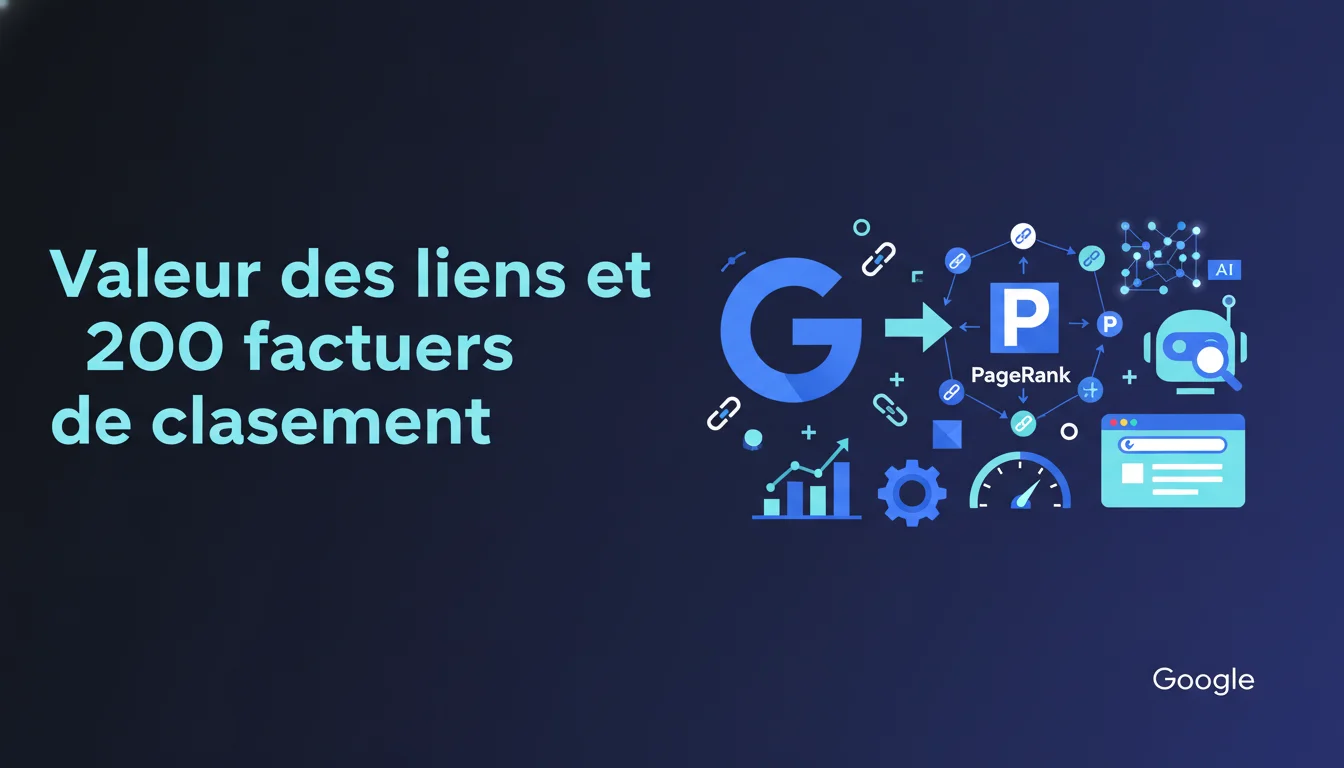
Google acknowledges the importance of PageRank and link volume while asserting that it utilizes over 200 ranking factors. The implication for SEOs: a strategy focused solely on acquiring backlinks risks volatility and loses effectiveness against competitors diversifying their strategies. Authority remains the long-term foundation, but it is no longer built solely through links.
What you need to understand
What does this mention of 200 factors really mean?
This statement from Google aims to moderate the historical obsession of SEOs with backlinks. The "200 factors" figure has circulated for years without ever being officially detailed. The goal is political: to discourage mass link buying practices and reposition the algorithm as a complex and holistic machine.
Specifically, Google admits that PageRank and the amount of links remain major signals, but refuses to elevate them as unique variables. Other factors include semantic relevance, behavioral signals, content freshness, editorial quality, Core Web Vitals, technical structure, topical authority, recognized entities, and many more. Some weigh heavily, while others serve as binary filters (mobile-friendly, HTTPS).
Why does Google say that focusing solely on links is not advisable?
Because the recent algorithms (Helpful Content, Product Reviews, Core Updates) increasingly evaluate the intrinsic quality of content and user experience. A site packed with backlinks but with mediocre content, a poor user experience, or negative behavioral signals (high bounce rate, low session time) will not sustainably remain in the top 3.
Google also wants to prevent SEOs from neglecting on-page and technical levers. A fast site, well-structured, with optimized internal linking and comprehensive content can outperform a competitor with more links but a shaky architecture. Links remain an accelerator, not a guarantee.
What does "building your authority" mean in this context?
Authority is not limited to the link profile. Google increasingly values topical authority: a site that covers a subject in depth, generates natural citations, brand mentions, direct searches, and positive engagement signals. This is the concept of E-E-A-T (Experience, Expertise, Authoritativeness, Trustworthiness) applied at the domain level.
Building this authority involves producing reference content, acquiring natural editorial backlinks, developing a presence on specialized networks and forums, and generating direct traffic. It's a foundational task that cannot be measured solely by Domain Rating or Trust Flow.
- PageRank and links remain critical factors, but their relative weight decreases against qualitative signals.
- The 200 factors are not all equal: some are binary, while others heavily influence ranking.
- Authority builds across multiple dimensions: links, content, behavioral signals, recognized entities, E-E-A-T.
- A mono-lever strategy (links only) exposes you to volatility from algorithm updates.
- Google is pushing for a holistic approach to discourage one-dimensional optimization tactics.
SEO Expert opinion
Is this statement consistent with field observations?
Yes and no. Correlation studies (Ahrefs, SEMrush, Moz) still show a strong correlation between the volume/quality of backlinks and positions. Links remain one of the most discriminative levers, especially in competitive sectors (finance, health, law). Claiming that they are just "one factor among 200" denies this empirical reality.
However, since 2021-2023, we have indeed observed that sites with mediocre link profiles but exhaustive content and strong user signals can rise to the top 10 on informational queries. Google increasingly favors sites that address search intent directly with structured content, even if their domain authority is average. [To be verified]: Google has never disclosed the actual weighting of the 200 factors, nor their evolution over time.
What nuances should we add to this statement?
The weight of links varies significantly depending on the type of query and the sector. For YMYL (Your Money Your Life) queries, backlinks from authoritative sources remain nearly mandatory. In less competitive niches or on informational long-tail queries, good content can compensate for a weak link profile.
The notion of authority is also ambiguous. Google never precisely defines this term. Is it about Trust Flow, number of referring domains, age, brand mentions, direct searches? Probably a mix of all these, but without clear visibility, it's difficult to optimize strategically. [To be verified]: no public metric faithfully captures what Google calls "authority".
When does this rule not apply?
For hyper-competitive queries ("car insurance", "mortgage credit", "divorce lawyer Paris"), links remain the dominant factor. No site ranks in the top 3 without a solid backlink profile, regardless of other signals. Google can repeat that there are 200 factors, but the top 10 are consistently sites with high DR/DA.
Similarly, in sectors where trust is critical (health, finance), links from recognized institutions (universities, reputable media, professional organizations) act as trust signals that cannot be compensated otherwise. A medical site without backlinks from scientific journals or hospitals will never break through, even with exhaustive content.
Practical impact and recommendations
What should you do to diversify your ranking levers?
Start by auditing your non-link signals: Core Web Vitals, bounce rate, session time, content structure, internal linking, mobile optimization, thematic coverage. Use Google Search Console to identify pages with good impressions but low CTR, a sign of a relevance issue or meta-description.
Next, strengthen your topical authority: cover your niche in depth with content clusters (pillars + satellites), work on entities and schema markup, develop a branding strategy (direct searches, mentions without links). The goal is to become a recognized reference in your field, not just a site with many backlinks.
What mistakes should you avoid in interpreting this statement?
Do not fall into the opposite trap: completely neglect backlinks under the pretext that there are "200 factors". Links remain a powerful accelerator, especially in competitive sectors. The idea is not to rely solely on them, not to abandon them.
Also, avoid believing that all factors weigh equally. Some (such as mobile-friendliness or HTTPS) are binary filters that exclude you if not respected, but do not propel you into the top 3 once valid. Others (links, semantic relevance, user signals) have a direct and measurable impact on ranking.
How can you verify that your strategy is balanced?
Analyze your organic traffic sources: if 80% of your visibility depends on a few highly optimized pages for links, you are vulnerable. A healthy profile shows a diversity of high-performing pages, with strong signals across multiple dimensions (technical, content, UX, links).
Use tools like Screaming Frog, Ahrefs, and Google Analytics to cross-reference data: pages with many backlinks but little traffic (relevance or UX issue), pages with few links but good traffic (strong behavioral signals), technical pages that are not optimized despite good content. These misalignments reveal your weaknesses.
- Audit your Core Web Vitals and fix critical issues (LCP > 2.5s, CLS > 0.1).
- Develop a content clustering strategy to strengthen topical authority.
- Optimize internal linking to redistribute PageRank and guide crawlers.
- Work on behavioral signals: CTR, session time, bounce rate.
- Do not neglect backlinks, but prioritize quality and thematic relevance.
- Integrate schema markup to help Google understand your entities and your expertise.
❓ Frequently Asked Questions
Les 200 facteurs de classement ont-ils tous le meme poids ?
Peut-on se classer sans backlinks si le contenu est excellent ?
Que signifie concretement "construire son autorite" selon Google ?
Les Core Web Vitals font-ils partie des 200 facteurs ?
Faut-il arreter les campagnes de link building apres cette declaration ?
🎥 From the same video 18
Other SEO insights extracted from this same Google Search Central video · duration 35 min · published on 29/04/2014
🎥 Watch the full video on YouTube →
💬 Comments (0)
Be the first to comment.