
Official statement
Other statements from this video 18 ▾
- 1:05 Contenu dupliqué : Google pénalise-t-il vraiment les pages canoniques ?
- 2:05 Faut-il vraiment manipuler les paramètres d'URL pour éliminer les contenus dupliqués ?
- 2:07 Faut-il vraiment s'inquiéter si Google indexe plusieurs versions d'une même page ?
- 5:26 Pourquoi Google ne vous montre-t-il qu'un échantillon de vos backlinks dans Search Console ?
- 5:46 Pourquoi Google ne vous montre-t-il qu'un échantillon de 1000 backlinks dans Search Console ?
- 7:26 Faut-il vraiment remplir les pages produits de texte pour le SEO ?
- 7:30 Comment optimiser efficacement une fiche produit pauvre en contenu textuel ?
- 7:56 Les liens naturels suffisent-ils vraiment à positionner un site en 2025 ?
- 8:24 Les liens naturels suffisent-ils vraiment à bâtir votre autorité SEO ?
- 10:44 Pourquoi Google insiste-t-il sur les 200 facteurs de classement alors que les liens dominent toujours ?
- 16:28 Faut-il vraiment optimiser titres et descriptions pour ranker en 2025 ?
- 22:00 Faut-il vraiment cibler une audience précise plutôt que viser large en SEO ?
- 23:38 Les sites de comparaison et d'avis ont-ils vraiment un avantage SEO ?
- 26:45 Sous-domaine ou sous-répertoire : Google fait-il vraiment une différence pour le SEO ?
- 30:40 Les liens de faible qualité sont-ils vraiment ignorés par Google ?
- 32:18 Les textes alternatifs d'images peuvent-ils vraiment différencier les variantes produits aux yeux de Google ?
- 33:45 Le design et les animations nuisent-ils vraiment au référencement naturel ?
- 33:45 Le temps de chargement impacte-t-il vraiment le SEO plus que le design visuel ?
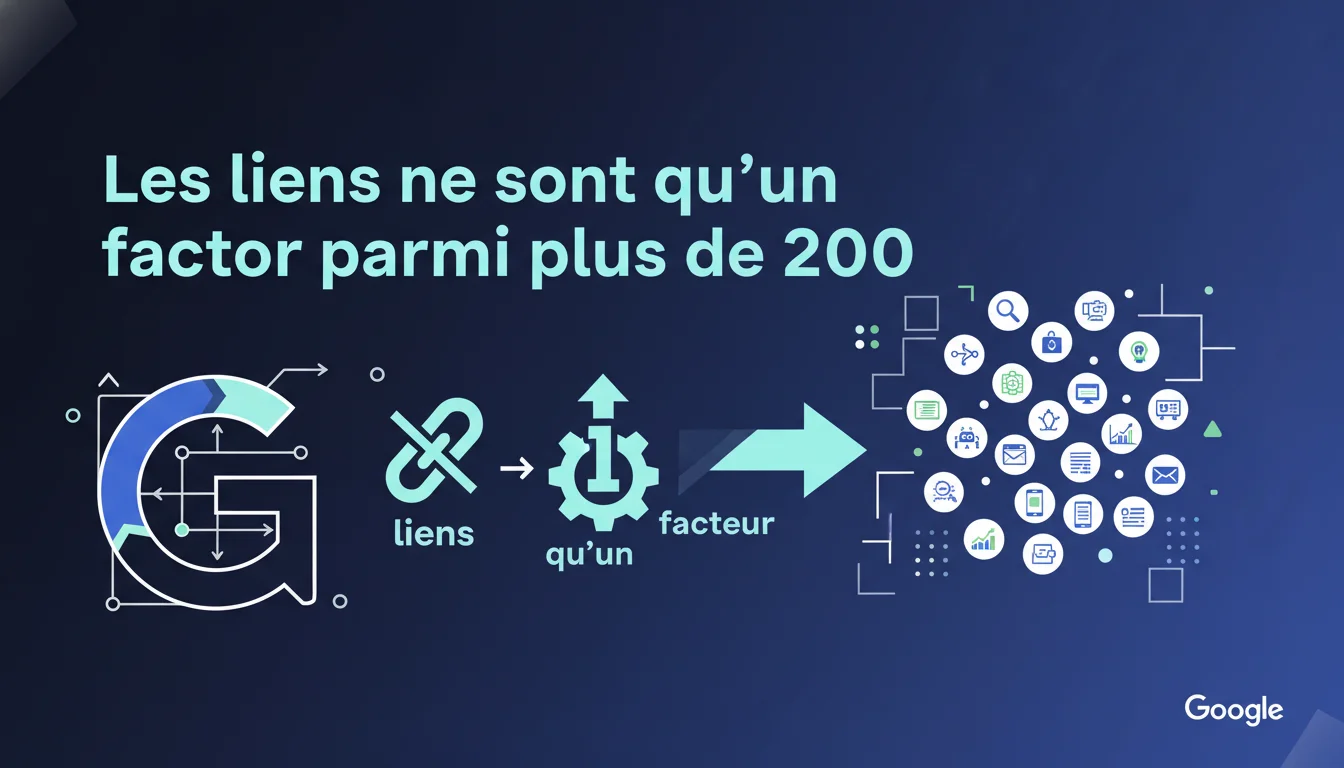
Google claims that links and PageRank are just one factor among over 200 in its ranking algorithm. This statement is aimed at tempering the SEO industry's historical obsession with link building. In practice, this does not mean that links are negligible, but that relying exclusively on them without addressing content, technical aspects, and user experience leads to failure.
What you need to understand
Where does this figure of "over 200 factors" come from?
Google has been repeating for years that its ranking algorithm incorporates hundreds of signals. The figure of 200+ has become an official mantra, but it remains deliberately vague. No exhaustive list has ever been published. Google sometimes mentions 200, sometimes several hundred, without ever clarifying if each variation of the same signal counts as a distinct factor.
What PageRank and links represent in this equation is not really known. Saying "one factor among 200" implies an importance of 0.5%, which would be absurd given the observable impact of backlinks. The wording is misleading: some factors weigh 100 times more than others. An authoritative link is not worth an obscure microformat.
Why does Google insist on this statement?
Because the SEO industry has long been obsessed with links. For more than a decade, link building was the kingpin. Buying, exchanging, spamming directories: the whole strategy revolved around PageRank. Google had to deploy Penguin and a variety of filters to break this model.
Today, Google wants to reposition the discourse: links matter, but not alone. The goal is to push webmasters to diversify their efforts. Quality content, technical architecture, engagement signals, mobile, speed… all of this must be on the table. Google no longer wants SEO to be reduced to a back-link hunting game.
What does this change concretely for a site?
This confirms what practitioners observe: a site with a poor link profile but excellent in all other areas can outrank a competitor loaded with backlinks but technically flawed. We see this on informational queries where sites without obvious authority rank in the top 3 because their content perfectly addresses the search intent.
Conversely, a technically perfect site but invisible to the web (zero external backlinks) will plateau. Links remain an irreplaceable signal of popularity and trust. Google's message is not "ignore links", it's "stop believing they are enough".
- Links remain a major factor, but their relative weight is diminishing in the face of the explosion of user experience and semantic relevance signals.
- No isolated factor guarantees ranking: an effective SEO strategy must be multidimensional.
- The algorithm is evolving: what worked 5 years ago (mass links) does not work the same way today.
- Quality outweighs quantity: 10 relevant links are worth more than 1000 worthless directories, but 10 links alone are not enough without solid content.
- Google wants to break one-dimensional strategies: betting everything on a single lever (links, keywords, speed) exposes you to the volatility of updates.
SEO Expert opinion
Is this statement consistent with what we observe in the field?
Yes and no. On competitive commercial queries, try to rank without quality backlinks: good luck. Sectors like finance, insurance, real estate, and health… it's impossible to break into the top 10 without a solid link profile. The sites that rank all have a foundation of authority built over the years.
However, on long-tail informational queries, we regularly see freshly published content, with zero external backlinks, occupying the first page. Why? Because Google prioritizes semantic relevance, freshness, and content structure. Links become secondary when search intent is ultra-specific.
So yes, links are just one factor among others, but their weight varies greatly depending on the type of query, competition, and sector. Google is not lying, but its wording obscures this complexity.
What nuances should we add to this message?
The first nuance: not all factors are equal. Saying "one among 200+" suggests an equivalence that does not exist. Some signals are decisive, others marginal. Links clearly belong to the first group, even if their historical dominance is eroding.
The second nuance: PageRank is no longer the only link signal. Google now uses dozens of variants: thematic authority, freshness of links, semantic context of anchors, growth patterns of profiles… Reducing this to "links" is an oversimplification. When Google says "links and PageRank", it refers to a family of signals, not a single score.
[To be verified] The third nuance: Google never communicates weighted figures. It is impossible to know if links weigh 5%, 15%, or 30% in the algorithm. This opacity is strategic: it prevents SEOs from over-optimizing a single lever. Therefore, be cautious of any definitive claims about the relative importance of factors.
In what cases does this rule not apply?
For branded queries, links matter very little. If someone types "Nike shoes", Nike.com will rank first even if a competitor had ten times more backlinks. Signals of notoriety, direct searches, and historical CTR overshadow everything else.
On ultra-local queries ("plumber Paris 15"), local SEO prevails: Google My Business, reviews, NAP citations, geographic proximity… Traditional backlinks play a minor role compared to these specific signals. A tradesperson without any external links can dominate their geographic area.
Finally, on news sites, freshness and speed of publication take precedence. An article published 10 minutes ago on Reuters can rank instantly in the top 3, even without a single backlink pointing to that precise URL. The factor of time temporarily overshadows other signals.
Practical impact and recommendations
What should you do concretely in your SEO strategy?
Stop concentrating 80% of your budget on link building. Yes, links remain important, but a site that is technically flawed or has mediocre content will never rank sustainably, even with a competitive link profile. Rebalance your efforts: 30% link building, 40% content, 30% technical and UX, is a much healthier ratio.
Adopt a multidimensional approach: regularly audit your site on all fronts. Core Web Vitals, internal linking, crawl depth, editorial quality, semantic structure, mobile… each flaw becomes a burden when the competition excels everywhere. Google rewards balanced sites, not champions of a single discipline.
What mistakes should you absolutely avoid?
Don’t fall into the trap of "everything but links". Some SEOs, after reading this statement, decide to completely skip link building. Mistake. On 90% of strategic queries, you plateau without quality backlinks. Google’s message is not "ignore links", it’s "don’t bet ONLY on them".
Avoid also the obsession with 200 invisible factors. Some spend weeks micro-optimizing marginal signals (exotic microdata, ultra-technical optimizations) hoping to gain 0.1% of an advantage. Focus on the fundamentals: strong content, clean technical setup, relevant links, smooth user experience. The rest is noise.
How to check if your strategy is balanced?
Conduct an honest audit of your effort distribution. If 70% of your SEO time goes into link prospecting, you are unbalanced. The same goes if you never touch the code, or if your content is three years old without updates. A healthy site evolves simultaneously on all fronts.
Compare your SEO profile with competitors who rank ahead of you. Not just their backlinks: also look at their speed, estimated bounce rate, content depth, and internal linking. Often, the gap does not come from a single factor but from an addition of small advantages across 10 different dimensions.
- Audit your site on at least 5 dimensions: content, technical, links, UX, mobile.
- Rebalance your budget: a maximum of 40% on a single lever (including link building).
- Measure your progress on each axis with dedicated KPIs (not just positions).
- Compare your multidimensional profile with the top 3 of your target queries.
- Regularly update your existing content, not just create new.
- Monitor the evolution of Core Web Vitals and fix regressions immediately.
❓ Frequently Asked Questions
Les liens sont-ils vraiment moins importants qu'avant pour le classement Google ?
Combien de ces 200+ facteurs faut-il optimiser pour ranker ?
Un site sans aucun backlink peut-il ranker en première page ?
Google publie-t-il la liste complète des 200 facteurs ?
Faut-il arrêter le netlinking après cette déclaration de Google ?
🎥 From the same video 18
Other SEO insights extracted from this same Google Search Central video · duration 35 min · published on 29/04/2014
🎥 Watch the full video on YouTube →
💬 Comments (0)
Be the first to comment.