
Official statement
Other statements from this video 18 ▾
- 1:05 Contenu dupliqué : Google pénalise-t-il vraiment les pages canoniques ?
- 2:05 Faut-il vraiment manipuler les paramètres d'URL pour éliminer les contenus dupliqués ?
- 2:07 Faut-il vraiment s'inquiéter si Google indexe plusieurs versions d'une même page ?
- 5:26 Pourquoi Google ne vous montre-t-il qu'un échantillon de vos backlinks dans Search Console ?
- 5:46 Pourquoi Google ne vous montre-t-il qu'un échantillon de 1000 backlinks dans Search Console ?
- 7:26 Faut-il vraiment remplir les pages produits de texte pour le SEO ?
- 7:30 Comment optimiser efficacement une fiche produit pauvre en contenu textuel ?
- 7:56 Les liens naturels suffisent-ils vraiment à positionner un site en 2025 ?
- 8:24 Les liens naturels suffisent-ils vraiment à bâtir votre autorité SEO ?
- 10:44 Pourquoi Google insiste-t-il sur les 200 facteurs de classement alors que les liens dominent toujours ?
- 13:13 Les liens représentent-ils vraiment moins de 0,5% des facteurs de classement Google ?
- 16:28 Faut-il vraiment optimiser titres et descriptions pour ranker en 2025 ?
- 22:00 Faut-il vraiment cibler une audience précise plutôt que viser large en SEO ?
- 23:38 Les sites de comparaison et d'avis ont-ils vraiment un avantage SEO ?
- 30:40 Les liens de faible qualité sont-ils vraiment ignorés par Google ?
- 32:18 Les textes alternatifs d'images peuvent-ils vraiment différencier les variantes produits aux yeux de Google ?
- 33:45 Le design et les animations nuisent-ils vraiment au référencement naturel ?
- 33:45 Le temps de chargement impacte-t-il vraiment le SEO plus que le design visuel ?
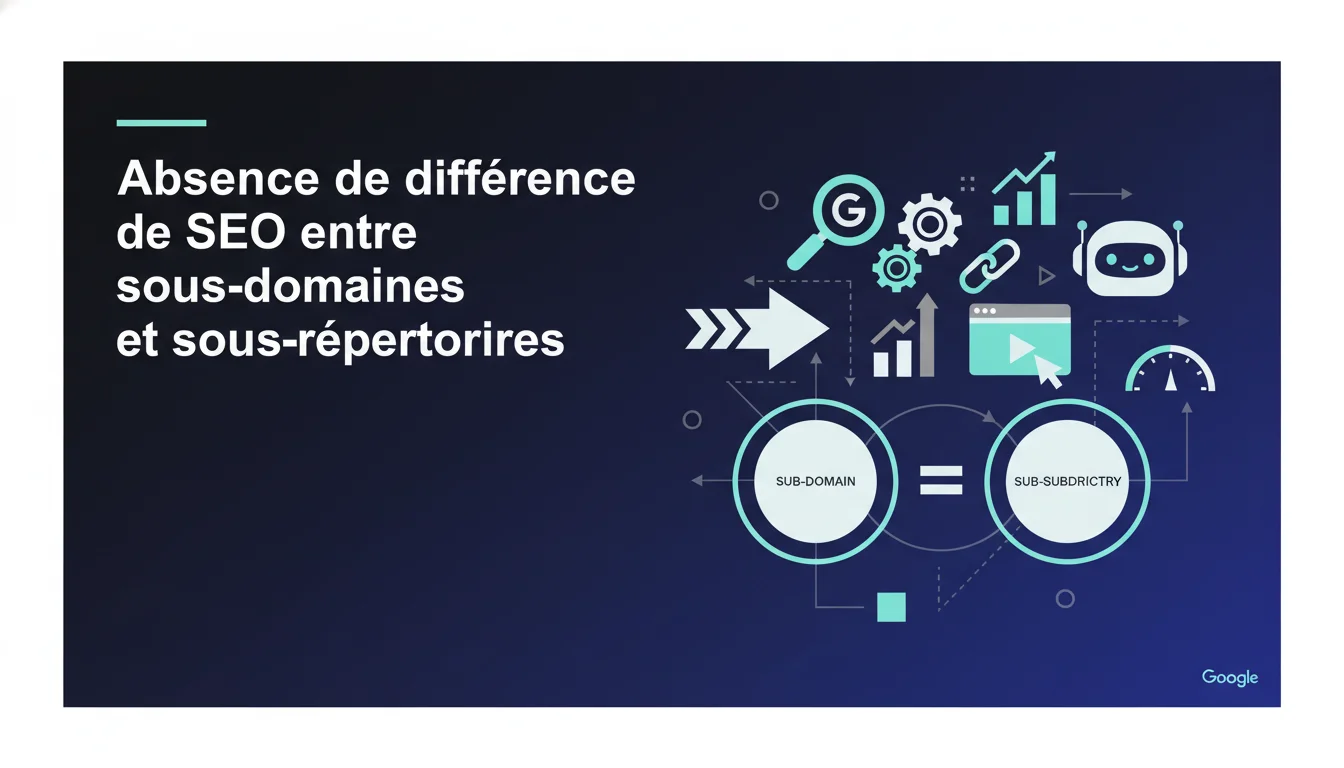
Google claims that no significant SEO difference exists between subdomains and subdirectories for a blog or section of a site. The choice should be made based on your technical and organizational constraints. However, this theoretical neutrality hides important nuances related to authority transfer, crawl budget, and backlink perception that every SEO should master.
What you need to understand
Does this statement challenge years of SEO practices?
For a long time, the SEO community has debated the optimal architecture between subdomains (blog.yoursite.com) and subdirectories (yoursite.com/blog). Google’s official position aims to settle this debate: technically, their algorithm treats both structures equivalently.
This assertion fits into a broader narrative in which Google repeats that URL architecture matters less than content quality and thematic relevance. Their system is supposed to recognize that a subdomain belongs to the same owner and is part of the same editorial ecosystem as the main domain.
Why does this question frequently arise among practitioners?
Real-world observations do not always align with this statement. Many SEOs find that identical content performs differently depending on whether it is located on a subdomain or in a subdirectory. Backlinks pointing to the main domain seem to benefit a subdirectory more directly than a subdomain.
The real issue lies in the authority transfer. A subdirectory naturally benefits from the root domain’s power, while a subdomain often has to build its own authority. While Google may claim to treat both similarly, the mechanisms for distributing PageRank do not work the same way in both cases.
What are the concrete implications for indexing and crawling?
Google allocates a crawl budget per domain. When you create a subdomain, you potentially fragment this budget among multiple entities. For a small site, the impact remains negligible. For a site with thousands of pages, this fragmentation can slow down the indexing of new pages.
Search Console and Analytics also handle subdomains and subdirectories differently. A subdomain often requires separate configuration, complicating the tracking and analysis of overall performance. This administrative separation reflects a technical reality that Google downplays in its communications.
- Google theoretically treats subdomains and subdirectories equivalently for ranking purposes
- Authority transfer and PageRank distribution function differently in practice
- Crawl budget can be fragmented with multiple subdomains
- Administrative and analytical management is more complex with subdomains
- Backlinks to the main domain benefit subdirectories more directly
SEO Expert opinion
Does this claimed neutrality align with real-world observations?
Let’s be honest: Google’s official position simplifies a reality that is much more nuanced. A/B tests conducted by several agencies show measurable performance differences between the two architectures. An e-commerce site that migrates its blog from a subdomain to a subdirectory generally experiences an improvement in organic traffic within 3 to 6 months.
This difference can be explained by the way authority signals propagate. An external link pointing to your main domain strengthens all the pages in the subdirectory through internal linking. For a subdomain, this transfer is less direct and requires explicit links between the main domain and the subdomain.
In what scenarios does a subdomain remain relevant?
Despite these limitations, certain contexts fully justify the use of subdomains. When you manage thematically distinct sections with separate teams, different technologies, or specific branding needs, a subdomain provides valuable technical flexibility.
Multilingual or multi-regional sites represent a legitimate use case: fr.yoursite.com, uk.yoursite.com. Similarly, a SaaS platform with a functionally distinct client area (app.yoursite.com) gains architectural clarity. In these situations, the potential SEO cost is outweighed by organizational and technical benefits. [To be verified]: the actual impact varies according to the main domain's SEO maturity.
What gray areas does Google not clarify?
The statement overlooks several critical points. How does Google determine that a subdomain belongs to the same owner? What signals does it use to establish this connection? Does a simple declaration in Search Console suffice? These questions remain without clear official answers.
The timing of recognition also poses a problem. Does a new subdomain take time to be associated with the main domain in the algorithm? Field reports suggest an observation delay of several weeks before Google fully processes the relationship between the two. During this period, the subdomain starts with an authority handicap.
Practical impact and recommendations
What architecture should be chosen for a new editorial project?
For a business blog or a resource section aimed at generating SEO traffic, the subdirectory wins out in 90% of cases. You immediately capitalize on the existing authority of your main domain, and each piece of content published strengthens the entire site through internal linking.
A subdomain is only justified if you have blocking technical constraints: incompatible technical infrastructure, a distinct team with a different tech stack, or the need to clearly separate environments for security or performance reasons. In all other cases, you complicate your life without real benefit.
How to correct a problematic existing architecture?
If your blog is already running on a subdomain and performing poorly, a migration to a subdirectory can unlock the situation. This technical operation requires careful 301 redirects, internal link updates, and close monitoring during the transition phase.
First, measure the actual performance gap. Compare the organic traffic of the subdomain to that of your main pages. If the gap exceeds 40-50% for similar quality content, the migration is worth considering. Anticipate an adjustment period of 2 to 4 months before seeing the full effects.
What mistakes should be absolutely avoided in this decision?
Do not create subdomains by default or out of habit. Each additional subdomain dilutes your SEO presence and complicates the governance of your digital ecosystem. Multiple subdomains often proliferate without a clear strategy, creating confusion for both Google and your users.
Another common trap is neglecting the linking between the main domain and the subdomain. If you opt for a subdomain, compensate for the authority handicap with regular contextual links from your main pages to your subdomain. Without this bridge, you create two isolated SEO islands that do not mutually reinforce each other.
- Systematically prefer the subdirectory unless there are major technical constraints
- Ensure that the technical team can manage a subdirectory before opting for a subdomain
- Implement clean 301 redirects during any architectural migration
- Create a solid internal linking structure between the main domain and subdomain if the latter is unavoidable
- Declare all subdomains in Search Console to facilitate tracking
- Measure the impact for 3 to 6 months after any architecture change
❓ Frequently Asked Questions
Un sous-domaine hérite-t-il automatiquement de l'autorité du domaine principal ?
Les backlinks vers mon domaine principal profitent-ils à mon blog en sous-domaine ?
Dois-je créer une propriété Search Console séparée pour chaque sous-domaine ?
Une migration de sous-domaine vers sous-répertoire comporte-t-elle des risques ?
Les sites multilingues doivent-ils utiliser des sous-domaines ou des sous-répertoires ?
🎥 From the same video 18
Other SEO insights extracted from this same Google Search Central video · duration 35 min · published on 29/04/2014
🎥 Watch the full video on YouTube →
💬 Comments (0)
Be the first to comment.