
Official statement
Other statements from this video 1 ▾
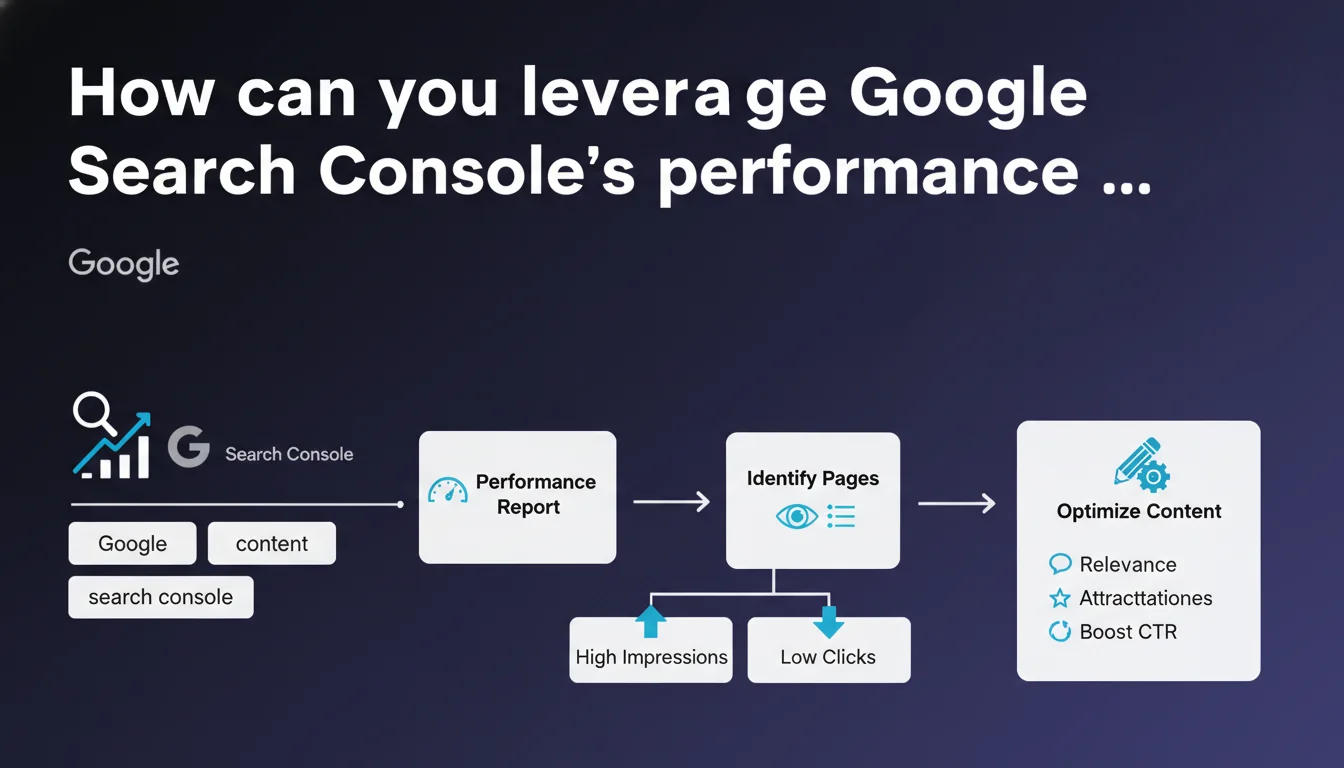
Google recommends using the Performance Report in Search Console to identify pages that generate many impressions but few clicks, then optimize their content to increase their attractiveness. The goal: improve CTR by working on the relevance and presentation of search results.
What you need to understand
Why does Google emphasize the performance report so much?
The Search Console performance report remains one of the most underutilized tools among SEO practitioners. Yet it reveals concrete opportunities: pages that rank, that get visibility, but that fail to convert that visibility into actual traffic.
This statement follows a simple logic — good ranking without clicks is a missed opportunity. Google pushes webmasters to analyze the gap between impressions and clicks to identify content that deserves editorial and structural optimization work.
What exactly constitutes a problematic click-through rate?
There is no universal threshold, and Google carefully avoids providing one. A 2% CTR at position 5 can be excellent in some industries and catastrophic in others. Context matters: search intent, SERP type, presence of featured snippets, richness of visual elements.
What really counts is the relative gap: if a page at position 3 underperforms compared to another at position 7 on similar queries, there's clearly an attractiveness problem. And that's where the analysis becomes relevant.
What levers does Google implicitly point to?
The recommendation deliberately remains vague — improve relevance and attractiveness. Concretely, this points to several avenues: title tags and meta descriptions, content structure, use of structured data, or even updating content to better match intent.
But be careful: Google doesn't say that optimizing CTR will directly improve your ranking. It says that well-ranking but rarely-clicked pages represent a waste of visibility.
- The performance report identifies pages with an unbalanced impressions/clicks ratio
- Low CTR often reveals a problem of alignment between the promise (title/description) and search intent
- Optimization should focus on SERP presentation, not just the page content itself
- You must compare relative performance between similar pages, not rely on generic benchmarks
SEO Expert opinion
Is this statement really new or useful?
Let's be honest: this recommendation isn't revolutionary. Any SEO practitioner already uses (or should use) the performance report to identify quick wins. What's missing is granularity: Google says nothing about thresholds, about correlations between CTR and ranking, about the real impact of title optimization on positions.
The problem is that Google conflates two distinct logics. On one hand, improving CTR to maximize traffic at constant position — a legitimate marketing objective. On the other, the underlying idea that CTR might influence ranking — something Google has always officially denied, while leaving room for doubt. [To verify]
What nuances should we add to this recommendation?
Optimizing CTR without thinking can be counterproductive. A sensationalist title that promises what the page doesn't deliver will boost CTR... and spike bounce rate. Google knows this, and so do its algorithms. Attractiveness should never sacrifice relevance.
Also, some pages naturally have low CTR, and that's normal. Simple informational queries often generate featured snippets or direct answers in the SERP — the user gets their answer without clicking. Trying to improve CTR in these cases is fighting the SERP structure itself.
In what cases does this approach not work?
Pages at positions 8-10 with few clicks don't necessarily deserve CTR optimization — they first need ranking optimization. Improving the meta description of an invisible page is pointless. Prioritize pages already on page 1, ideally at positions 3-7, where CTR improvement has measurable impact.
Practical impact and recommendations
What should you concretely do with the performance report?
The first step is to filter pages by descending impressions, then analyze their CTR relative to their average position. Spot anomalies: a page at position 3 with a 5% CTR is probably underperforming, unless the SERP is saturated with rich elements.
Next, compare the titles and descriptions of high-performing pages with underperforming ones. Look for patterns: length, tone, presence of numbers, explicit promises. Test variations, measure impact over 2-3 weeks. If CTR rises without bounce rate degradation, you've won.
What mistakes should you avoid in this process?
Don't fall into the clickbait trap. A title optimized for CTR that doesn't match the actual page content creates frustration — and Google will eventually demote the page if user signals degrade. The consistency between promise and content remains absolutely top priority.
Another classic mistake: focusing only on high-impression pages. Sometimes a niche page with 500 impressions/month and 2% CTR represents a better opportunity than a generic page with 10,000 impressions and 8% CTR. Look at absolute traffic potential, not just ratios.
How do you measure the effectiveness of your optimizations?
Use the date range comparison feature in Search Console. Isolate the pages you've optimized, compare CTR before/after over equivalent periods. Watch out for seasonal variations or ranking fluctuations that might bias your analysis.
Also monitor bounce rate and session duration in Google Analytics. If CTR increases but these metrics degrade, you've created a gap between promise and reality — you need to correct course quickly.
- Extract pages with >1,000 impressions/month and CTR below the median for their position
- Analyze titles/descriptions of competitors well-ranked on the same queries
- Rewrite tags by integrating differentiating elements: numbers, explicit benefits, action words
- Implement structured data (FAQ, HowTo, Product) to enrich SERP display
- Measure impact after 2-3 weeks, adjust if needed
- Never sacrifice relevance for attractiveness — consistency comes first
❓ Frequently Asked Questions
Le CTR est-il un facteur de ranking direct dans Google ?
Quel est un bon CTR moyen pour une page en position 3 ?
Peut-on trop optimiser un title pour le CTR ?
Les données structurées améliorent-elles vraiment le CTR ?
Faut-il optimiser toutes les pages avec beaucoup d'impressions ?
🎥 From the same video 1
Other SEO insights extracted from this same Google Search Central video · published on 31/10/2023
🎥 Watch the full video on YouTube →
💬 Comments (0)
Be the first to comment.