
Official statement
Other statements from this video 1 ▾
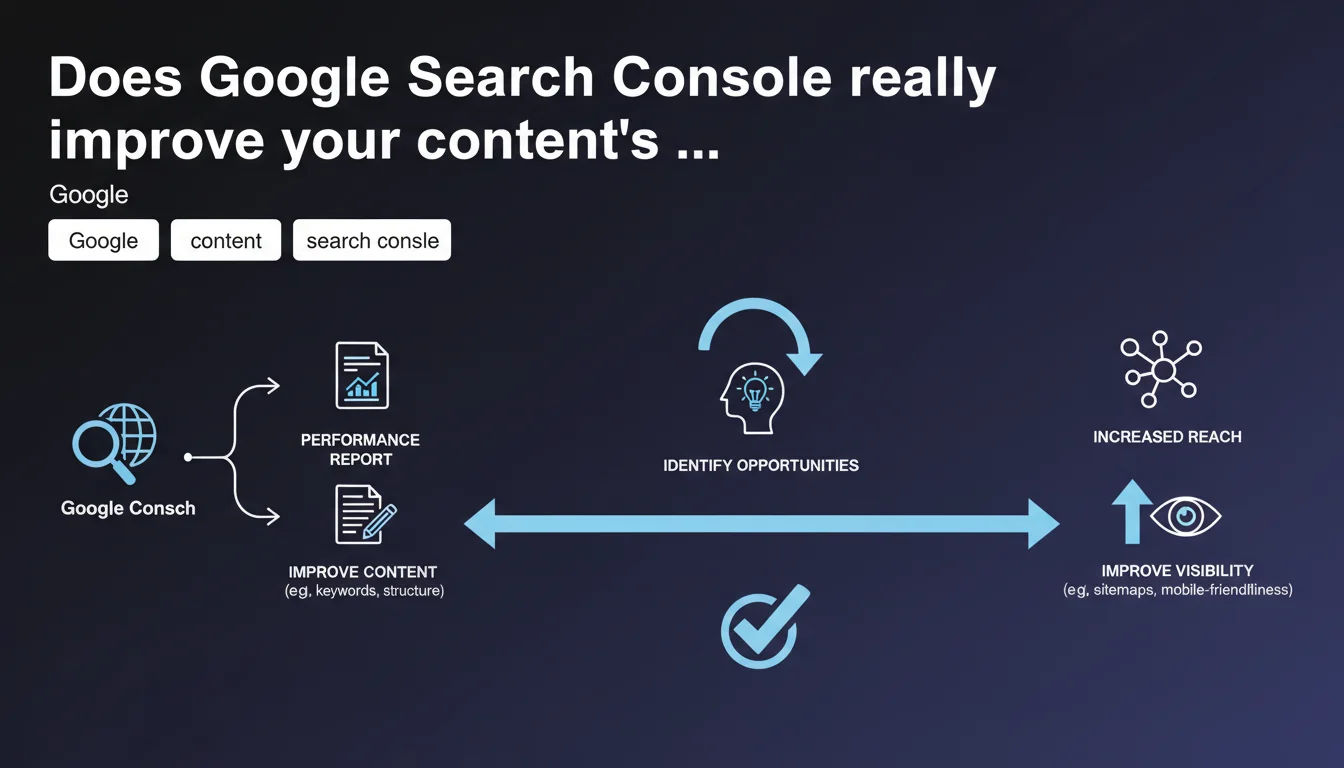
Google Search Console provides performance data on your pages to identify improvement opportunities. The tool analyzes reach and relevance, but remains a descriptive dashboard — not a magic solution that optimizes your content for you.
What you need to understand
What exactly does Google say in this statement?
Google presents Search Console as a tool for improving the reach and relevance of your content. Concretely, the tool analyzes page performance and identifies improvement opportunities.
This wording intentionally stays broad. Google talks about "information" and "opportunities," but doesn't detail which metrics to leverage or how to interpret them in a strategic context. Reach and relevance are marketing concepts, not precise technical KPIs.
What Search Console data allows you to act on these two axes?
For reach, performance reports (impressions, CTR, average positions) and index coverage data give you a view of the volume of crawled and displayed pages. On the relevance side, analyzing actual search queries allows you to adjust content to better match detected search intent.
But be careful: Search Console will never tell you "your content lacks depth" or "this page is off-topic." It shows signals — low impressions, mediocre positions, absent clicks — that you must interpret yourself.
What is the limitation of this Google tools approach?
Google promotes its own tool, which shouldn't be surprising. Search Console is useful, but it suffers from update delays, sampling on certain reports, and the absence of competitive context.
To truly improve reach and relevance, you must cross this data with semantic analysis, editorial content audits, and third-party tools that measure perceived quality by users — not just the metrics Google chooses to show you.
- Search Console provides performance and coverage data, not editorial diagnosis.
- Reach = exposure volume (impressions, indexed pages). Relevance = intent/content fit (deduced from queries).
- The tool does not replace strategic content and competitive analysis.
- GSC data has delays, sampling, and blind spots.
SEO Expert opinion
Is this statement consistent with practices observed in the field?
Yes, broadly speaking. SEO professionals use Search Console daily to spot underperforming pages, detect traffic drops, or identify high-potential queries. But Google's wording — "improve reach and relevance" — is too vague to be actionable as stated.
In practice, gains rarely come from Search Console alone. They come from a rigorous analysis methodology: cross-referencing GSC with Google Analytics (or GA4), crawl tools, semantic analysis, and content audits. Search Console is an entry point, not a turnkey solution. [To verify]: Google never specifies which metrics to prioritize or how to interpret them in specific competitive contexts.
What nuances should be added to this statement?
First point: Search Console only measures what Google chooses to show you. Some queries are hidden to "protect privacy," some reports are sampled beyond a certain threshold. You never get the complete picture.
Second point: "improving relevance" assumes you already know what relevant content looks like. GSC will tell you a page ranks poorly on a query, but it won't tell you why — or what needs rewriting, or whether the problem stems from content, structure, internal linking, or authority.
In what cases is this approach insufficient?
Search Console is ineffective at diagnosing editorial quality issues: pages that are too short, duplicated content across sections, vague wording, or inaccessible jargon. It also doesn't detect user experience problems that impact bounce rate or reading time.
Furthermore, GSC doesn't help you prioritize. You have 500 indexed pages with average positions between 15 and 30 — which ones should you optimize first? The tool provides no priority score based on business potential or improvement feasibility.
Practical impact and recommendations
What should you concretely do with Search Console data?
Start by identifying high-potential pages: those receiving many impressions but few clicks (low CTR), or those ranking between 5th and 15th place on strategic queries. These are quick wins.
Next, cross-reference actual queries with your existing content. If a page ranks on a query you hadn't consciously targeted, it's either an opportunity (create dedicated content) or a semantic drift signal (refocus the page on its core intent).
Finally, monitor index coverage to detect excluded pages, 404 errors, and misconfigured canonicals. A page that isn't indexed has no reach, regardless of its relevance.
What mistakes should you avoid when using Search Console?
Classic mistake: optimizing only average positions without looking at impression volume. A position 3 on a query with 10 monthly impressions won't change your traffic.
Another trap: believing every fluctuation in GSC is a signal for immediate action. Data has noise, seasonal variations, sampling artifacts. Don't react immediately — analyze trends over several weeks.
Finally, don't overlook mobile vs desktop performance. Performance can diverge significantly between devices, and Google indexes mobile-first. If your desktop data is good but mobile is mediocre, you have a structural problem.
How do you verify you're using Search Console well to improve reach and relevance?
Establish a weekly analysis routine: export performance data, filter by page or query, identify significant variations. Cross-reference with Analytics data to compare organic traffic with user behavior.
Document every optimization triggered by GSC and measure its impact after 4 to 6 weeks. If you modify a title tag or add content, note the date and check if average position, CTR, or impressions change.
- Identify pages with high impression volume but low CTR (optimize title/meta)
- Spot positions 5-15 on strategic queries (improve content/internal linking)
- Analyze actual queries to adjust page semantics
- Monitor index coverage to fix errors and exclusions
- Compare mobile vs desktop performance (mobile-first indexing)
- Cross-reference GSC data with Analytics to detect inconsistencies
- Document each action and measure impact after 4-6 weeks
❓ Frequently Asked Questions
Search Console suffit-elle pour optimiser la pertinence de mon contenu ?
Pourquoi certaines de mes requêtes n'apparaissent-elles pas dans Search Console ?
Quelle est la différence entre impressions et portée dans Search Console ?
Dois-je optimiser toutes les pages qui ont des impressions mais peu de clics ?
À quelle fréquence faut-il consulter Search Console pour améliorer son SEO ?
🎥 From the same video 1
Other SEO insights extracted from this same Google Search Central video · published on 31/10/2023
🎥 Watch the full video on YouTube →
💬 Comments (0)
Be the first to comment.