
Official statement
Other statements from this video 4 ▾
- □ Why does user and competitive analysis really make or break your SEO strategy?
- □ Does Google really understand what your site is about if you don't tell it clearly?
- □ Does Google really require you to remove 'fluffy content' from your pages to rank higher?
- □ Does complex SEO really matter to rank on Google, or is simplicity enough?
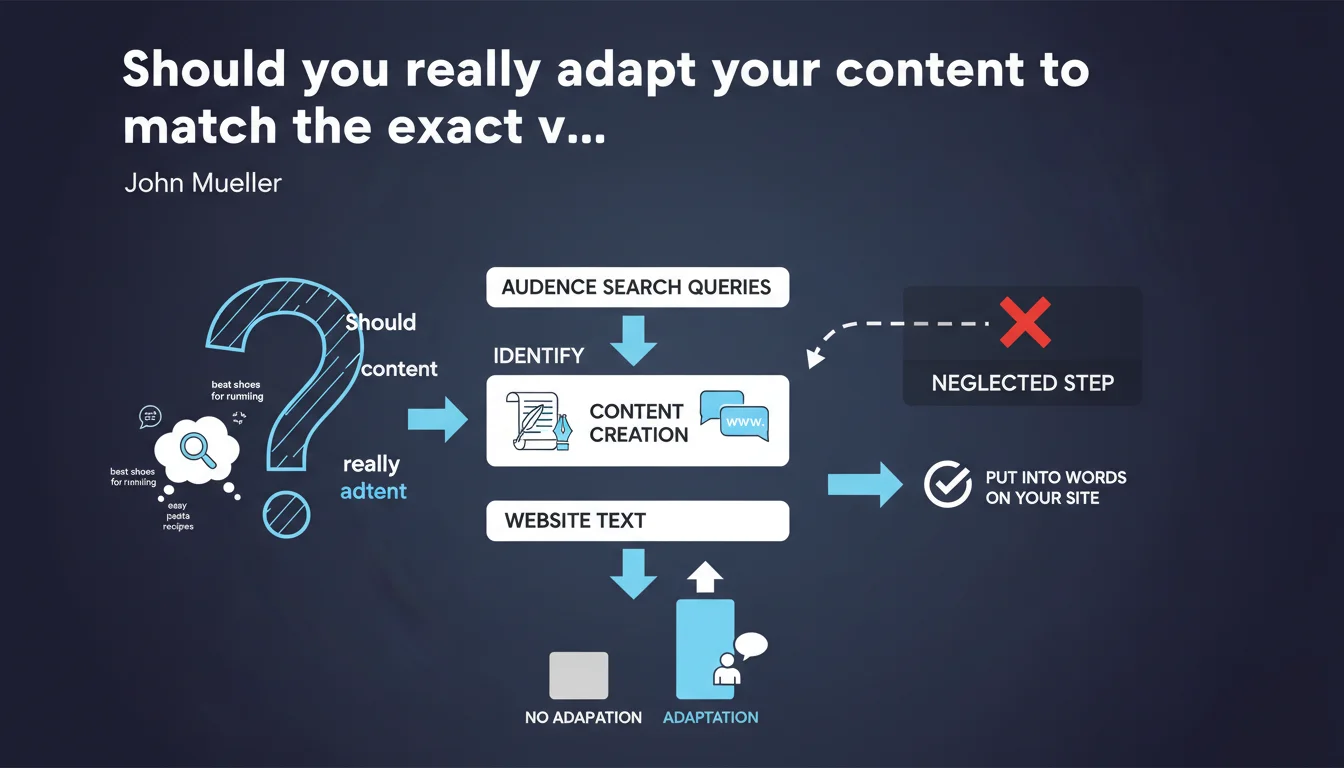
Google confirms that the match between the keywords used on your site and the terms searched by your audience remains a fundamental principle that is often overlooked. Mueller emphasizes the need to translate concretely into words what your audience is looking for, rather than imposing your internal jargon or editorial preferences.
What you need to understand
Why is Mueller reminding us of a 20-year-old SEO obvious truth?
This statement may seem bewilderingly banal to anyone who has practiced SEO for more than 6 months. Yet Mueller feels the need to reiterate this elementary principle: use the words your users type into the search bar.
The reason? A recurring observation on the ground. Too many sites use their internal vocabulary, their industry jargon, or worse — a marketing tone disconnected from actual search queries. The result: invisible pages despite potentially relevant content.
What does it concretely mean to "put into words what your audience is looking for"?
Mueller is not talking about keyword stuffing. He is talking about semantic alignment between search intent and the vocabulary used on the page. If your target audience searches for "mortgage loan no down payment", writing "residential financing with limited equity capital" will not work — even if it is technically equivalent.
This approach requires preliminary keyword research, but above all editorial discipline: give up your preferred vocabulary if it is not your audience's. It is less attractive than talking about content strategy or semantic architecture, but it is the foundation.
How can this be "often neglected" when it is taught everywhere?
Because there is a chasm between knowing and doing. Marketing teams often prioritize their brand positioning, writers their style, executives their internal terminology. SEO arrives at the end of the chain with an already-validated editorial charter that ignores actual searches.
Another trap: confusing content volume with semantic relevance. Producing 50 articles without ever using the exact terms your target audience searches for is building in a vacuum.
- Semantic alignment between content and actual audience queries
- Prioritize search vocabulary over industry or marketing jargon
- Need for preliminary and documented keyword research
- Editorial discipline to resist internal preferences
- Avoid confusing content volume with terminological relevance
SEO Expert opinion
Is this statement consistent with observed practices?
Yes, but with a major caveat. Google has significantly refined its semantic understanding in recent years — BERT, MUM, language models. In theory, the engine should understand that "employment law attorney wrongful termination" and "legal defense contested severance" target similar intentions.
In real-world practice? Pages that use the exact searched terms still massively outperform. Google's contextual understanding remains a bonus, not a crutch to compensate for unsuitable vocabulary. Especially on moderately competitive queries where the algorithm does not have 10,000 signals to refine its interpretation.
What limitations should be placed on this principle?
First pitfall: over-optimization. Mechanically repeating the same terms to match searches generates unreadable and counterproductive content. Google also values fluidity, synonyms, natural variations. Semantic alignment yes — disguised keyword stuffing, no.
Second limitation: some sophisticated sectors (finance, health, law) must juggle between necessary technical terminology and accessible popularization. It is impossible to use only public vocabulary when technical precision is an expertise criterion. The solution? Structure content in layers — accessible introduction with searched terms, technical development with industry jargon.
[To verify] Mueller does not specify how Google arbitrates between strict semantic relevance and overall content quality. On ambiguous or emerging queries, data is insufficient to decide. Empirically, a well-written page with slightly misaligned vocabulary can outperform a mediocre over-optimized page — but the quality delta must be significant.
In what contexts is this rule not sufficient?
On ultra-competitive queries, using the right keywords is a ticket to entry, not a competitive advantage. Everyone is already using them. The difference then comes down to domain authority, backlinks, site architecture, UX signals.
Another case: sites with strong brand reputation or loyal audience. Some traffic comes from branded searches or direct navigation — strict semantic alignment on generic queries matters less. But for 95% of sites without this crutch, Mueller's principle remains cardinal.
Practical impact and recommendations
What should you concretely do to align content and searches?
First step: identify the exact terms used by your audience. Google Search Console (Performance tab) shows you queries that generate impressions but few clicks — often a sign of semantic disconnect. Analyze queries that convert with your competitors (tools like SEMrush, Ahrefs).
Next, compare this data against your existing content. Conduct a page-by-page audit: do the identified terms appear in titles, H1s, the first 100 words, subheadings? If not, you have your rewriting roadmap.
Finally, establish a mandatory editorial process: every new page must start with validated keyword research, not a marketing idea. The writing brief must list terms to include imperatively — not as creative constraint, but as visibility guarantee.
What mistakes should you avoid in this semantic optimization?
Never sacrifice readability for optimization. A paragraph stuffed with poorly integrated keywords is immediately obvious — and Google measures bounce rate. The goal is to naturally use the searched terms, not artificially impose them.
Another trap: ignoring formulation variations. If your audience searches equally for "cheap car insurance" and "affordable auto insurance", cover both. Google understands semantic proximity, but why take the risk of using only one formulation when you can structure content to integrate both?
Last point — remember that search vocabulary evolves. Terms that worked 18 months ago may have been superseded by new formulations. Review your keyword research every quarter minimum, especially in dynamic sectors.
How can you verify your site respects this principle?
Use a crawl tool (Screaming Frog, OnCrawl) to extract Title tags, H1s, first paragraphs from all your strategic pages. Export to CSV, then compare this vocabulary with your priority keyword lists. The disconnect is often striking.
Also test the manual method: take your 20 most important pages, open them in private browsing, read the first 200 words. Ask yourself honestly whether someone typing your target query into Google would immediately recognize this page answers their question. If you hesitate, it does not.
- Extract actual queries from Google Search Console and competitor tools
- Audit existing vocabulary page by page (titles, H1s, introductions)
- Establish systematic editorial brief based on validated keywords
- Naturally integrate searched terms without over-optimizing
- Cover common formulation variations in your sector
- Revise keyword research every 3 to 6 months
- Measure semantic gap with regular site crawls
- Manually test immediate intent recognition on key pages
❓ Frequently Asked Questions
Utiliser des synonymes suffit-il ou faut-il vraiment reprendre les termes exacts des recherches ?
Comment identifier les termes que mon audience utilise vraiment ?
Dois-je réécrire tout mon contenu existant si le vocabulaire ne correspond pas ?
Le keyword stuffing est-il efficace si je veux vraiment utiliser les termes exacts ?
Cette règle s'applique-t-elle aussi aux recherches vocales et aux featured snippets ?
🎥 From the same video 4
Other SEO insights extracted from this same Google Search Central video · published on 17/08/2023
🎥 Watch the full video on YouTube →
💬 Comments (0)
Be the first to comment.