
Official statement
Other statements from this video 4 ▾
- □ Faut-il vraiment adapter son contenu au vocabulaire exact de sa cible ?
- □ Google peut-il vraiment comprendre de quoi parle votre site si vous ne le lui dites pas clairement ?
- □ Faut-il vraiment supprimer le « contenu superflu » de vos pages pour ranker ?
- □ Le SEO complexe est-il vraiment nécessaire pour ranker sur Google ?
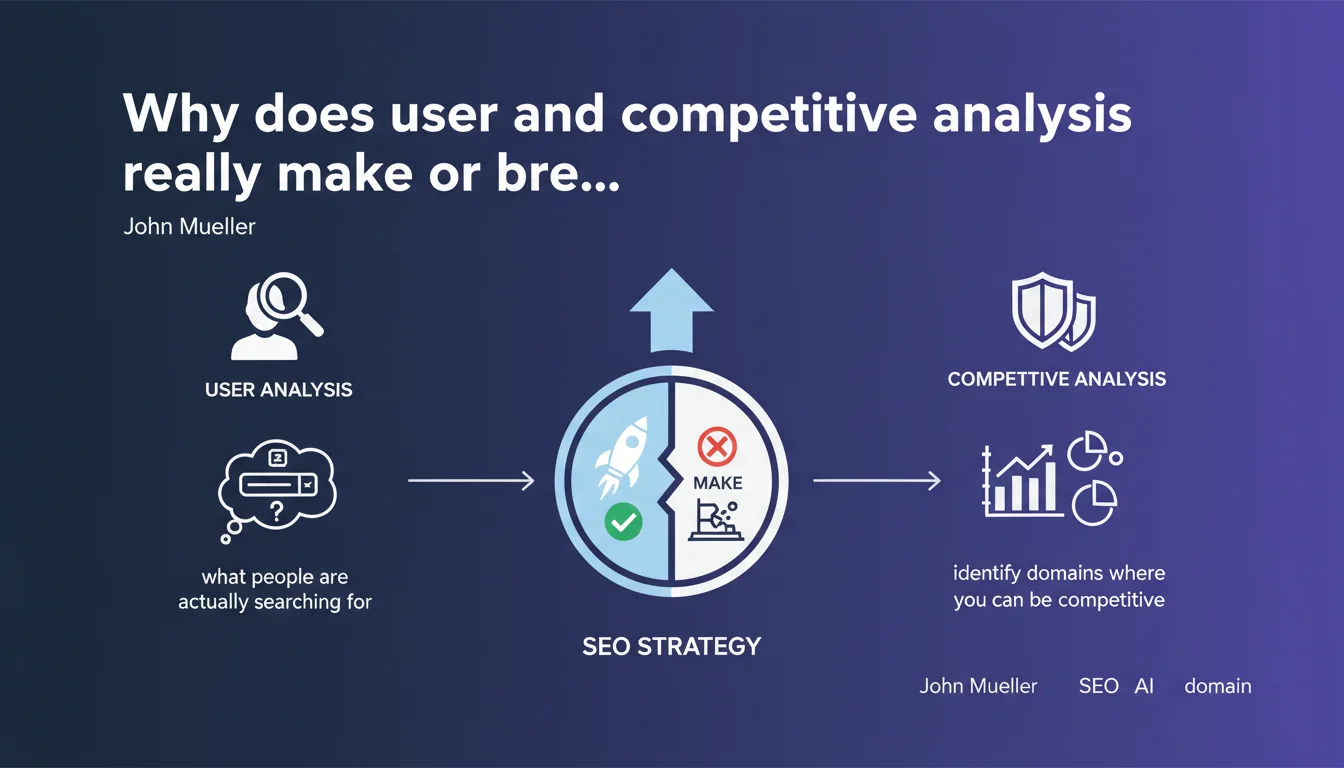
Google reminds us that understanding real search intentions and identifying exploitable competitive gaps remains fundamental. Without this dual analysis, it's impossible to prioritize your SEO efforts effectively. The message may sound basic, but it highlights a ground truth: many sites optimize for poorly suited queries or attempt to compete in spaces where they have zero chance.
What you need to understand
Is this statement so obvious it becomes hollow?
At first glance, yes. Understanding your users and competitors falls under basic marketing common sense. Yet John Mueller emphasizes this point — a sign that Google still observes too many sites optimizing "in a vacuum," without genuine market understanding.
Concretely? Sites targeting queries with theoretical volume but zero commercial intent, or stubbornly pursuing keywords where the top three positions are locked down by giants with 10 years of history and six-figure content budgets.
What does "understanding what people are actually searching for" really mean?
Not simply checking search volumes in a tool. It's about capturing the actual intent behind a query: does the user want to buy, compare, learn, solve an urgent problem?
Google continuously refines its understanding of intent through post-click behavior, bounce rates back to SERPs, query reformulations. If your content doesn't match the dominant intent Google has identified for a query, you'll rank poorly — even with technically flawless content.
How do you identify domains where you can genuinely compete?
Competitive analysis isn't about listing your rivals, but mapping the forces at play by query type. Some semantic spaces are saturated, others offer untapped angles.
Criteria to examine: domain authority (DR/DA), content depth, freshness, format diversity, E-E-A-T signals, internal linking quality. If all competitors on a query show DR 70+ with hundreds of backlinks, you're better off pivoting toward long-tail variants or specific angles.
- Search intent: decrypt what the user truly expects (informational, transactional, navigational)
- SERP analysis: observe which formats rank (long-form articles, videos, lists, interactive tools)
- Competitive gaps: identify queries where your rivals are absent or weak
- Feasibility: assess your actual capacity to produce objectively superior content with current resources
- ROI prioritization: target opportunities with high commercial potential and low barrier to entry first
SEO Expert opinion
Is this statement aligned with real-world observations?
Completely. But here's the problem: Google frames this as a strategic principle while offering zero operational guidance. How do you precisely evaluate search intent when Google itself mixes informational and commercial results on certain queries? How do you quantify your actual "competitiveness"?
The reality is Google will never tell you: "Your DR is 25, forget queries where Amazon and Wikipedia rank in top 3." You discover this at your own expense — or through years of field experience. [To verify]: Mueller implies there are always spaces where you can compete, but for new sites in ultra-saturated niches, that's debatable.
What interpretation mistakes must you avoid?
First mistake: believing "understanding users" means multiplying marketing personas and running focus groups. Wrong. In SEO, it means analyzing actual queries in Search Console, questions asked on forums, Google Suggest suggestions, and People Also Ask features.
Second mistake: confusing "competitive analysis" with "copying competitors." Observing what works for them is a starting point, but Google favors qualitative differentiation. If you replicate their exact strategy with fewer resources, you lose by default.
When does this approach reach its limits?
For news sites or ultra-volatile topics, competitive analysis has a lifespan of mere hours. Building long-term strategy is impossible when SERPs pivot daily.
Another limit: mixed or ambiguous intent queries. Sometimes even Google doesn't fully know what the user wants — hence SERPs mixing videos, products, articles, images. In this case, your "user understanding" remains one interpretation among many.
Practical impact and recommendations
What concrete steps should you take to apply this advice?
Start with an intent audit on your main queries. For each keyword you're targeting, manually analyze the top 10 results: which content type dominates? What depth? What editorial angle?
Next, cross-reference with your Search Console data. Identify queries where you rank 11-20: these are your low-effort opportunities. Often, recalibrating content toward dominant intent triggers a visibility jump.
How do you assess your true competitiveness on a given query?
Build a multi-criteria evaluation framework. For each top 10 competitor, note: domain DR, backlinks to that page, page age, content depth, visible E-E-A-T signals (identified author, cited sources, certifications).
If the median competitor shows DR 60+ and you're at DR 20, you have two options: target less disputed long-tail variants, or invest heavily in link building and premium content over 12-18 months. Be honest about your resources before committing.
What mistakes should you avoid in this process?
Don't rely solely on keyword tools to estimate intent. Volumes and CPC give clues, but only SERP analysis reveals the truth. A query with 5,000 volume can be worthless if intent doesn't match your offering.
Also avoid tunnel vision: too many SEOs analyze their 5 direct commercial competitors, when Google may favor indirect players (media, forums, aggregators) on certain queries. Broaden your radar.
- Audit your 20 priority queries: manually analyze SERPs to identify dominant intent
- Cross-reference Search Console and keyword tools to spot opportunities in positions 11-30
- Evaluate competitiveness via DR, backlinks, page age, content depth of top 10 results
- Identify 3-5 editorial angles unexploited by your direct competitors
- Prioritize queries where you can produce objectively superior content with current resources
- Implement monthly SERP monitoring on strategic queries to detect intent shifts
- Test long-tail variants or specific angles before attacking ultra-competitive queries
❓ Frequently Asked Questions
Comment identifier l'intention de recherche réelle derrière une requête ?
Faut-il analyser tous ses concurrents ou seulement les leaders de marché ?
Comment savoir si une requête est trop compétitive pour mon site ?
L'analyse concurrentielle est-elle valable sur le long terme ou faut-il la refaire régulièrement ?
Peut-on se fier uniquement aux outils de mots-clés pour cette analyse ?
🎥 From the same video 4
Other SEO insights extracted from this same Google Search Central video · published on 17/08/2023
🎥 Watch the full video on YouTube →
💬 Comments (0)
Be the first to comment.