
Official statement
Other statements from this video 4 ▾
- □ Why does user and competitive analysis really make or break your SEO strategy?
- □ Should you really adapt your content to match the exact vocabulary of your target audience?
- □ Does Google really understand what your site is about if you don't tell it clearly?
- □ Does complex SEO really matter to rank on Google, or is simplicity enough?
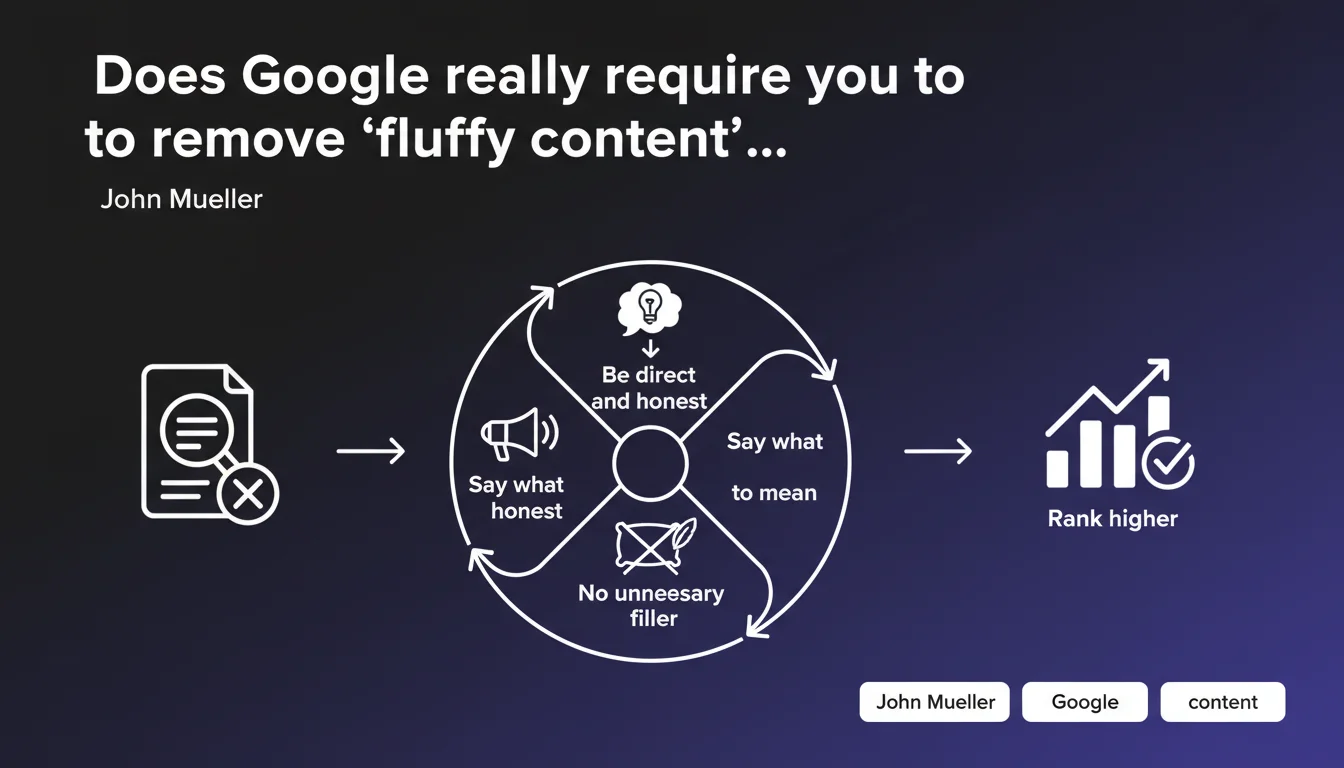
Google recommends getting straight to the point in your content and eliminating unnecessary filler. In practice, this means every section of a page must deliver real value to the user without diluting the main message through hollow paragraphs or repetitions. The challenge: how far should you trim without sacrificing the depth needed for strong SEO performance?
What you need to understand
What does Google actually mean by 'superficial content'?
Superficial content is anything that lengthens a page without adding informational value. Endless introductions that rephrase the same idea three times, 'historical context' sections unrelated to the search query, keyword repetitions disguised as semantic variations.
Google wants to reward pages that answer the search intent directly. If a user clicks and has to scroll three screens before finding the answer, that's a negative signal. The algorithm prioritizes information density over volume.
How does this directive fit into recent algorithm updates?
This statement aligns with the push toward Helpful Content. Google has repeatedly emphasized the need for content that serves users, not robots.
Sites penalized during recent Core Updates often shared a common pattern: pages artificially bloated to hit a 'magic word count' minimum, without that volume being justified by subject depth.
Does 'direct and honest' really mean 'short'?
No. Direct content can be 3,000 words if every paragraph delivers distinct information. The issue isn't absolute length, but the signal-to-noise ratio.
A technical page about network protocols can legitimately be long. A product page describing something simple in 2,000 words with semantic variations of the same argument—that's filler.
- Superficial content: anything that adds length without adding value (hollow intros, repetitions, off-topic tangents)
- Helpful Content: Google penalizes pages built for bots instead of answering real user questions
- Signal-to-noise ratio: the goal isn't word count, it's information density in each section
- Direct content isn't necessarily short, but every paragraph must justify its existence
SEO Expert opinion
Is this directive actually consistent with what Google rewards in rankings?
Yes and no. On clear informational queries, we do see that concise, well-structured pages outperform verbose blocks of text. A tutorial that gets to the point often beats an article burying the info in unnecessary context.
But on competitive queries or YMYL topics, length remains an indirect ranking factor—not for its own sake, but because it lets you cover more subtopics, capture more long-tail variations, and demonstrate deeper expertise.
[To verify]: Google provides no metric to distinguish 'helpful content' from 'filler.' We're flying blind on what exactly constitutes 'superficial' by their standards.
What nuances should you apply to this recommendation?
The meaning of 'direct' shifts with search intent. A transactional query ('buy X') demands immediate answers: price, availability, CTA. A complex informational query ('how does X work?') expects depth.
The risk is that publishers over-interpret this directive and produce content that's too skeletal. A 400-word article on a topic deserving 1,500 developed words is also a problem—you won't cover the semantic field adequately, won't address related questions, and lose thematic authority.
When does this rule not apply strictly?
In expert content targeting knowledgeable audiences, information density can require technical developments that seem 'heavy' but are essential. A 5,000-word SEO whitepaper isn't filler if every section delivers solid technical analysis.
Similarly, some editorial formats—long guides, exhaustive comparisons—justify their length through completeness. The issue isn't word count; it's when word count doesn't match the actual value delivered.
Practical impact and recommendations
What should you do with your existing content?
Audit your key pages with a critical eye. Identify sections that add nothing to user understanding or decision-making. Generic introductions, unnecessary definitions ('The internet is a global network…'), hollow transitions.
Run the 'cut test': remove a paragraph. If the page remains comprehensible and complete, it was filler. If you lose key information, keep it.
How do you structure new content to be 'direct and honest'?
Start with the answer or main point. Users scan—if essential information is buried in paragraph five, you lose engagement and behavioral signals.
Use clear subheadings that pose questions or promise concrete benefits. Avoid vague phrases like 'Some things to consider.' Go with 'What criteria should you verify before buying?'
One paragraph = one idea. If you're developing two different points in one block, split them. Scannability is a UX signal Google picks up through engagement metrics.
What mistakes should you absolutely avoid?
Don't artificially inflate to hit a fantasized 'minimum word count.' There's no magic threshold. A 600-word page perfectly targeted can outperform a 2,500-word block of diluted content.
Skip semantic reformulations without added value. Repeating 'SEO optimization,' 'natural search ranking,' 'Google position improvement' in consecutive sentences is noise. Google understands synonyms—no need to line them all up.
Don't delete useful content in the name of streamlining. If a section adds technical nuance, data, or concrete examples, it earns its place.
- Audit existing content to remove sections with no value-add (hollow intros, repetitions, off-topic digressions)
- Apply the 'cut test': if a paragraph can be removed without losing information, it's filler
- Structure new content starting with the main answer, before context
- Use clear, action-oriented or question-based subheadings, not vague phrases
- Keep each paragraph to a single idea to improve scannability
- Don't chase an arbitrary word quota—prioritize information density
- Avoid semantic reformulations that add no new meaning
- Preserve technical or detailed sections if they answer legitimate audience questions
❓ Frequently Asked Questions
Quelle est la longueur idéale d'un contenu selon cette directive de Google ?
Comment savoir si mon contenu contient du « remplissage » ?
Faut-il supprimer les introductions de mes articles pour aller « droit au but » ?
Est-ce que cette recommandation s'applique aussi aux pages commerce ?
Google pénalise-t-il vraiment les contenus trop longs ?
🎥 From the same video 4
Other SEO insights extracted from this same Google Search Central video · published on 17/08/2023
🎥 Watch the full video on YouTube →
💬 Comments (0)
Be the first to comment.