
Official statement
What you need to understand
Hreflang tags are HTML attributes that indicate to search engines the language and geographic target of a web page. They primarily serve to avoid duplicate content issues between linguistic versions of the same site.
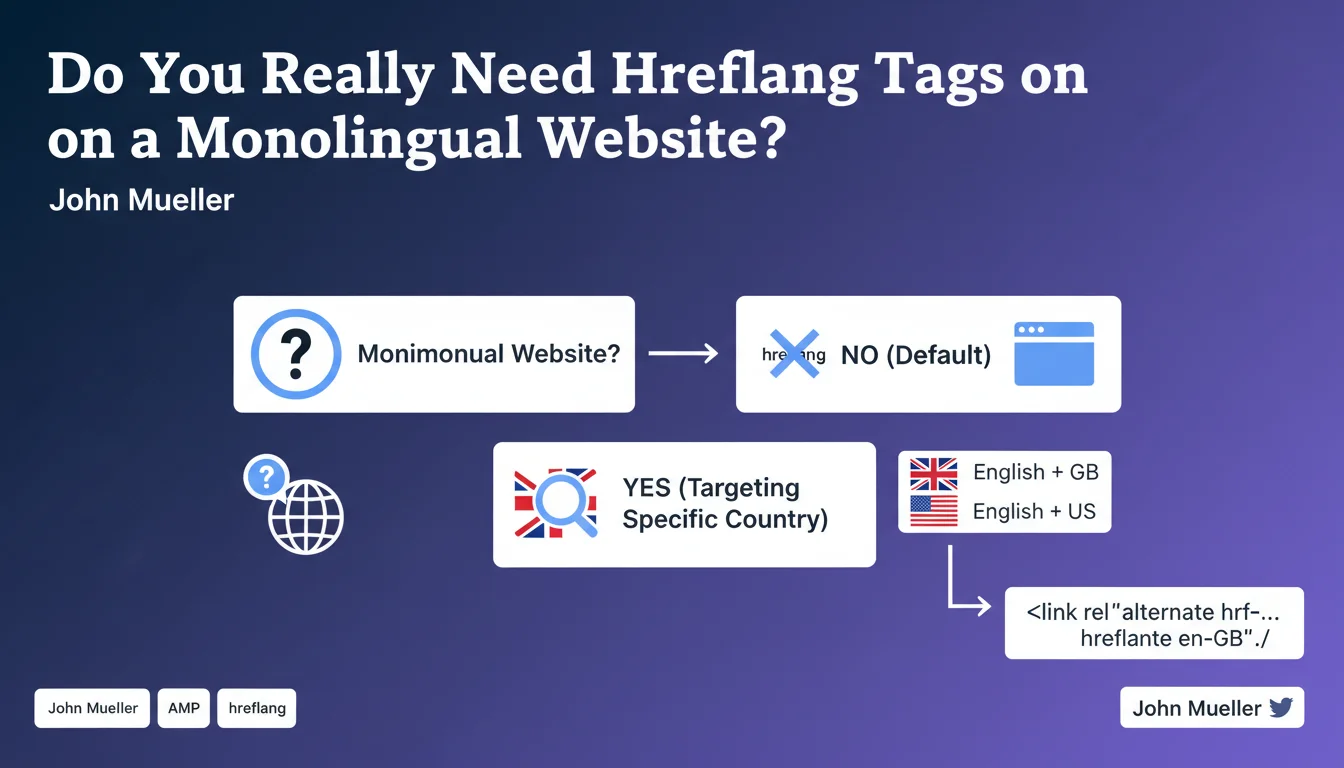
John Mueller clarifies an essential point here: a site published in a single language has no technical obligation to implement Hreflang tags. This clarification clears up a frequent confusion among SEO practitioners who thought these tags were systematically necessary.
However, Mueller introduces an important nuance for geographic targeting. Even with a single language, Hreflang tags allow differentiation of regional variants and improve the relevance of results according to the user's location.
- Monolingual site without geographic targeting: Hreflang tags are not necessary
- Monolingual site with multi-country targeting: Hreflang tags remain relevant (e.g., en-GB vs en-US)
- Multilingual site: Hreflang tags are strongly recommended to avoid cannibalization
- The tags serve for correct version association, not solely for translation
SEO Expert opinion
This statement is perfectly consistent with field observations. Many monolingual sites without international ambitions function very well without Hreflang, which confirms that Google does not make it a direct ranking criterion.
The real added value of Hreflang appears in contexts of differentiated geographic targeting. An English-language e-commerce site serving the United Kingdom, United States, Australia, and Canada will benefit significantly from this implementation to display the correct version according to the user's location.
There are also edge cases where the recommendation may be nuanced. For example, a site targeting only France but offering content in French might want to specify fr-FR to avoid appearing in results for Belgium, Switzerland, or French-speaking Canada, even if it's not strictly necessary.
Practical impact and recommendations
- Audit your context: Identify whether your site is truly multilingual or multi-geographic before any implementation
- Monolingual site, single country: Don't waste time on Hreflang, focus on content and other SEO signals
- Monolingual site, multi-country: Implement Hreflang to differentiate en-US, en-GB, en-AU, en-CA with appropriate regional variants
- Check consistency: If you implement Hreflang, ensure that each page references all its variants, including itself
- Favor a single method: Choose between HTML tags, XML sitemap, or HTTP headers, avoid mixing approaches
- Test systematically: Use Search Console to validate your implementation and identify errors
- Document your strategy: Create a correspondence table between URLs, languages, and targeted countries to maintain consistency
- Remove if not relevant: If you have Hreflang tags without a real targeting need, consider removing them to simplify your architecture
The technical implementation of Hreflang tags, while conceptually simple, requires in-depth expertise to avoid pitfalls. Between validating ISO codes, managing bidirectional references, implementation choices, and continuous monitoring of errors in Search Console, this optimization can quickly become time-consuming.
For sites with complex international architectures or large catalogs, support from a specialized SEO agency helps secure implementation, avoid costly errors, and focus on your core business while benefiting from proven expertise on these advanced technical aspects.
💬 Comments (0)
Be the first to comment.