
Official statement
What you need to understand
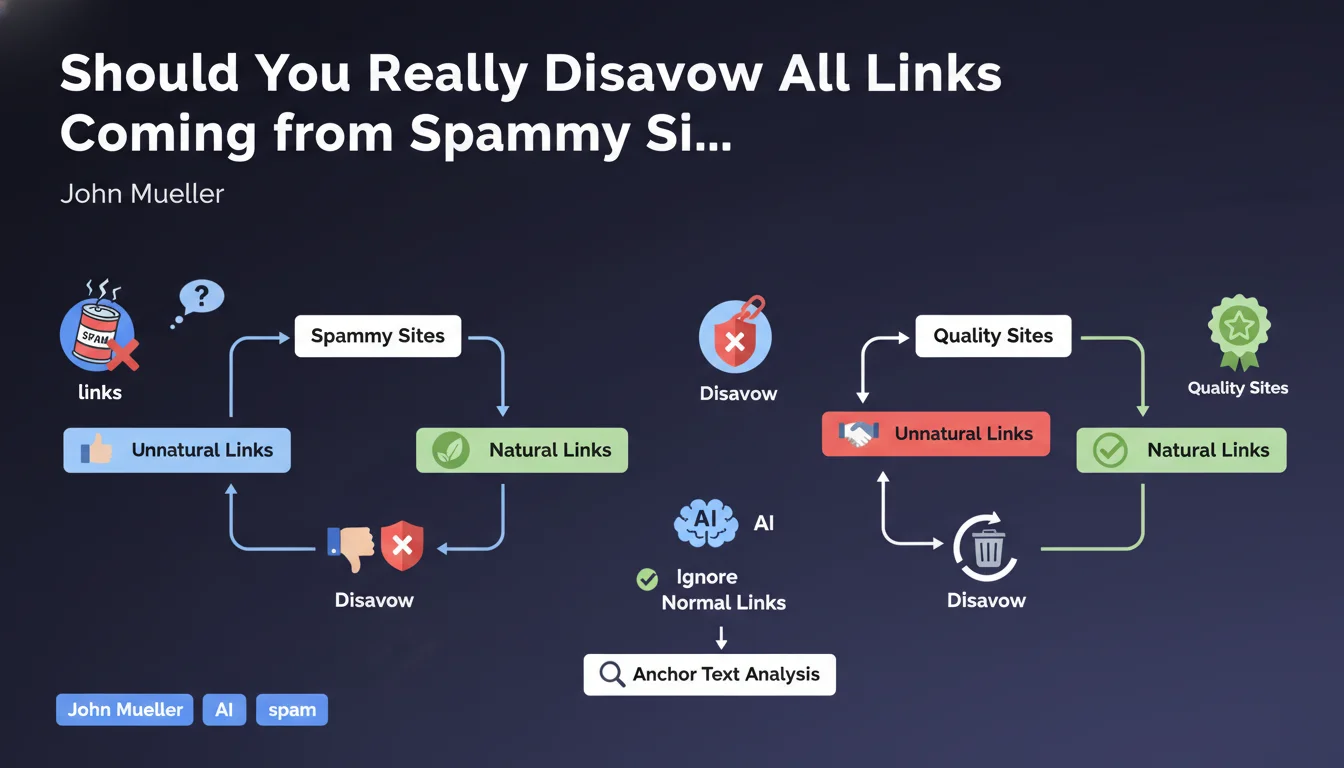
This official statement from Google provides essential clarifications on managing spammy links, particularly in the context of Negative SEO attacks. The specific case addressed concerns massive links from low-quality sites that point to non-existent URLs (404 pages) on a target site.
Google confirms that its algorithm automatically ignores links pointing to 404 pages. This means these links have no impact, either positive or negative, on the site's ranking. The explanation is logical: if the destination page doesn't exist, the link cannot transmit any value (link juice) or any negative signal.
Regarding the disavow tool, Google clarifies how it works: when a link is disavowed, the system is explicitly informed to not take this link into account in any way, whether beneficial or harmful. This complete neutralization helps protect a site against potential external manipulation.
- Links to 404 pages are automatically ignored by Google
- Disavowal completely neutralizes a link (neither positive nor negative)
- It's possible to disavow an entire domain rather than individual links
- These situations don't require complex or time-consuming actions
- The risk of Negative SEO through this method is therefore very limited
SEO Expert opinion
Google's position is consistent with field observations over several years. Documented cases of successful Negative SEO through massive spammy link creation are extremely rare, and practically non-existent when these links point to 404s. Google's algorithms are sophisticated enough to identify and neutralize these abnormal patterns without manual intervention.
Nevertheless, some important nuances deserve to be highlighted. If spammy links point to actually existing and indexed pages, particularly strategic pages, the situation may be different. In this case, although Google claims to handle link spam automatically through its algorithms, preventive disavowal may be wise, especially if the influx of links is massive and sudden. Additionally, the psychological impact on third-party metrics (Ahrefs, Majestic, etc.) may worry some clients, even if technically Google doesn't take them into account.
Practical impact and recommendations
This statement considerably simplifies the management of suspected Negative SEO attacks and allows you to prioritize your time on more impactful optimizations.
- Don't panic if you notice spammy links to 404 pages - they are automatically ignored
- Use domain-wide disavowal rather than link by link to save time ("domain:" option in the disavow file)
- Limit the time spent analyzing this type of links - focus on on-site optimizations and content
- Maintain an updated disavow file for clearly spammy domains, but without daily obsession
- Monitor links to your existing strategic pages instead - that's where the real potential risk lies
- Don't invest in expensive tools solely to monitor this type of ineffective attack
- Document massive attacks with screenshots, but without urgent action if they target 404s
- Avoid creating pages just because spammy links point to non-existent URLs
💬 Comments (0)
Be the first to comment.