
Official statement
What you need to understand
Why does Google take so long to reassess a site after content cleanup?
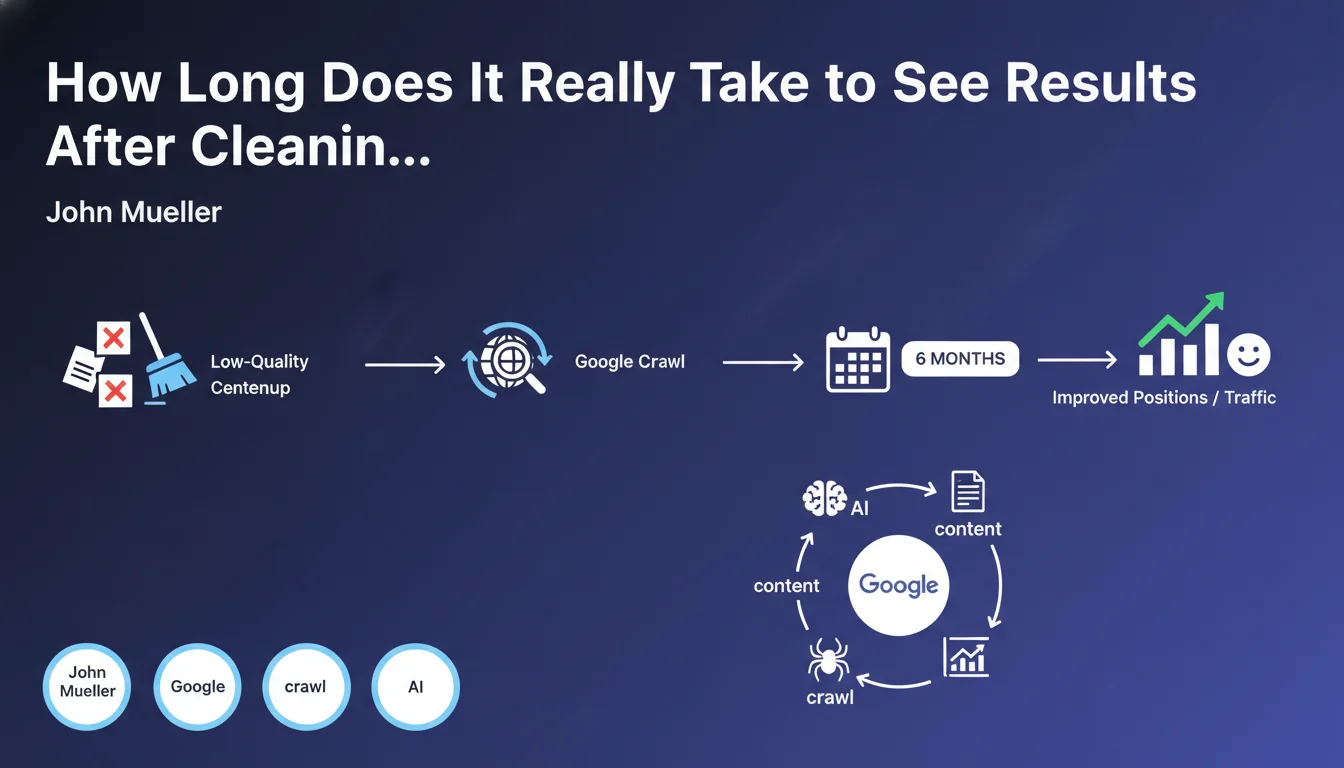
The 6-month timeframe mentioned by Google is explained by the crawling and global reassessment process of the site. Google doesn't visit all pages of a site simultaneously, but proceeds in successive waves based on the allocated crawl budget.
For a quality change to be taken into account, Google must have recrawled enough pages to have an updated overview. Only after this global reassessment can the algorithm adjust its perception of domain quality and impact rankings.
What factors influence how quickly a site gets reassessed?
The timeframe mainly depends on the site's size and its crawl budget. A small site with a few hundred pages can be fully recrawled in a few weeks, while a site with several thousand or millions of pages will require several months.
The content update frequency, domain authority, and technical structure also influence how quickly Google revisits pages. Sites with frequent crawling will see effects more quickly.
What are the key takeaways from this statement?
- Massive quality improvements require significant latency time before impacting rankings
- The 6-month timeframe is an indication for large sites, not an absolute rule
- Google must have an updated global view of the site to adjust its quality assessment
- Site size and crawl budget are the determining factors for this timeframe
- Patience is necessary: results are not immediate after structural modifications
SEO Expert opinion
Does this statement match what SEO practitioners actually observe?
This information from Google indeed corresponds to field observations by SEO experts. Quality improvement projects (thin content removal, weak page overhauls) rarely show results before 2-4 months, and sometimes much longer.
However, the range is highly variable. On sites with fewer than 1000 pages with good crawl rates, the first signs of improvement can appear within 4-6 weeks. On sites with several tens of thousands of pages, 6 months is sometimes even optimistic.
What important nuances should be added to this statement?
It's crucial to distinguish between different types of modifications. Technical changes (fixing 404 errors, speed improvements) or content on already well-crawled pages can have a faster impact, sometimes within a few weeks.
On the other hand, modifications aimed at changing the global quality perception of the domain (massive removal of weak content, improvement of hundreds of pages) require this long reassessment period. This is a warning signal: don't expect immediate results.
In which cases can these timeframes be shortened or extended?
Timeframes can be significantly reduced on sites with excellent technical infrastructure, a well-designed dynamic sitemap, and strategic use of IndexNow or Search Console to signal important changes.
Conversely, sites with major technical issues (low crawl budget, recurring server errors, deep structure) will see these timeframes extend considerably. A penalized site or one with a spam history may also require even more time to regain Google's trust.
Practical impact and recommendations
What should you actually do to optimize these reassessment timeframes?
First and foremost, optimize your crawl budget by eliminating unnecessary pages from crawling (facets, superfluous URL parameters) and strategically using robots.txt and noindex tags. Ensure important pages are easily accessible.
Use Search Console to submit modified or deleted URLs. Update your XML sitemap to reflect the new structure and actively submit it. Monitor coverage reports to identify crawl issues.
Improve your freshness signals by regularly updating retained content, adding modification dates, and maintaining regular editorial activity. This encourages Google to crawl more frequently.
What critical mistakes should you avoid during this transition period?
Don't change your strategy too quickly. Many SEOs panic after 2-3 weeks without results and cancel their modifications or make new ones. This prevents Google from having a stable view of the site and delays results even further.
Avoid deleting content massively without analysis. Each deletion should be justified by data (traffic, conversions, actual quality). Overly aggressive deletion can negatively impact pages that were generating long-tail traffic.
Don't neglect appropriate 301 redirects for deleted content that had backlinks or traffic. Sloppy management of deletions can lead to loss of link equity and traffic.
How do you track and measure the impact of your actions during this period?
- Document precisely the date of each important modification (deletions, improvements) to correlate with subsequent traffic changes
- Monitor the crawl rate in Search Console to verify that Google is actually revisiting your modified pages
- Analyze the evolution of positions on keyword groups rather than individual queries to detect trends
- Measure engagement metrics (time on page, bounce rate) on improved pages to validate the quality of modifications
- Create segments in Analytics to isolate traffic from modified pages versus the rest of the site
- Check the indexing status of modified pages to confirm they are being recrawled and reindexed
- Track the evolution of the number of indexed pages if you've performed massive deletions
💬 Comments (0)
Be the first to comment.