
Official statement
What you need to understand
What is Google's official stance on links from adult sites?
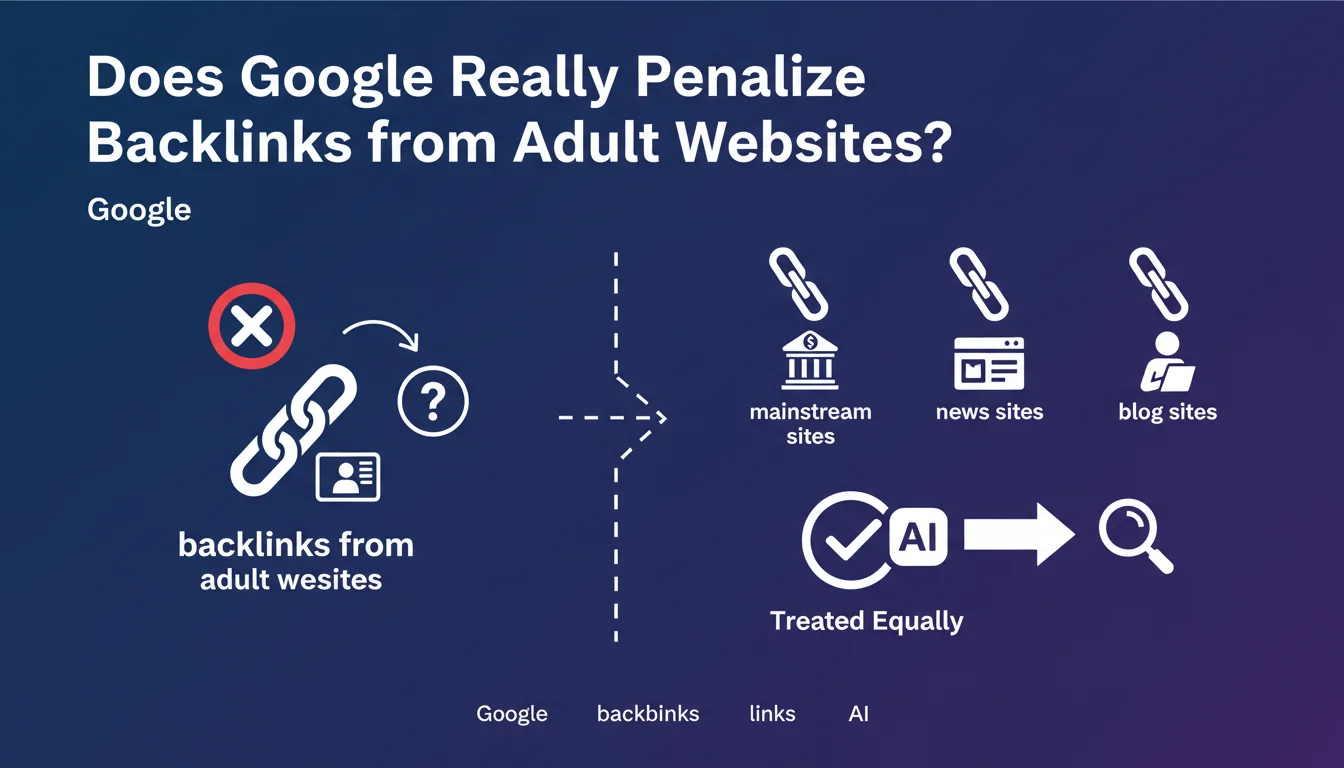
Google clearly states that backlinks from adult sites do not undergo any discriminatory treatment in its ranking algorithm. Apart from the SafeSearch filter, which allows users to filter sensitive content, no other specific filter is applied to these sites.
This statement confirms that the search engine evaluates links based on their intrinsic quality, not on the theme of the source site. A link remains a recommendation signal, regardless of where it comes from.
Why does this clarification matter for SEO practitioners?
This clarification debunks a widespread belief in the SEO community that links from adult sites are automatically toxic or penalizing. This misconception has pushed many webmasters to systematically disavow these links.
Google thus reaffirms that its algorithm analyzes the quality signals of the link itself: contextual relevance, source page authority, anchor text, etc. The nature of the source site's content is not in itself a devaluation criterion.
How does Google distinguish adult sites from other sites?
The search engine uses its SafeSearch system to identify and categorize adult content. This system allows users who activate it to filter results containing explicit content.
However, this categorization does not affect PageRank or how links are evaluated. It serves solely for user filtering purposes, not for algorithmic devaluation of links.
- No automatic penalty: adult sites are not discriminated against in the algorithm
- SafeSearch is independent: this user filter does not impact the calculation of link value
- Qualitative evaluation: links are judged on their own merits, not on the source theme
- Equal treatment: an adult link follows the same rules as a mainstream link
SEO Expert opinion
Is this statement consistent with real-world observations?
As an SEO expert, I can confirm that this position from Google is generally consistent with what we observe in link profile analyses. Sites receiving backlinks from adult sources do not show systematic penalties related solely to this origin.
However, there is an important nuance: if many adult sites use spam techniques (link farms, artificial networks, over-optimized anchors), it is these practices that are penalized, not the theme itself. The correlation between adult sites and spam can create confusion.
What nuances should be added to this statement?
Google's statement is true in principle, but several contextual factors deserve attention. A link from a high-authority adult site, with relevant editorial context, can indeed transmit value.
On the other hand, adult sites often present atypical link profiles: unbalanced outbound/inbound ratio, unnatural link patterns, generic anchors. These characteristics can trigger warning signals in the algorithm, independent of the adult theme.
In what cases might this rule not fully apply?
For certain regulated industries (finance, health, children), receiving links from adult sites may raise questions of thematic consistency and reputation. Google might consider these associations as unnatural or manipulative.
Moreover, E-E-A-T criteria (Experience, Expertise, Authoritativeness, Trustworthiness) can indirectly affect perception. A YMYL site receiving massive links from adult sites could see its credibility questioned, even if the link itself is not technically devalued.
Practical impact and recommendations
Should you systematically disavow links from adult sites?
The answer is clearly no. Automatically disavowing these links is an outdated practice that can even cause you to lose valid PageRank. Google recommends reserving disavowal for cases of proven spam or manual actions.
Focus instead on the qualitative analysis of each link: does it come from a page with real content? Is the context natural? Is the anchor over-optimized? These criteria matter far more than simply the theme of the source site.
How do you analyze the real quality of a backlink from an adult site?
First assess whether the link presents manipulation signals: footer placement, satellite page without content, exact commercial anchor, absence of editorial context. These elements indicate a low-quality link, regardless of its source.
Then examine the metrics of the source site: real organic traffic, incoming link profile, content freshness, page indexation. A legitimate and active adult site can transmit value just like a mainstream site.
What should you do if your site receives massive unsolicited links from adult sites?
If you notice a negative SEO attack with a sudden influx of suspicious links, first document the pattern. Check whether these links correspond to a coordinated campaign with identical anchors or grouped dates.
In this specific case, and only this one, a targeted disavow file may be justified. But wait to see a real negative impact on your rankings before acting, as Google generally handles these situations automatically well.
- Do not automatically disavow links from adult sites
- Analyze the intrinsic quality of each link (context, anchor, placement)
- Favor a qualitative rather than thematic approach
- Reserve disavowal for cases of obvious spam or documented negative attacks
- Monitor your link profile to detect abnormal patterns
- Focus your energy on acquiring quality links rather than excessive cleanup
- Document your analyses to justify any actions to Google
💬 Comments (0)
Be the first to comment.