
Official statement
What you need to understand
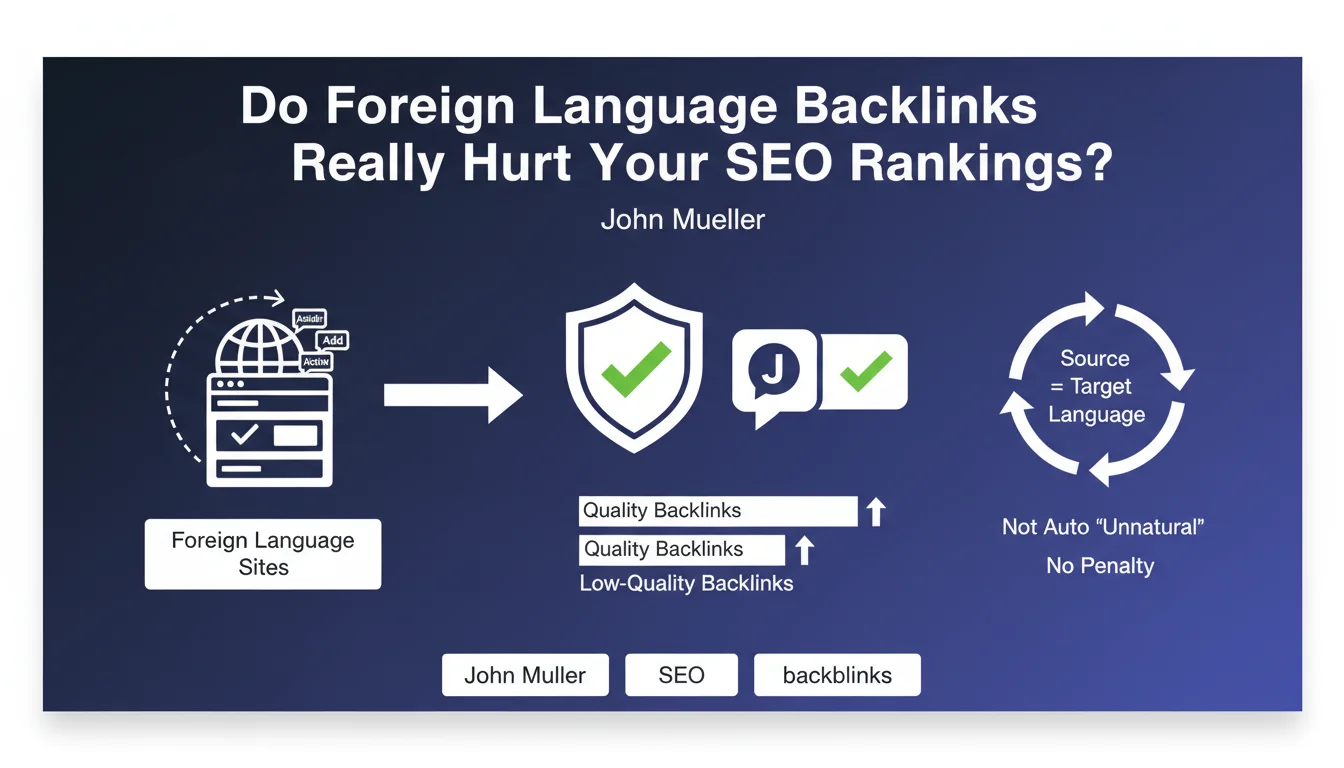
Google has clarified its position regarding backlinks coming from sites in different languages than your website. Contrary to a common misconception, these links are not automatically considered unnatural or low quality.
This clarification is important because it challenges a common practice: exclusively favoring links in the same language. While this approach remains relevant from a strategic perspective, it is not a technical requirement imposed by Google's algorithm.
The search engine recognizes that the web is multilingual by nature. A French site can legitimately receive links from a German, Spanish, or Japanese site if the content is relevant and the citation is natural.
- Multilingual backlinks are not penalized by default
- Thematic relevance takes precedence over the source site's language
- Google evaluates link naturalness independently of language
- A 100% monolingual link profile is not an algorithmic requirement
SEO Expert opinion
This statement is perfectly consistent with what we've been observing in the field for years. Quality international sites naturally obtain backlinks in different languages, especially in sectors like technology, science, or tourism.
However, an important nuance must be made: if the majority of your backlinks come from languages totally disconnected from your target audience, this may signal an artificial link profile. A local French site receiving 80% of links from Chinese or Russian sites without apparent reason remains suspicious.
In practice, always prioritize quality and editorial consistency over language. An excellent German blog post citing your French content provides more value than a low-quality French directory.
Practical impact and recommendations
- Don't systematically reject backlink opportunities from foreign language sites if the topic is relevant
- Analyze your current link profile: assess the proportion of multilingual links and their consistency with your business
- Focus on thematic relevance and source site authority rather than language
- For sites with an international audience, actively seek backlinks in the languages of your target markets
- Document the rationale behind multilingual backlinks (international partnerships, media coverage, etc.)
- Nevertheless, monitor that an abnormal proportion of links in irrelevant languages doesn't pollute your profile
- Use backlink analysis tools to identify the language of referring domains
- Don't invest effort in removing legitimate multilingual backlinks
In summary: The language of a backlink is not a penalization criterion in itself. Always prioritize quality, thematic relevance, and link naturalness, regardless of its language of origin.
The in-depth analysis of your backlink profile and the identification of relevant opportunities, whether monolingual or multilingual, require technical expertise and a comprehensive strategic vision. These complex audits, involving the evaluation of hundreds or even thousands of links according to multiple criteria, can quickly become time-consuming and require specific skills. To structure a coherent and optimal link-building strategy, support from a specialized SEO agency can prove valuable to avoid misjudgments and maximize the effectiveness of your efforts.
💬 Comments (0)
Be the first to comment.