
Official statement
What you need to understand
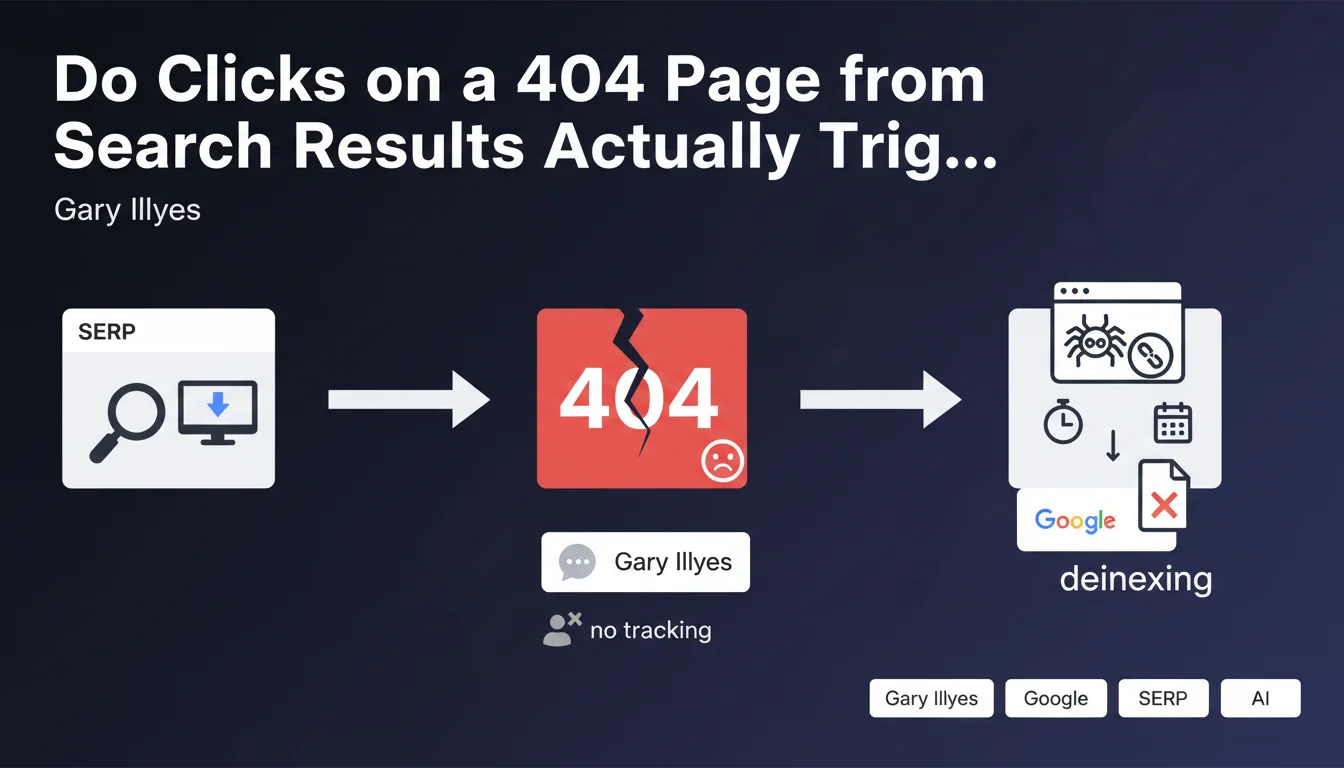
This statement from Google clarifies a fundamental point about crawl budget and HTTP error management. Contrary to popular belief, blocking 404 pages in robots.txt prevents search engines from discovering and processing them correctly.
Googlebot crawls billions of URLs every day that return 404 errors, and this is perfectly normal behavior. These errors are an integral part of the web: deleted pages, obsolete URLs, broken links, structural changes...
The search engine needs to access these error pages to confirm their status, update its index accordingly, and deindex content that no longer exists. Blocking these URLs from crawling creates a blind spot in which Google cannot distinguish between an inaccessible page and a deleted page.
- 404 errors are normal and don't penalize a site's SEO
- Google must be able to crawl 404s to properly deindex the affected URLs
- Blocking 404s in robots.txt prevents index updates and creates zombie URLs
- 404 and 410 codes must remain accessible to crawling for effective index cleanup
SEO Expert opinion
This recommendation is completely consistent with field observations. Many sites make the mistake of wanting to "hide" their 404 errors from search engines, thinking it harms their perceived quality. This is a fundamental misunderstanding of how crawlers work.
In reality, Google strongly prefers a straightforward 404 code to a hidden page, inappropriate redirect, or soft 404 (error page that returns a 200 code). These practices create confusion and actually waste crawl budget.
An important nuance: if you have thousands of automatically generated 404 pages from spam attacks or chaotic URL parameters, the priority is to fix the source of the problem (security, canonicalization) rather than blocking the crawl. The symptom is not the problem.
Practical impact and recommendations
- Check your robots.txt: make sure you're not blocking URL patterns with 404 errors
- Audit your 404s in Search Console: identify important pages to redirect with 301s to relevant content
- Leave minor 404s alone: obsolete pages, old URLs without traffic, external broken links don't require action
- Avoid soft 404s: your error pages must return a real 404 code, not a 200 code
- Prefer 410 code for permanently deleted content: stronger signal than 404 for rapid deindexing
- Monitor 404 spikes: abnormal volume may indicate a technical problem (failed migration, broken internal links)
- Don't redirect systematically: a redirect to the homepage is worse than a straightforward 404 if no relevant alternative exists
Optimal management of HTTP errors and crawl budget requires a nuanced technical approach and regular monitoring. These optimizations are part of a comprehensive technical SEO strategy that can quickly become complex to orchestrate, particularly during migrations or site redesigns. Support from a specialized SEO agency allows you to benefit from in-depth expertise to identify the right priorities, avoid common mistakes, and implement monitoring processes tailored to your specific context.
💬 Comments (0)
Be the first to comment.