
Official statement
What you need to understand
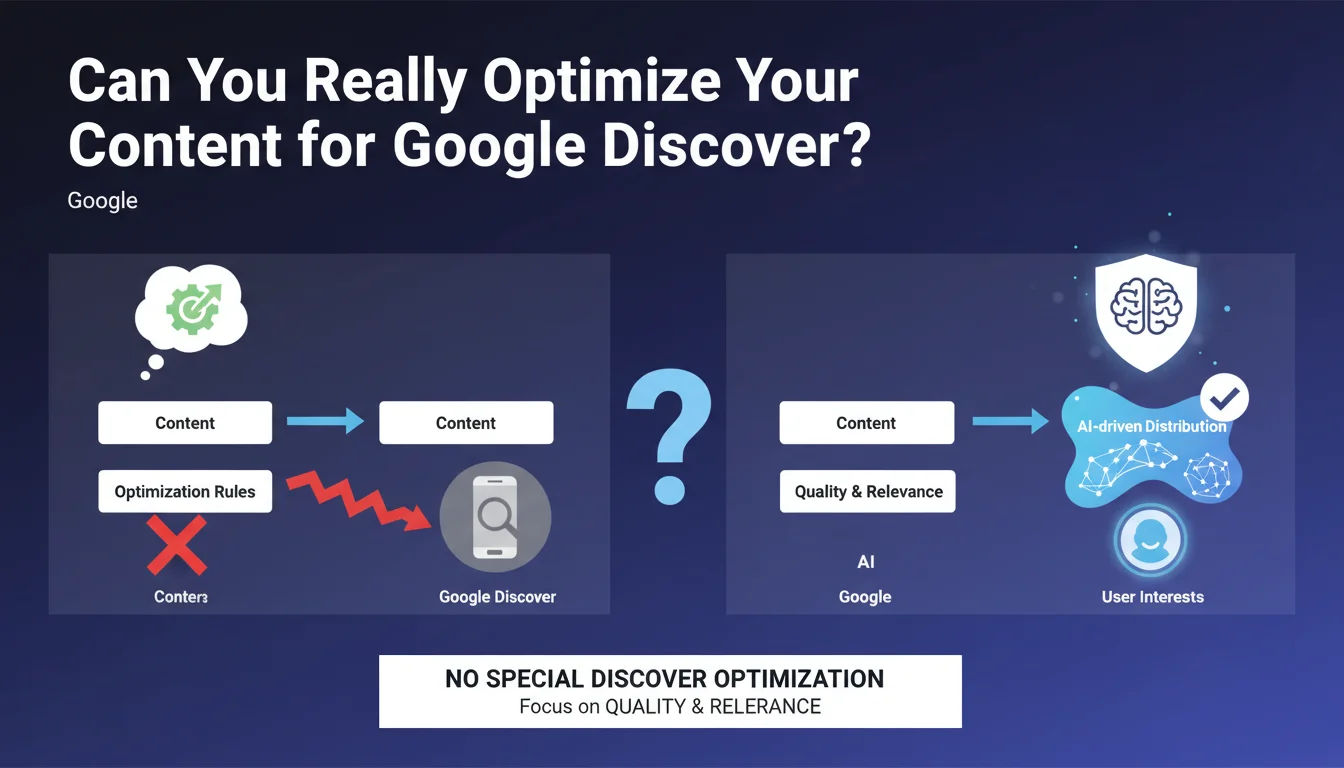
Google has recently clarified its position regarding Google Discover, this feature that offers personalized content to mobile users. The company states that there is no way to create specifically optimized content to appear in Discover.
This statement highlights the fundamental nature of Discover: it is a system based on personalization and users' browsing history, rather than on classic SEO criteria. The content displayed therefore varies considerably from one user to another.
Unlike traditional Google search where you can target specific keywords, Discover operates on an algorithmic recommendation model. It analyzes past behaviors, interests, and interactions to suggest relevant content.
- Discover prioritizes personalization based on user history
- There is no specific "SEO recipe" for Discover
- General quality signals remain paramount
- Content freshness and thematic relevance play a role
- Classic SEO practices remain the best approach
SEO Expert opinion
This position from Google is perfectly consistent with what we have been observing in the field for years. Sites that perform well in Discover are generally those that already apply solid SEO fundamentals: quality content, optimized images, impeccable user experience.
Nevertheless, certain patterns emerge from our analyses. Content that generates the most traffic from Discover is often visually attractive (high-quality, large images), recent, and deals with trending topics or popular evergreen subjects. The E-E-A-T dimension (Experience, Expertise, Authoritativeness, Trustworthiness) also seems to play a predominant role.
The important nuance to make: although we cannot guarantee a presence in Discover, we can clearly maximize our chances by respecting Google's quality criteria and understanding our audience's expectations.
Practical impact and recommendations
- Maintain SEO fundamentals: continue to apply natural referencing best practices without creating a separate strategy for Discover
- Invest in quality visuals: use high-resolution images (minimum 1200px width) and optimize them technically with relevant alt tags
- Prioritize editorial freshness: regularly publish new content and update your existing articles to maintain their relevance
- Structure your pages correctly: use appropriate structured data (Schema.org), particularly for articles, recipes, and video content
- Optimize for mobile: ensure your site offers an exemplary mobile experience (Core Web Vitals, responsive design, smooth navigation)
- Work on your topical authority: develop recognized expertise in your field to strengthen E-E-A-T signals
- Analyze your performance: regularly monitor your Discover data in Search Console to identify content that resonates with your audience
- Do not create content "for Discover": avoid sensational headlines or superficial content that would seek to manipulate the algorithm
- Stay authentic: focus on creating content that truly meets the needs and interests of your target audience
Implementing these optimizations requires a comprehensive and coordinated approach that touches on the technical, editorial, and strategic aspects of your online presence. This holistic vision of modern SEO, combining technical expertise and fine understanding of algorithms, can prove complex to orchestrate effectively in-house. To maximize your chances of success in Discover while strengthening your overall search engine optimization, support from a specialized SEO agency can provide you with the multidisciplinary expertise and strategic perspective necessary to deploy these optimizations in a coherent and sustainable manner.
💬 Comments (0)
Be the first to comment.