
Official statement
What you need to understand
What is Google's official position on text quantity?
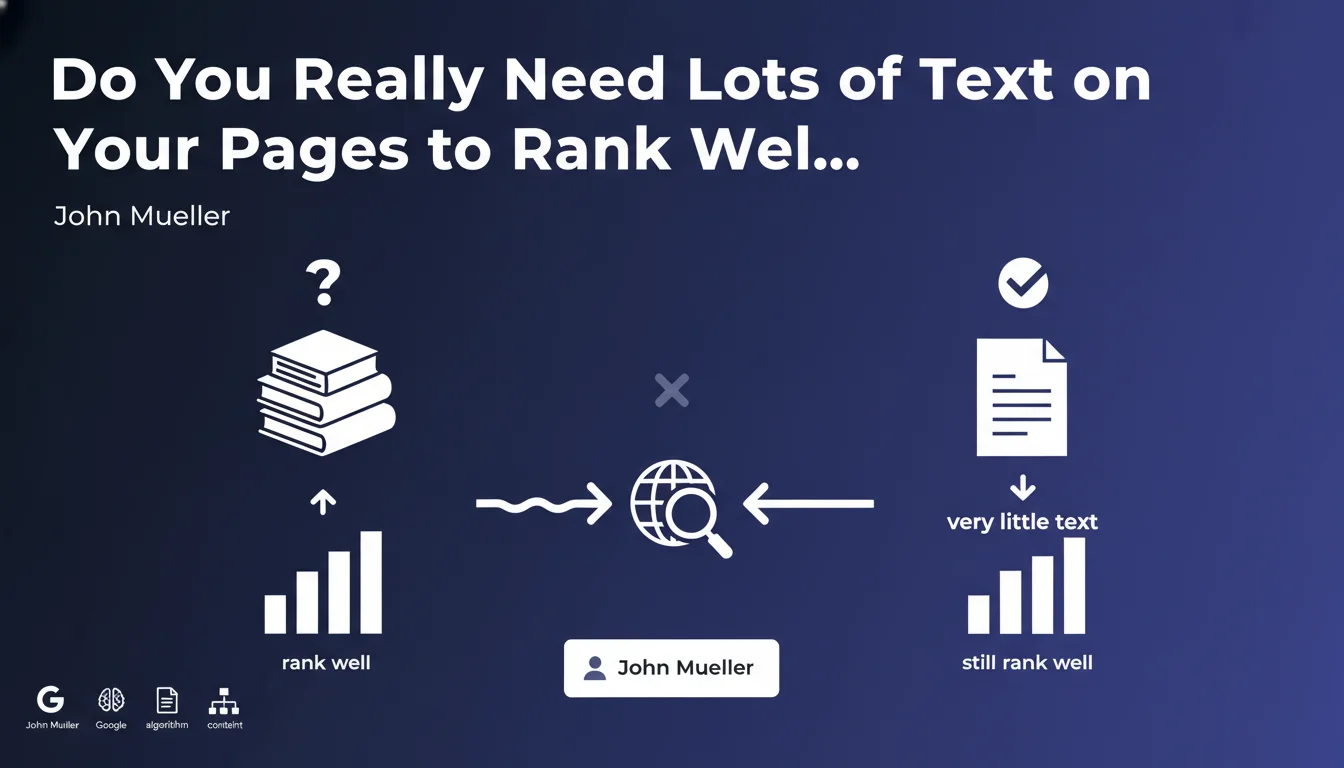
Google clearly states that text quantity is not a quality criterion in itself. A page can contain very little textual content and still be perfectly relevant to users.
This statement challenges a widespread belief in the SEO community: that long-form content is systematically favored. Google focuses primarily on relevance and usefulness of content, not on its volume.
What does this statement actually mean for the Panda filter?
The Panda algorithmic filter targets low-quality content but doesn't automatically penalize short pages. Having numerous pages with little text doesn't systematically trigger this filter.
The key is that these pages provide real added value to users, even with limited textual content. A news brief, a minimalist product page, or a confirmation page can all be legitimate.
What types of pages can legitimately have little text?
Many page formats work perfectly well with reduced textual content: news briefs, photo galleries, contact pages, visual product pages, or confirmation pages.
- Text quantity is not an isolated quality criterion
- Short pages can be relevant if they meet a user need
- The Panda filter doesn't specifically target short content but rather content without value
- There's no need to deindex legitimate pages with little text
- Relevance takes precedence over content volume
SEO Expert opinion
Is this statement consistent with practices observed in the field?
In practice, we indeed observe that many sites with short but relevant content rank very well. News sites, minimalist e-commerce platforms, and portfolios are proof of this.
However, there is a frequent correlation between long content and good rankings, not because of length itself, but because developed content generally covers a topic more comprehensively and better addresses complex search intents.
What essential nuances should be added to this statement?
Google's statement must be contextualized. While quantity alone is not a criterion, the ability to comprehensively answer a query is. For complex informational queries, substantial content often remains necessary.
Moreover, the notion of "little text" is relative. A product page with 50 words but rich structured data, customer reviews, and quality visuals offers more value than a generic 1,000-word page.
In which cases does text quantity remain an important factor?
For in-depth informational queries, substantial content remains essential. If a user searches for "how to create a complete SEO strategy," they naturally expect developed content.
Similarly, in highly competitive sectors where competitors offer exhaustive content, limiting yourself to a few lines will mechanically disadvantage you, not through penalty but through lack of competitiveness.
Practical impact and recommendations
How do you determine the appropriate content length for each page?
Always start from your target audience's search intent. Analyze currently ranking results to identify the expected level of depth. A navigational search requires little content, an informational search demands more.
Examine your engagement metrics: bounce rate, time on page, conversion rate. If your short pages perform well on these indicators, they're probably appropriate.
What mistakes should you absolutely avoid regarding text quantity?
Never create artificial content solely to reach an arbitrary word count. Google increasingly detects padding without added value.
Also avoid systematically deindexing your short pages out of fear of Panda. If these pages have real utility for your visitors, keep them indexed.
- Analyze search intent for each page type before defining content length
- Prioritize quality and relevance over word count
- Keep short pages that provide real value indexed (briefs, technical sheets, etc.)
- For complex topics, develop enough to cover the subject comprehensively
- Use visual, structured, and multimedia content to enrich short pages
- Monitor your engagement metrics to validate the relevance of your editorial choices
- Never add superfluous text just to reach a word quota
- Adapt your content strategy to the competitive context of your sector
💬 Comments (0)
Be the first to comment.